Deep work.
What is it, why we're all getting less of it and how to change that.

RescueTime tracked 185 million working hours and found that the average knowledge worker gets 2 hours and 48 minutes of genuinely productive work done per day. Not just focused work, but any productive work in any form. If you narrow it to the kind of concentrated, uninterrupted thinking that actually moves things forward, this number is even lower.
The reason isn't necessarily laziness or poor discipline. It's that the structure of a normal working day makes sustained concentration genuinely difficult. Meetings scattered through the afternoon. Slack running in the background. A phone on the desk. A calendar that treats every open hour as fair game. In that environment, even motivated, capable people end up spending most of their time on tasks that feel productive but don't require or produce their best thinking.
Deep work is the opposite. Cal Newport coined the term in his 2016 book, but the research behind it goes back decades. This guide covers what that research actually says, why it matters, and how you can achieve more deep work.
What is deep work?
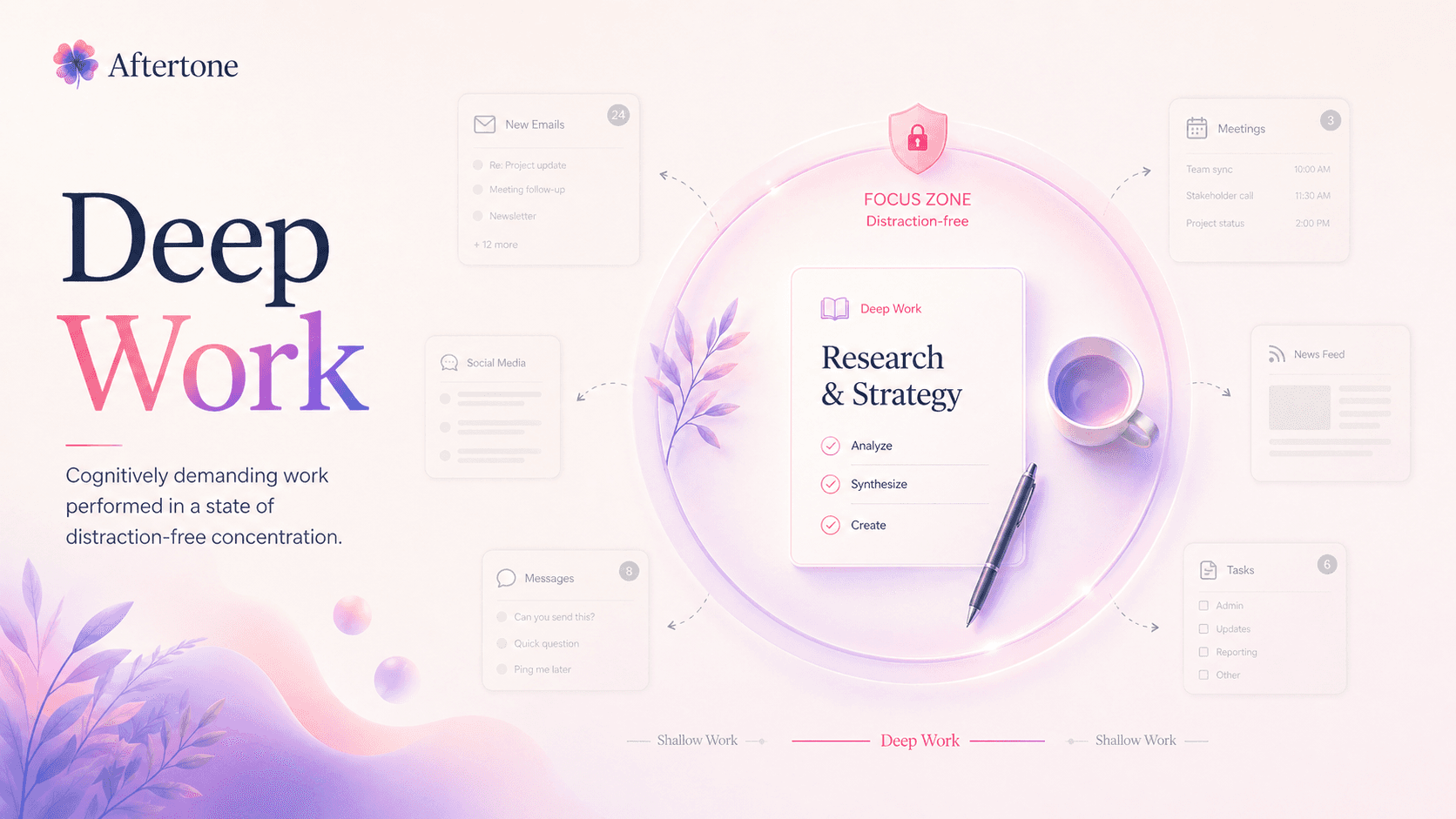
Newport's definition is professional activity in a distraction-free environment that pushes your cognitive capabilities to their limit. Work that creates real value, improves your skill, and produces output that's hard for others to replicate.
The opposite is shallow work. Emails, status updates, most meetings and administrative tasks. Things you can do while half-distracted and that someone else could do just as well with a bit of context. Shallow work is often genuinely necessary. The problem is that it competes for the same resource as deep work — your attention — while requiring completely different conditions.
A useful test is to ask yourself the follow questions
Does this task need sustained, undivided focus to do well?
Does it push toward the edge of what you're currently capable of?
Would it take someone else real time and effort to produce the same output?
If yes to all three, it's deep work.
Why your brain needs uninterrupted time
The case for deep work isn't just theoretical, there's a large body of research that backs it up:
Focused attention builds skill faster. Anders Ericsson spent decades studying elite performers across various fields: musicians, chess players, surgeons, and athletes. His finding was that what separates the best from the merely good isn't the total hours they put in, but the quality of attention during those hours. Concentrated, effortful practice drives the brain to strengthen the neural pathways involved in the work. Distracted practice produces measurably less improvement. Two hours of real focus doesn't just feel different from four hours of split attention. It produces a different outcome, in the work and in the person doing it.
→ See: Deep Work and Protected Focus Blocks
Interruptions cost far more than the interruption itself. Gloria Mark at UC Irvine found that after being interrupted, it takes an average of 23 minutes to fully regain concentration. A two-minute Slack message can cost upto 23 minutes of reduced-quality work, even after you've put the phone down and you're back on your task.
→ See: Interruption Recovery Cost
Mark also found that a single phone notification, even one you don't act on, disrupts attention almost as much as actually picking the device up. The disruption is in seeing that something is waiting, not in responding to it.
→ See: Notification Distraction
Switching between tasks has a tax. Sophie Leroy's research found that when you move from one task to another, part of your attention stays on the previous task, especially if it was unfinished. She called this attention residue. You start the new task with less mental capacity than you'd have if you hadn't switched, and it takes time for that residue to clear. In a day full of context switches, those residues accumulate. By the afternoon, you're trying to concentrate under conditions shaped by every transition you've made since morning.
→ See: Attention Residue and the full guide: The Real Cost of Context Switching
Research from Rubinstein, Meyer, and Evans put the combined cost of switching between different types of demanding cognitive work at up to 40% of productive time. Across a full working day, that's a significant amount of time wasted switching between tasks.
→ See: Task Switching Costs
Willpower runs out. Roy Baumeister's research showed that the ability to make decisions, including the decision to stay focused on a task rather than check your phone, depletes across the day. By afternoon, you have less of it than you did in the morning. This is partly why deep work is harder to protect later in the day. So it's often easier to reach flow state earlier in the day.
Four ways to structure deep work into your day
Newport described four approaches to help achieve deep work:
The monastic approach means eliminating or drastically reducing shallow work commitments altogether. Think of a writer who doesn't do email during the months they're drafting a book. This works for a small group of people who have full control over their schedule. For most people with team obligations, clients, or employees, it's not realistic. But it sets the ceiling for what's possible when someone takes the conditions for deep work seriously.
The bimodal approach divides time into clearly defined deep and shallow periods at the level of days or weeks. A consultant who blocks Monday through Wednesday for focused project work and keeps Thursday and Friday for calls and communication is using this approach. The key is that the deep periods are fixed in advance and treated as non-negotiable, not as preferences that are flexible when something more urgent arrives. This requires real control over your calendar, but when that's possible, it creates a cleaner separation between the two types of work than anything else.
The rhythmic approach is the most practical for most people. Protect the same block of time every day. I.e. the first two hours of the morning, before anything else claims them and do it consistently. The research on habit formation supports this: a fixed time becomes a trigger for the behaviour over time. The decision shifts from "will I do deep work today" to "this is just what happens at 9am." → See: Habit Formation Timeline
The journalistic approach means switching into deep focus whenever a gap in the schedule appears, on demand. Newport named it after journalists who learn to write on deadline, anywhere, regardless of conditions. This is the hardest to do well and it requires the ability to enter concentration quickly, which most people need years of practice to develop.
For most founders and knowledge workers, the rhythmic approach is where to begin. One protected block, same time every day, until it becomes automatic.
Getting a focussed block to actually work
Blocking your calendar out for focussed park is the easy part. But often, the struggles appear with execution.
The scheduling decision is made in advance, in a calm moment, with good intentions. But the execution happens in a real environment — usually after a morning that already involved some email, on a machine with 20 open tabs from yesterday, with Slack running in the background and a notification badge on the phone.
The fix is environmental, not necessarily motivational. Ensuring that you have only one task that you're working on. Closing any outstanding tabs. Ensuring that notifications are muted. These are the practical implementation of what the research on attention residue and decision fatigue actually recommends. Reduce the things that suck your attention and add cognitive load to help you achieve flow.
This is exactly what Aftertone's Focus Screen is built for. When your deep work block starts, the interface narrows to the current task. Everything else disappears. The decision about what to work on was already made in the calendar. The execution environment just enforces it.
→ See: Flow State Conditions
A few tips that help you ensure your deep focus block works for you:
Name a task, not the slot. "Deep work, 9am" is easy to sacrifice when something comes up, because nothing specific is lost. "Write the first draft of the Q2 board update, 9am" is harder to let go of, because there's a named thing being abandoned. Specificity also matters at the start of your session, knowing exactly what the output is supposed to be means you start working immediately rather than spending the first 20 minutes deciding.
→ See: Specificity Effect, Zeigarnik Effect
Front-load it. The earlier in the day, the more decision-making capacity you have available to defend the block against competing demands. Research by Wieth and Zacks also shows that analytical performance peaks at chronotype-optimal windows. For most people, this is earlier in the day, though not for everyone. If you don't know it already, you can find out your working chronotype below.
→ Find your optimal window: Chronotypes and Productivity
Keep it away from meetings. A block immediately before a meeting fills up with preparation and mental background noise. A block immediately after a meeting carries the attention residue of that meeting into the first 20-30 minutes of the session. Try to avoid blocking focussed time either side and ensure that you include buffer times either side of meetings so that your work is accurately reflected.
→ See: Buffer Time and Transition Periods
Don't over-schedule it. Newport is clear that very few people can sustain more than four hours of genuine deep work per day. Most people starting out should aim for 90 minutes.
→ See: The Planning Fallacy
Why an open meeting schedule doesn't help
If you're someone that takes meetings often, it's important to batch your meeting schedule. This is the only effective way to create the conditions that help you achieve deep work.
Say for instance your typical day involves a 9:30am standup, an 11am check-in, and a 2pm 1:1. This isn't simply three 30-minute meetings. These 3 calls break the day into windows of roughly 90 minutes each, with the actually usable concentration time inside each window significantly shorter, because the preparation before each meeting and the attention residue after it eat into both ends. What looks like a day with plenty of working time often has less than two hours of genuine deep work availability in it, distributed across fragments that each require rebuilding context from scratch.
This is typical for knowledge workers, and it explains why people with meeting-heavy calendars routinely feel busy and underperform relative to their ability at the same time.
→ See: Buffer Time and Transition Periods
By batching these meetings, you'll create full days or half-days with no meetings at all. These are structurally protected times that help promote deep work. A standing rule (e.g.tuesdays are no-meeting days, always) requires far fewer individual decisions to maintain than a weekly intention to protect time when possible.
How to know if it's actually working
Most people block the time, sometimes complete the session, and then have no real view of whether the practice is producing results over time. Whether the blocks are being eroded week by week. Whether the weeks that felt most productive shared structural features with each other. Whether the gap between scheduled and completed deep work is growing or shrinking.
Without this knowledge, you can't improve your capacity to reach flow.
The metric Aftertone tracks for this is flow hours which is defined as any working period of at least 25 minutes of continuous focus, separated by breaks of no more than 20 minutes. It's a stricter definition than most people use when they estimate how much focused work they got done, which is part of the point. The number you feel like you achieved and the number the data shows are usually different, and the gap between them is where the value often lies.
Alongside flow hours, Aftertone calculates flow efficiency: your flow hours as a percentage of total scheduled working time. Here are our benchmarks:
Below 20% means the week was structurally fragmented. Meetings, switching, or environment are dominating regardless of intention.
Between 20 and 40% is typical for knowledge workers in meeting-heavy roles and an honest baseline for most people starting out.
Between 40 and 60% is where a working deep work practice tends to land once the structural changes are in place.
Above 60% is excellent and where founders and operators should aspire to be.
Both numbers are surfaced automatically in Aftertone's weekly report, alongside the gap between blocks scheduled and blocks completed.
Teresa Amabile's research across 12,000 working diary entries found that the single biggest driver of a good working day was meaningful progress, not necessarily praise or incentives. The weekly report is how that progress becomes visible and actionable over time.
→ See: Progress Principle, Self-Monitoring and Progress Tracking, Reflection and After-Action Reviews
Deep work for different types of work
The principles we've outlined are the same across roles. But there are some specifics depending on your role:
Founders and operators face a version where the shallow work is often genuinely urgent. Real fires, decisions and people who need responses. The structural shift that works is treating the deep work block as the fixed point around which everything else schedules, rather than the other way around. Reactive work expands to fill whatever space it's given.
→ Best Productivity Apps for Founders and Entrepreneurs
Developers need longer continuous blocks than most roles because of how much context has to be held in working memory at once. Reasoning about a complex codebase, tracking the implications of a change, and writing code that actually solves the problem correctly requires building up a mental model that takes time and collapses quickly under interruption. A developer interrupted every 45 minutes can produce code. But they can't consistently produce the quality of reasoning their role requires.
→ Best Mac Calendar Apps for Developers
Writers and researchers often face an internal version of the distraction problem as much as an external one. The pull to research one more thing, check one more source, read one more article before starting is a form of task avoidance that feels like preparation. Specific focus blocks needs to be created for preparation and execution time. Otherwise a generic focus block will often extend into unlimited prep time.
→ Best Time Blocking Apps for Writers
People with ADHD often find that the rigid version of deep work scheduling creates more problems than it solves. Time-blindness makes strict minute-by-minute structure feel punishing rather than protective. The research suggests flexibility inside the session — protecting the block at the container level while allowing what happens within it to be responsive — tends to work better than a schedule that doesn't account for how ADHD attention actually functions.
The methods that support it
Deep work isn't necessarily a productivity method. It's an outcome that good techniques try to foster. Here are some other productivity principles that help further create the conditions for flow.
Getting Things Done (GTD) handles any open loops. The principle behind it is that absolute anything, whether a task or unfinished commitment should go into the trusted system. That system is flexible but calendars/task managers are a popular use case. By offloading anything that's in your brain onto a task manager, you're eliminating any attention residue or mental noise that prevents deep work.
The Eisenhower Matrix helps with prioritisation of tasks. It stems from Eisenhower who classed tasks as either important or urgent, and recognised that the majority of his decisions were either one or the other. From this insight, the Eisenhower Matrix was created with four quadrants depending on whether tasks were urgent and/or important.
Time blocking is the direct structural support for deep work. It involves directly scheduling tasks onto your calendar with a projected start time and duration. This leverages the principle of implementation intentions to significantly increase the likelihood that a task gets completed.
→ How to Time Block Your Day, Time Blocking Template
The weekly review is how the practice gets better over time. Looking at what actually happened last week — which blocks completed, which got eroded, where the time actually went — creates a feedback loop that makes the following week structurally better.
→ Weekly Review and Planning Rituals
The shutdown ritual is the part most people skip. It involves a deliberate end to the working day by reviewing what's open, deciding what moves to tomorrow, and formally closing. It's what allows genuine psychological detachment from work during the hours that are supposed to be for recovery. Research across 26,000+ participants found that psychological detachment during off-hours is the single strongest predictor of reduced fatigue. You can't sustain concentrated work without real recovery, and recovery requires actually stopping.
The tools question
Most productivity advice treats the tools question as secondary. Get the habits right first, then worry about the software. There's some truth to that. A protected block in a basic calendar beats a fragmented day in the most sophisticated app available.
But tools are not all neutral. The specific things that determine whether a deep work practice holds over time vary significantly between different software: whether it's easy to create and protect named blocks, whether the execution environment removes competing demands the moment the block starts, whether there's any visibility into what actually happened versus what was planned. Getting these wrong is one of the main reasons good intentions don't compound into a real practice.
Most scheduling tools handle the scheduling. Almost none handle the execution environment or the feedback loop. Those two gaps are where most deep work practices often fall apart.
Aftertone is built to close both. When a block starts, our Focus Screen narrows the interface to one task and removes everything else from view. No notification badges, open tabs, or view of the upcoming tasks.
On the feedback side, Aftertone tracks flow hours automatically. Defined as any period of at least 25 minutes of continuous focus separated by breaks of no more than 20 minutes. It then calculates your flow efficiency: flow hours as a percentage of total scheduled work time. Aftertone tells you what actually happened, and the gap between those two numbers is usually the most useful thing a person working on their deep work practice can see.
→ Best Deep Work Apps for Mac → Best Deep Work Scheduling Apps 2026 → Best Focus Apps for Mac
Related reading:
Last updated: April 2026
FAQs
What is deep work?
Cal Newport's definition is professional activity performed in a distraction-free environment that pushes your cognitive capabilities to their limit. Work that creates real value, improves your skill, and produces output that's hard for others to replicate. A useful test: does the task need sustained, undivided focus to do well? Does it push toward the edge of what you're currently capable of? Would it take someone else real time and effort to produce the same output? If yes to all three, it's deep work.
How much deep work does the average person actually get done?
RescueTime tracked 185 million working hours and found the average knowledge worker gets 2 hours and 48 minutes of genuinely productive work done per day. Narrow that to concentrated, uninterrupted thinking and the number is lower. Aftertone users average 5.3 hours.
Why does being interrupted cost more than just the interruption itself?
Gloria Mark at UC Irvine found that after being interrupted it takes an average of 23 minutes to fully regain concentration. A two-minute Slack message can cost up to 23 minutes of reduced-quality work after you're back on the task. Sophie Leroy's research adds to this: switching tasks before finishing leaves cognitive traces called attention residue that drag down whatever you do next. In a day full of context switches those residues accumulate.
How many hours of deep work can you realistically do per day?
Newport is clear that very few people can sustain more than four hours of genuine deep work per day. Most people starting out should aim for 90 minutes. The goal is consistency, not duration. One protected block at the same time every day, until it becomes automatic, produces better results than occasional long sessions.
What is flow efficiency and how is it measured?
Flow efficiency is your flow hours as a percentage of total scheduled working time. Below 20% means the week was structurally fragmented. Between 20 and 40% is typical for knowledge workers in meeting-heavy roles. Between 40 and 60% is where a working deep work practice tends to land. Above 60% is where founders and operators should aim. Aftertone tracks both flow hours and flow efficiency automatically in the weekly report.
Why is a meeting-heavy calendar so damaging to deep work?
Three meetings scattered through the day don't just take 90 minutes. They break the day into fragments, each requiring rebuilding context from scratch, with preparation before each meeting and attention residue after it eating into both ends. What looks like a day with plenty of working time often has less than two hours of genuine deep work availability in it. Batching meetings into specific days is the structural fix.
Which approach to deep work works best for most people?
The rhythmic approach. Protect the same block of time every day, ideally early, before anything else claims it, and do it consistently. Research on habit formation shows that a fixed time becomes a trigger for the behaviour over time. The decision shifts from whether you'll do deep work today to this is just what happens at 9am.