The Principle
There's a category of work that can't be done in the gaps between meetings - work that requires sustained, uninterrupted thinking to do well. Writing that needs to develop an argument. Code that needs to hold a complex system in mind. Analysis that requires following a thread without dropping it. This kind of work doesn't just need time. It needs unbroken time. And unbroken time is increasingly rare.
The research doesn't come from a single study on "deep work" itself, but from converging evidence that interruptions increase cognitive cost, task switching degrades performance, and the state of full absorption that produces the best thinking - what Csikszentmihalyi called flow - requires unbroken concentration. Protecting a block of time from interruption isn't a luxury. For complex work, it's the minimum viable condition for doing it well.

Definition
Deep work refers to sustained, undistracted cognitive effort on a demanding task. The research doesn't come from a single study on 'deep work' itself, but from converging evidence that interruptions increase stress, task switching degrades performance, and flow states require unbroken concentration.
What The Research Shows
Mark, Gudith & Klocke (2008) showed interrupted workers complete tasks at significantly higher stress and effort even without time loss.
Leroy (2009) demonstrated that attention residue from incomplete tasks impairs subsequent performance.
Csikszentmihalyi & LeFevre (1989) provided the empirical foundation for flow states: uninterrupted absorption when challenge matches skill produces peak performance and intrinsic satisfaction. Rubinstein et al. (2001) showed task-switching costs increase with complexity, supporting uninterrupted work on complex tasks. The concept of 'deep work' as a unified practice was popularized by Cal Newport (2016) but is not itself a peer-reviewed construct.

What This Means
Interruptions increase the cognitive cost and stress of work even when they do not increase the time spent. Even one consistently defended 90-minute focus block per day produces disproportionate output compared to the equivalent fragmented time.
What Most People Get Wrong
Deep work is often framed as requiring several hours of uninterrupted time, which makes it feel impractical for most schedules.
Research on focus and interruption does not support this minimum. Even a single 60 to 90 minute protected block produces significantly different output than the equivalent fragmented time. The barrier is not duration. It is interruption.
When it Fails…
ADHD makes long blocks harder to sustain. People with time blindness or attention dysregulation may need shorter blocks with more structure rather than 90-minute sessions.
Collaborative roles have structural limits. People whose work is inherently relational cannot always protect extended uninterrupted blocks without real professional cost.
Optimal block length is individual. There is no single duration that works for everyone - forcing 90-minute sessions on someone whose natural rhythm is 45 minutes is counterproductive.
What This Means For You…
The reason your most important work gets done on quiet mornings, or late evenings, or during travel - and rarely during a normal Tuesday - is not motivation or energy. It's interruption. Normal working hours are structured around availability, and availability is the enemy of the sustained attention that demanding work requires. Building protected focus blocks into your schedule is the act of deciding in advance that some work is important enough to deserve conditions where it can actually be done properly. Even one 90-minute protected block per day, consistently defended, compounds significantly over weeks and months.
How Aftertone Implements It.
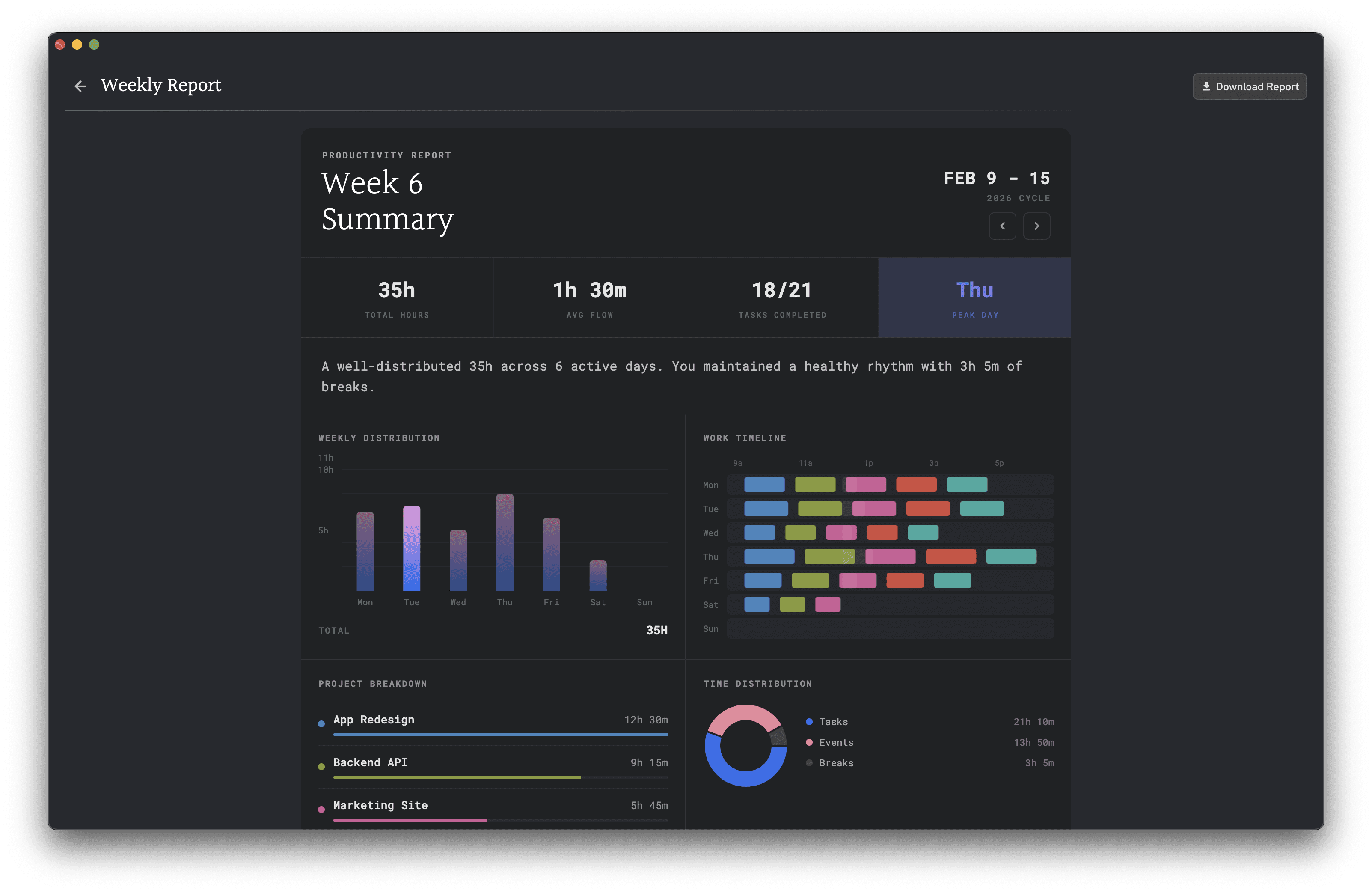
Focus Mode (Tab) shows one task at a time with the background blurred and everything else removed from the screen. Completing a task with Enter immediately surfaces the next one - there is no navigation decision between tasks. Press B to take a break at any point without losing your place. Cmd+A toggles Auto-Extend so sessions continue past the block boundary rather than stopping abruptly.
How To Start Tomorrow
Identify your one most important piece of work for tomorrow. Block 90 minutes for it - ideally in your highest-energy window of the day. Tell anyone who might interrupt you that you're unavailable during that time. Close every communication channel. Do only that work for the full block. This is the experiment: one properly protected block. Notice what you produce compared to a fragmented equivalent.
Related Principles
Attention Residue - focus blocks prevent residue accumulation from switching
Interruption Recovery - focus blocks eliminate the recovery cost cycle
Task Switching Costs - sustained focus on one task avoids switching overhead
Email Batching - batching communications protects focus block integrity
Related Reading
Best Deep Work Apps — The apps built specifically around the research covered here.
Best Deep Work Scheduling Apps — Scheduling tools that treat 90-minute focus blocks as the unit of planning, not tasks.
Best Mac Calendar Apps for Deep Work — Mac calendar apps that make deep work blocks visible and hard to erode.
Frequently Asked Questions
What is deep work?
Deep work, as defined by Cal Newport, is professional activity performed in a state of distraction-free concentration that pushes cognitive capability to its limit. It produces value that is hard to replicate and hard to teach. The contrasting state — shallow work — is logistical, replicable, and can typically be done while distracted.
Why do focus blocks of 60–90 minutes produce better results?
This duration aligns with the depth of concentration required for cognitively demanding work and the natural limits of sustained attention before meaningful cognitive fatigue sets in. Shorter blocks rarely allow enough time to reach and sustain the level of focus that produces high-quality output. Longer uninterrupted blocks are possible but require training and strong recovery practices.
How is deep work different from just working hard?
Effort and hours are not the defining variables. Deep work is specifically about the quality of attention applied — working without distraction at full cognitive capacity on tasks that require it. Someone working eight hours with constant interruptions and task switching is working hard but not doing deep work. The depth of focus is the distinguishing factor, not the quantity of effort.
How many hours of deep work is realistic per day?
Newport's research and applied observation suggest most people max out at around 4 hours of genuine deep work per day, with beginners closer to 1–2. Beyond that, cognitive fatigue degrades the quality of attention to the point where continuing produces diminishing returns. More time does not equal more deep work — quality of concentration is the constraint, not available hours.
Further Reading
Csikszentmihalyi, M., & LeFevre, J. (1989). Optimal experience in work and leisure. Journal of Personality and Social Psychology, 56(5), 815-822. DOI: 10.1037/0022-3514.56.5.815
Mark, G., Gudith, D., & Klocke, U. (2008). The cost of interrupted work: More speed and stress. Proceedings of CHI 2008, 107-110. DOI: 10.1145/1357054.1357072
Leroy, S. (2009). Why is it so hard to do my work? Organizational Behavior and Human Decision Processes, 109(2), 168-181. DOI: 10.1016/j.obhdp.2009.04.002