The Principle
A Slack message arrives mid-task. You spend three minutes responding, then return to your work. What you don't notice: for the next fifteen to twenty minutes, part of your cognitive system is still processing that reply. You're physically back. Your attention isn't.
This is attention residue. Named by organisational psychologist Sophie Leroy in her 2009 paper, it explains why knowledge workers feel perpetually behind despite working constantly. Switching tasks doesn't end one mental thread and start another cleanly. It layers them. The second task starts at a deficit.
The cost compounds across the day. Gloria Mark's research at UC Irvine — tracking 36 knowledge workers at second-by-second resolution — found that after an interruption, it takes an average of 23 minutes and 15 seconds before you return to the original task, and that the return is typically not clean: there are on average two intervening tasks before you come back. The Slack message doesn't just steal three minutes. It steals twenty-three. For most workdays involving dozens of interruptions, the cumulative cost of switching is not marginal. It is the day.
The practical fix is structural, not motivational. Leroy and Glomb's 2018 follow-up showed that a brief 'ready-to-resume plan' — one sentence noting where you left off and what you'd do first on returning — significantly reduces residue. The brain's need for completion is partly satisfied by the plan itself. Closing the loop cognitively doesn't require finishing the task. It requires resolving the open thread.

Definition
Attention residue is what happens when part of your brain stays on a task you've left, even after you've moved on. It's invisible, involuntary, and it makes the next thing you do worse than it would have been.
What The Research Shows
Leroy (2009) introduced the attention residue concept through two lab experiments, showing that switching from an incomplete task significantly impairs performance on the subsequent task. The effect is strongest when the prior task was left unfinished without a plan to return.
Leroy & Glomb (2018) demonstrated that creating a brief 'ready-to-resume' plan before switching mitigates attention residue. Time pressure on the prior task can help disengage, but under normal conditions, unplanned switches create substantial cognitive drag. Limitation: lab-based with student samples and artificial tasks.
Mark, Gudith, & Klocke (2008) shadowed 36 knowledge workers at the second-by-second level and found that interrupted work was resumed on the same day 81.9% of the time, but took an average of 23 minutes and 15 seconds to resume — and involved on average two intervening tasks before returning. This quantifies the recovery cost that attention residue produces: residue doesn't just impair the interrupting task, it extends the chain of disruption well beyond the original switch.

What This Means
Switching away from an unfinished task measurably degrades your performance on whatever comes next. The effect is strongest when you left without a clear stopping point or any plan to return.
What Most People Get Wrong
The dominant belief is that you can briefly check something and return to your work cleanly.
Research shows the switch is never clean. Traces of the interrupted task persist and degrade performance on whatever comes next. The time away is not the cost. The cognitive thread still running is. This applies equally to self-initiated switches and external interruptions.
When it Fails…
Lab conditions may not fully replicate real work. The original studies used student participants on artificial tasks - the magnitude in naturalistic settings may vary.
Time pressure can help. Under high time pressure on the prior task, the brain sometimes disengages more cleanly - making the effect weaker in deadline-driven work.
Similar tasks generate less residue. Switching between highly related tasks produces less cognitive drag than switching between very different task types.
What This Means For You…
Most workdays are structured almost perfectly to maximise attention residue. Meetings interrupt deep work. Slack sits open alongside the task at hand. Email is ambient. The result is that most people spend most of their day starting new sentences before finishing the last one - and wondering why nothing feels complete by evening. The implication isn't that you need to be unreachable. It's that switches need to be managed rather than accumulated. A switch with a plan attached is categorically different from an unplanned interruption - even when the time away is identical. The note takes ten seconds. The cognitive penalty it prevents can cost you the best part of an hour.
How Aftertone Implements It.
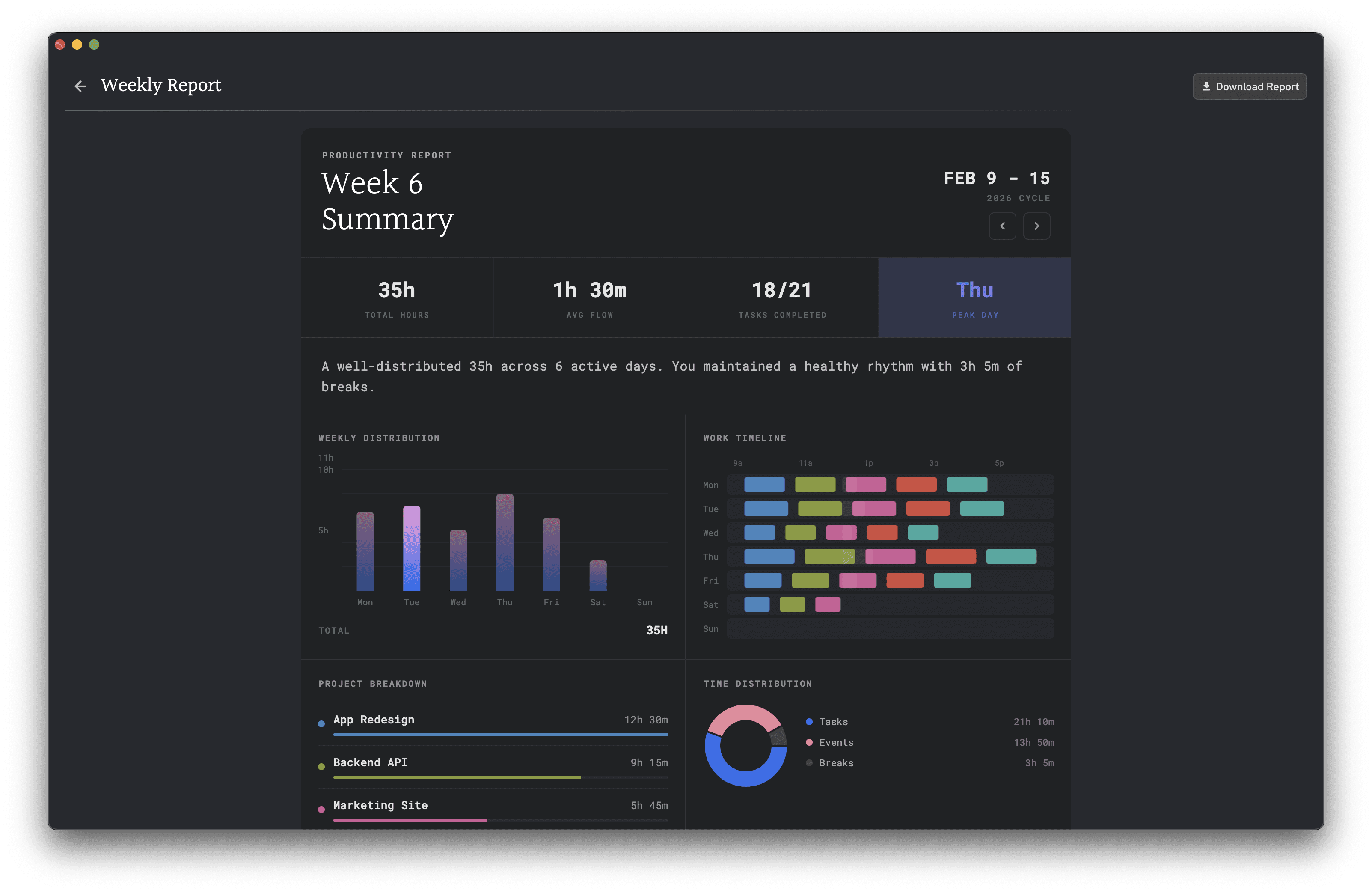
When you press Escape to leave Focus Mode, Aftertone takes you back to the Calendar view with your current task still visible. Pressing Tab returns you directly to that task - you do not need to navigate or remember where you were. The task notes field is the place to write a ready-to-resume note before you leave, so re-entering picks up with full context rather than reconstruction.
How To Start Tomorrow
Next time you're interrupted mid-task, take ten seconds before you switch: write one sentence about where you left off and what you'd do first when you return. Put it at the top of the document or on a sticky note. Notice what it feels like to return with that context versus without it. That's the mechanism - the note is the intervention.
Related Principles
Task Switching Costs - attention residue is the mechanism behind switching costs
Interruption Recovery - residue explains why recovery takes so long
Deep Work / Protected Focus Blocks - protecting focus blocks prevents residue accumulation
Implementation Intentions - a ready-to-resume plan is a form of implementation intention
Zeigarnik Effect - explains why incomplete tasks generate the cognitive pull that produces residue
Related Reading
Best Deep Work Apps — Apps built to reduce task switching and protect the focus this research shows you need.
Best Deep Work Scheduling Apps — Scheduling tools that batch similar work together to minimise residue.
Best AI Tools to Protect Deep Work Time — AI tools that actively defend your calendar against the fragmentation that causes residue.
Attention Residue: Productivity Guide — How to structure your day to minimise residue, with practical scheduling strategies.
Context Switching: The Hidden Cost — The broader framework for understanding what switching between tasks actually costs.
Frequently Asked Questions
What is attention residue?
Attention residue is the finding that when you switch from one task to another before fully completing the first, part of your attention stays behind on the previous task. This residual attention impairs performance on the new task. The term was coined by Sophie Leroy, whose research showed the effect is measurable and significant even after brief interruptions.
How long does attention residue last?
Leroy's research shows residue persists throughout the subsequent task — it's not a brief adjustment that fades in seconds. The most cited companion figure comes from Gloria Mark at UC Irvine: 23 minutes and 15 seconds before workers fully return to their original task after an interruption, on average — and that return involves on average two intervening tasks. The key variable is how the switch was made: a deliberate stopping point with a ready-to-resume note reduces residue significantly compared to an unplanned interruption, even when the time away is identical.
What's the difference between attention residue and distraction?
Distraction is an external pull on attention in the moment. Attention residue is an internal lingering from a previous task — it persists even after the distraction or interruption is gone. You can remove all external distractions and still experience attention residue if you have recently switched from an incomplete task.
How do you reduce attention residue?
The single most evidence-backed intervention is Leroy and Glomb's ready-to-resume plan: before switching, take ten seconds to write one sentence about where you left off and what you'd do first on returning. This partially satisfies the brain's need for completion and measurably reduces residue. Beyond that: complete tasks fully before switching where possible, build explicit transition buffers between dissimilar tasks, batch similar tasks to reduce the number of major context switches, and use an end-of-day shutdown ritual to clear open loops before stopping work.
Further Reading
Leroy, S. (2009). Why is it so hard to do my work? The challenge of attention residue when switching between work tasks. Organizational Behavior and Human Decision Processes, 109(2), 168-181. DOI: 10.1016/j.obhdp.2009.04.002
Leroy, S., & Glomb, T. M. (2018). Tasks interrupted: How anticipating time pressure on resumption of an interrupted task causes attention residue and low performance on interrupting tasks. Organization Science, 29(3), 380-397. DOI: 10.1287/orsc.2017.1184
Mark, G., Gudith, D., & Klocke, U. (2008). The cost of interrupted work: More speed and stress. Proceedings of CHI 2008, 107-110. DOI: 10.1145/1357054.1357072