The Principle
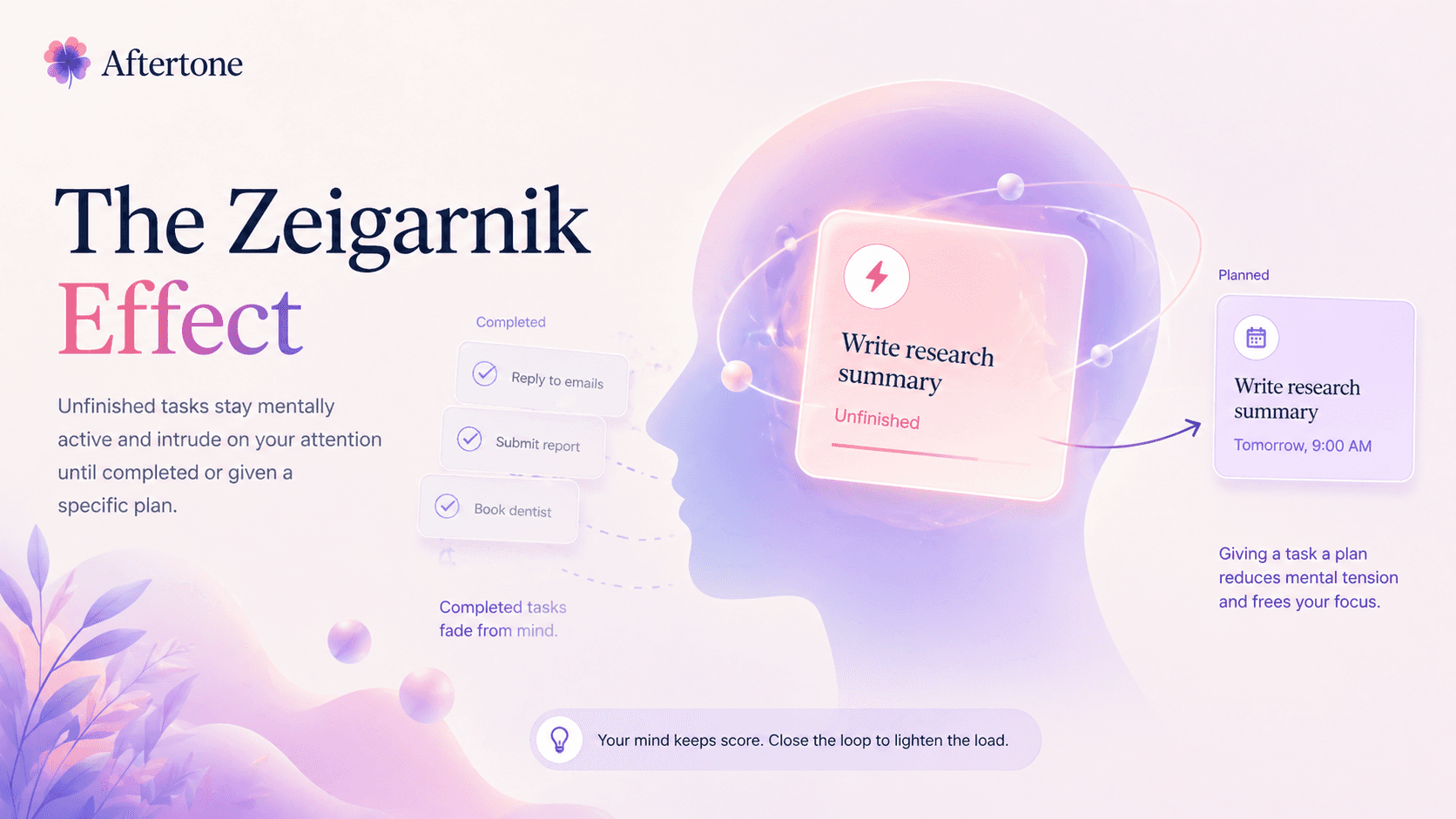
The Zeigarnik effect is the finding that incomplete tasks maintain an active cognitive representation that intrudes on attention until the loop is closed — either through completion or through a concrete plan. Bluma Zeigarnik documented this in 1927. Masicampo and Baumeister (2011) showed the plan-as-closure mechanism: a specific when-and-how plan reduces intrusive thoughts as effectively as finishing the task. The same mechanism explains why to-do lists at bedtime reduce sleep onset time — the plan externalises the open loop, allowing the brain to release it.
You're trying to focus on one thing but your mind keeps returning to another - something you started earlier and didn't finish, something you promised to do and haven't planned, something that's been sitting at the edge of your attention for days. You're not choosing to think about it. It's intruding. Your brain has flagged it as unresolved and keeps checking whether that's still true.
Bluma Zeigarnik observed in the 1920s that interrupted tasks are remembered better than completed ones - the brain maintains a kind of active representation of unfinished business that keeps demanding cognitive resources until the loop is closed. Masicampo and Baumeister later showed that you don't need to finish the task to close the loop. A specific plan for when and how you'll handle it achieves the same release. The intrusive thoughts stop not when the task is done, but when the brain has been given a credible plan for how it will be done.
The effect extends beyond the workday. Syrek et al. (2016) found that unfinished tasks at the end of the working week impair employee sleep on the weekend through rumination — a direct cost of open loops carried into rest time. Scullin et al. (2018) tested the remedy with polysomnography: participants who wrote a to-do list for the next few days before bed fell asleep significantly faster than those who wrote about completed activities. The more specific the to-do list, the faster they fell asleep. The plan closes the loop; the brain releases its hold on the incomplete thread.

Definition
Unfinished tasks stay active in your memory in a way that completed ones do not. This creates a nagging background tension that keeps intruding on whatever else you are trying to do. The relief does not require finishing the task. Research by Masicampo and Baumeister showed that making a specific plan for when and how you will return to the task closes the loop almost as effectively as completion.
What The Research Shows
Zeigarnik (1927) observed that waiters could recall unpaid orders in detail but forgot them immediately after payment, suggesting incomplete tasks maintain a heightened cognitive representation. Subsequent lab research confirmed that interrupted tasks are recalled significantly better than completed ones.
Masicampo and Baumeister (2011) extended this practically: across five experiments, they showed that making a specific plan for an unfinished task eliminated its cognitive intrusion as effectively as completing it. The mechanism appears to be that a credible plan satisfies the brain's need for closure without requiring actual completion. Limitation: the original Zeigarnik effect has shown variable replication strength; the Masicampo findings are more directly applicable to productivity contexts.
Syrek, Weigelt, Peifer & Antoni (2016) demonstrated a workplace extension: unfinished tasks at the end of the working week impaired employee sleep quality on the weekend through increased rumination, linking the Zeigarnik mechanism directly to recovery and wellbeing costs beyond working hours.
Scullin, Krueger, Ballard, Pruett & Bliwise (2018) tested the remedy in a polysomnography RCT (N = 57): participants randomly assigned to write a to-do list for upcoming tasks before bed fell asleep significantly faster than those who wrote about completed activities (9 minutes faster on average). The more specific and comprehensive the to-do list, the greater the sleep onset benefit — directly supporting the plan-as-loop-closure mechanism and providing the strongest experimental evidence for bedtime externalisation as a Zeigarnik intervention.

What This Means
You do not need to finish a task to stop it intruding on your attention - a specific plan for when and how you will return closes the mental loop almost as effectively as completion. The intrusive thoughts stop when the brain has a credible plan, not only when the task is done.
What Most People Get Wrong
The common advice is to never leave a task half-finished.
The Zeigarnik effect is real, but the remedy is not always completion. Making a specific plan for when and how you will return to an unfinished task closes the mental loop almost as effectively as finishing it. The relevant skill is not finishing everything before switching. It is leaving with a credible plan rather than leaving with nothing.
When it Fails…
The effect is weaker for low-importance tasks. The brain does not maintain the same active representation for tasks you do not particularly care about.
High anxiety can amplify rumination rather than resolve it. For some people, unfinished tasks trigger spiralling worry rather than productive planning impulse.
The plan must be specific to work. A vague intention to "deal with it later" does not close the loop - only a concrete time and action does.
What This Means For You…
The mental restlessness that makes it hard to focus - the sense of things pulling at you from the periphery - is usually not a focus problem. It's an open-loop problem. Every unplanned commitment, every task without a scheduled time, every thing you've promised yourself but haven't decided when to do is maintaining an active thread in your working memory. The remedy is not doing all of it immediately. It's capturing it specifically - with a time, a date, and a first action - so your brain can release the thread. A well-processed task list is not just a productivity tool. It's a cognitive quietening.
How Aftertone Implements It.
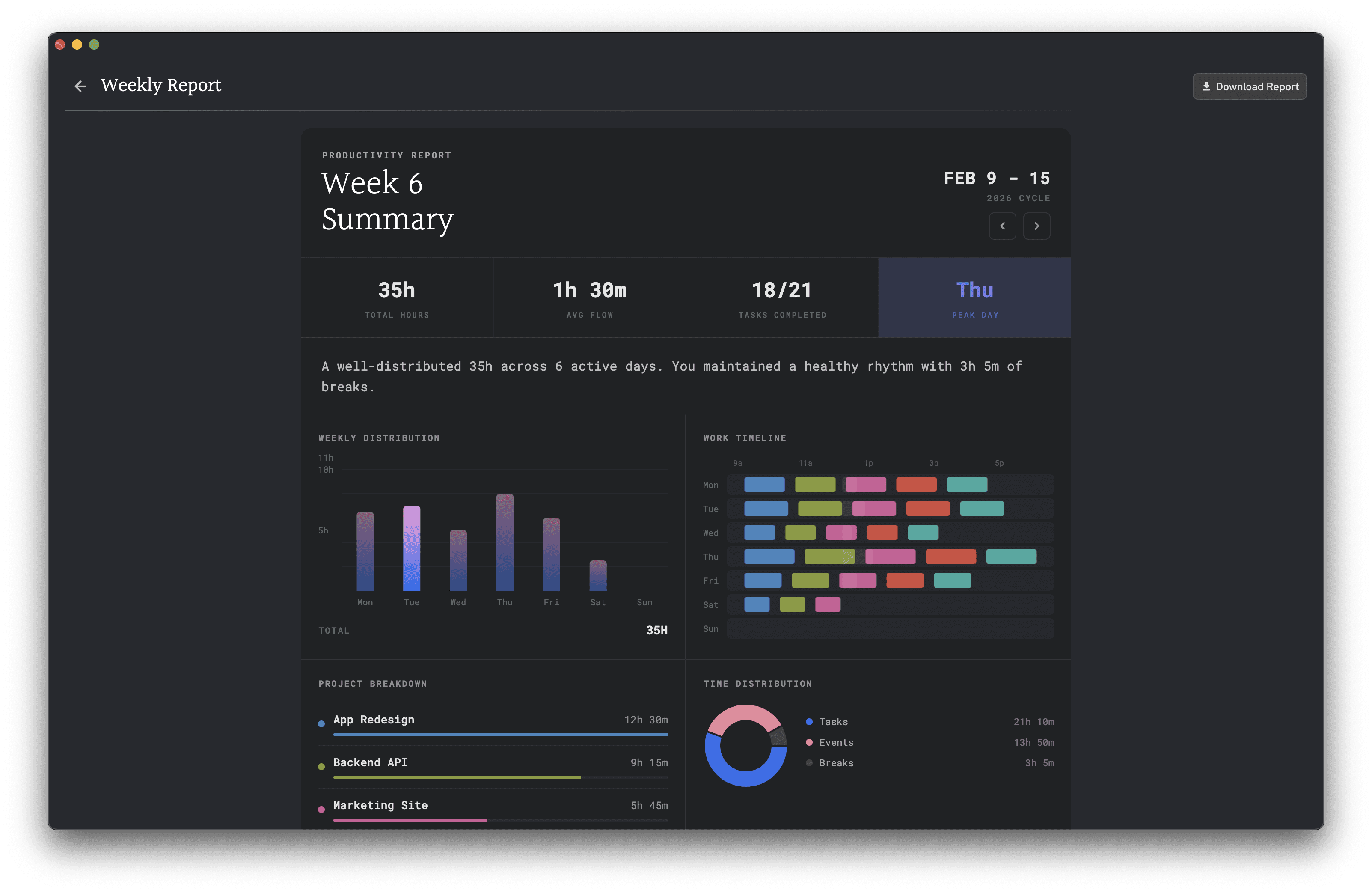
Pressing P on any task in your inbox assigns it a specific date, which closes the open loop - the task is planned, not floating. Quick Capture (Option+Space) lets you externalize anything that surfaces while you are working, immediately moving it from active memory to the inbox. The Planning View (Shift+P) at the end of the day is where you process anything still unscheduled into a committed plan.
How To Start Tomorrow
Right now, think of the thing that keeps nagging at you - the task or commitment that surfaces uninvited when you're trying to focus on something else. Open a notepad and write: what is it, what's the specific next action, and when will you do it. Close the notepad. Notice whether the nagging thought reduces in frequency over the next hour. That's the Zeigarnik effect being resolved by a plan rather than by completion.
Related Principles
Cognitive Offloading - the practical antidote
Implementation Intentions - planning closes loops
Attention Residue - unfinished tasks cause residue
Bedtime To-Do Lists - closing loops enables sleep
Related Reading
Best Time Blocking Apps — Scheduling a task with a specific time closes the loop your brain keeps returning to.
Best Weekly Review Apps — Weekly reviews that clear open loops so you finish the week without them following you.
Best AI Daily Planning Tools — Daily planners that capture and schedule unfinished tasks so they leave your working memory.
Weekly Review How-To — The weekly review is the systematic practice of closing open Zeigarnik loops before they accumulate into weekend rumination.
Planned vs Actual: Tracking Intentions — The practice of assigning specific times to tasks converts open loops into closed commitments.
Frequently Asked Questions
What is the Zeigarnik effect?
The Zeigarnik effect is the finding that people remember uncompleted tasks better than completed ones, and that unfinished tasks create persistent mental tension — intrusive thoughts that return involuntarily until the task is resolved. Named after Soviet psychologist Bluma Zeigarnik, who observed that waiters remembered orders better before they were served than after.
Why do unfinished tasks keep intruding on your thoughts?
The brain maintains active representations of unfinished goals to ensure they are not forgotten. This is an adaptive mechanism — it prevents you from losing track of open commitments — but it becomes costly when the number of unfinished tasks is large, when they cannot be immediately acted on, or when you need to focus on something else entirely. The intrusions are the system doing its job, but the job conflicts with focused work.
Does completing a task stop the mental intrusion?
Completing it stops it reliably. But research by Masicampo and Baumeister found that making a specific plan for the task — deciding when and how you will handle it — produces nearly the same reduction in intrusive thoughts as completing it. The brain treats a concrete plan as sufficient resolution of the open goal, which is the mechanism behind cognitive offloading and the bedtime to-do list effect.
How does the Zeigarnik effect affect sleep?
Unfinished tasks activate the same intrusion mechanism at night that they do during the day. Syrek et al. (2016) found that unfinished work at the end of the week impairs weekend sleep through rumination. Scullin et al. (2018) tested the solution: in a polysomnographic RCT, participants who wrote a specific to-do list for upcoming tasks before bed fell asleep an average of 9 minutes faster than those who wrote about completed activities. The key finding: the more specific and comprehensive the to-do list, the greater the sleep onset benefit. A plan does not just reduce daytime intrusion — it enables sleep by externalising the loops the brain would otherwise keep open overnight.
How many open tasks create meaningful cognitive interference?
The research does not give a precise threshold, as it varies with task salience and emotional significance. High-stakes unfinished tasks — a difficult conversation avoided, a commitment not yet honoured — generate more intrusion than low-stakes ones. The practical implication is that reducing the number of genuinely open loops through either completion or concrete planning has cumulative benefits to focus that grow with the number resolved.
Further Reading
Masicampo, E. J., & Baumeister, R. F. (2011). Consider it done! Plan making can eliminate the cognitive effects of unfulfilled goals. Journal of Personality and Social Psychology, 101(4), 667-683. DOI: 10.1037/a0024192
Zeigarnik, B. (1927). On finished and unfinished tasks. In W. D. Ellis (Ed.), A Source Book of Gestalt Psychology. Harcourt Brace.
Scullin, M. K., Krueger, M. L., Ballard, H. K., Pruett, N., & Bliwise, D. L. (2018). The effects of bedtime writing on difficulty falling asleep: A polysomnographic study comparing to-do lists and completed activity lists. Journal of Experimental Psychology: General, 147(1), 139-146. DOI: 10.1037/xge0000374
Syrek, C. J., Weigelt, O., Peifer, C., & Antoni, C. H. (2017). Zeigarnik's sleepless nights: How unfinished tasks at the end of the week impair employee sleep on the weekend through rumination. Journal of Occupational Health Psychology, 22(2), 225-238. DOI: 10.1037/ocp0000031