The Principle
By mid-afternoon, the decisions that seemed straightforward in the morning feel harder. What to prioritise, how to respond, whether to do the difficult task now or later - each one requires slightly more effort than it should. You're not tired in the way that sleep fixes. You're depleted in a more specific way: you've made a lot of decisions today, and the quality of each subsequent one is quietly degrading.
The ego depletion model - the idea that willpower and decision-making draw from a finite resource - has been contested in recent replications, with some large-scale studies finding much smaller effects than originally reported. What has held up better is the practical pattern: decision quality does decline over the course of a day marked by many decisions, whether the mechanism is a depleted resource, motivational shift, or accumulated cognitive fatigue. The implication for productivity is the same regardless of mechanism: reduce the number of trivial decisions you have to make, especially later in the day.

Definition
Every decision you make costs a small amount of cognitive effort. As decisions accumulate across the day, the quality of later ones tends to decline. Whether this is because willpower depletes like a resource, or because motivation and attention shift, the practical pattern holds: demanding decisions are better made earlier in the day, before smaller decisions have worn down your capacity for them.
What The Research Shows
Baumeister and colleagues (1998) proposed the ego depletion model - that self-control draws from a finite resource that depletes with use. The most striking field evidence came from Danziger and colleagues (2011), who found that parole judges granted parole around 65% of the time immediately after a food break and near 0% just before one, suggesting decision quality depends heavily on cognitive state.
However, large-scale replication attempts have found much smaller effects: Carter and colleagues (2015) found d = 0.04 after bias correction across 23 studies, and a multi-lab study by Vohs and colleagues (2021) with over 3,500 participants found d = 0.06. The mechanism is genuinely contested, but the practical pattern of declining decision quality under load is more robust than the original depletion model.

What This Means
Decision quality declines over a day of many decisions - a study of parole judges found they granted parole around 65% of the time after a break and near 0% just before one. The practical pattern holds even where the specific depletion mechanism is debated.
What Most People Get Wrong
The ego depletion model, the idea that willpower depletes like a fuel tank, has been challenged by large replication studies that found much smaller effects than originally reported.
The practical pattern it describes, declining decision quality over a day of many decisions, is more robust than the specific mechanism. Whether the cause is resource depletion, motivational shift, or accumulated cognitive fatigue, the implication for how to structure demanding decisions is the same.
When it Fails…
The depletion mechanism is contested. Large replication studies found much smaller effects than the original research - the practical pattern may be real while the specific model is oversimplified.
Unpredictable roles cannot always front-load decisions. Some jobs require real-time responsiveness that cannot be pre-planned regardless of cognitive state.
Over-automating decisions reduces autonomy. Removing too many choices from the process can make work feel mechanical and undermine intrinsic motivation.
What This Means For You…
Every decision you can remove from the moment of doing is cognitive capacity preserved for the decisions that genuinely require thought. Pre-deciding the night before, using templates and defaults, reducing the number of options available - all of these free up the mental resources that smaller decisions would otherwise consume. The most important decisions of your day should happen when your decision-making is sharpest, not when it's been worn down by hours of smaller ones. Front-loading your most demanding cognitive work is the practical application of this research regardless of which mechanistic explanation you find most convincing.
How Aftertone Implements It.
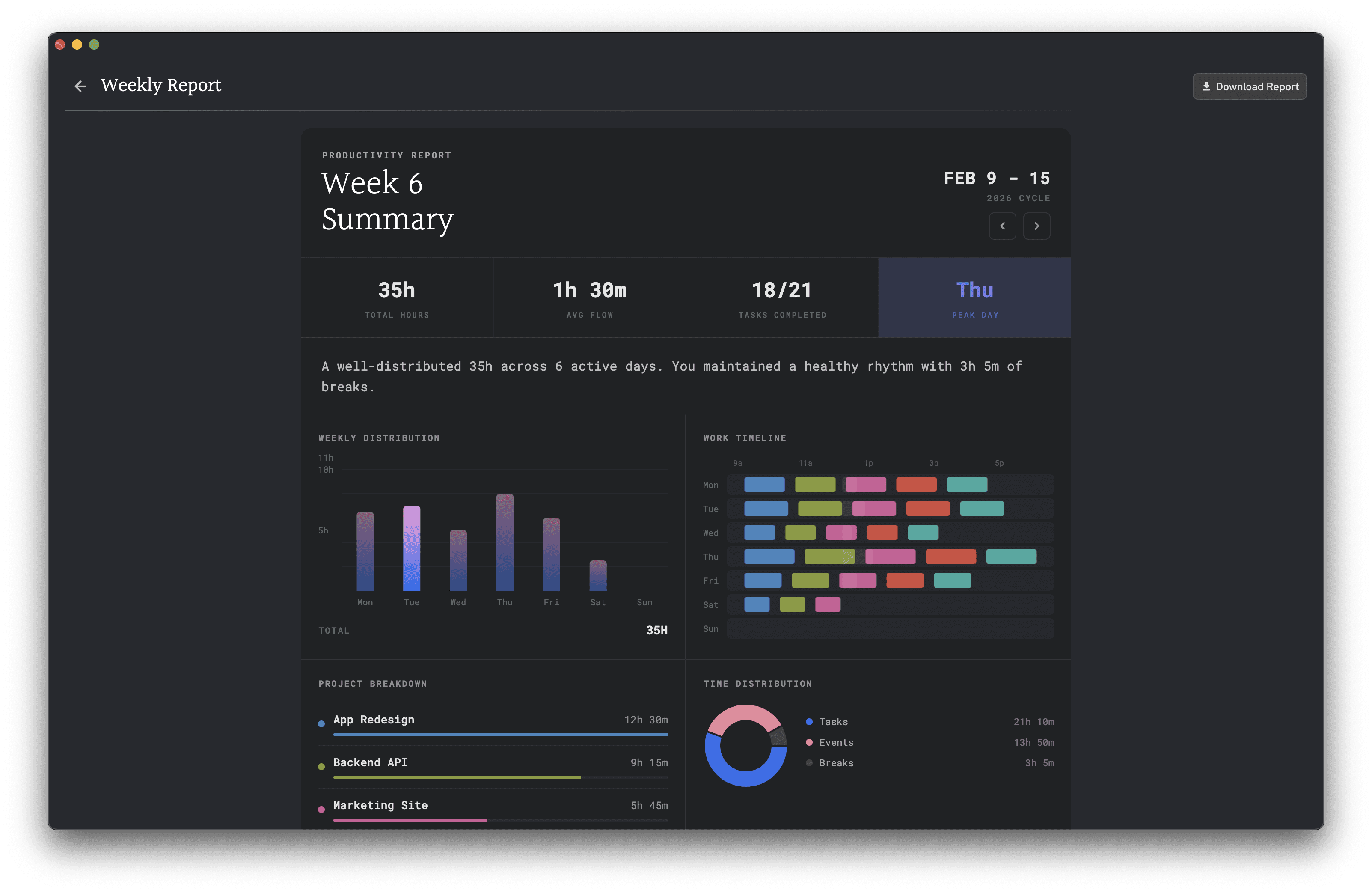
The weekly planning session - done once, Sunday or Monday - makes the key decisions about what matters this week before the week starts. Recurring tasks in Aftertone mean routine work does not require re-deciding when it happens. The Calendar view opens on today by default, with your time-blocked tasks already sequenced, so the first decision of the day is not "what should I work on" - it is already answered.
How To Start Tomorrow
Tonight, make as many tomorrow's decisions as you can: what you'll work on, in what order, what you'll eat for lunch, what you'll wear. Write them down so you don't have to re-decide in the morning. Then notice how the morning feels when the day is pre-decided versus when you're making those choices in real time under the competing pressures of the day having already started.
Related Principles
Planning Fallacy - planning ahead reduces errors
Overplanning - too much pre-planning has costs
Autonomy - removing too many decisions reduces autonomy
Time Blocking - blocks eliminate "what now?" decisions
Related Reading
Best AI Daily Planning Tools — AI planners that make decisions in advance so you face fewer of them during the day.
Best Time Blocking Apps — Scheduling the day ahead of time removes the in-day decision of what to do next.
Best Productivity Systems for High Performers — High-performer systems that reduce daily decision load through consistent structure.
Frequently Asked Questions
What is decision fatigue?
Decision fatigue is the deterioration of decision quality that occurs as the number of decisions made increases throughout the day. Research shows that people tend toward worse choices — more impulsive, more conservative, or more avoidant — as the cumulative decision load grows. The parole board study by Danziger et al. is the most cited example: approval rates dropped from around 65% to near zero as the session progressed, recovering after breaks.
Is ego depletion the same as decision fatigue?
Related but not identical. Ego depletion, proposed by Baumeister, is the broader claim that self-regulatory resources are consumed by any demanding mental or emotional effort and need to be replenished. Decision fatigue is one manifestation — the degradation of decision quality specifically. The ego depletion model itself has faced replication challenges, but the practical effect of decision accumulation on choice quality has been documented in applied settings independently of the theoretical mechanism.
What time of day are decisions best made?
For most people, cognitive resources are freshest in the morning after sleep — making complex, high-stakes decisions earlier in the day and protecting that window from trivial decisions is a consistent application of the research. The specific optimal window varies with chronotype: evening-type people may have a later peak. The key principle is making your most consequential decisions before the cumulative load of the day depletes the resources they require.
How do you reduce decision fatigue?
The primary strategies are reducing the number of decisions made and batching those that remain. Establishing defaults and routines eliminates repeated decisions entirely. Decision batching — making all scheduling and priority decisions in a single planning session rather than throughout the day — concentrates the cognitive cost into one window rather than spreading it across all working hours. Simplifying low-stakes choices (meals, clothing, routine tasks) preserves capacity for high-stakes ones.
Further Reading
Danziger, S., Levav, J., & Avnaim-Pesso, L. (2011). Extraneous factors in judicial decisions. Proceedings of the National Academy of Sciences, 108(17), 6889-6892. DOI: 10.1073/pnas.1018033108
Baumeister, R. F., et al. (1998). Ego depletion: Is the active self a limited resource? Journal of Personality and Social Psychology, 74(5), 1252-1265. DOI: 10.1037/0022-3514.74.5.1252