The Principle
Time blocking works because it operationalises the most replicated finding in goal-setting research: a task assigned to a specific time is dramatically more likely to happen than a task left on a list. Gollwitzer's implementation intention research found completion rates of 91% for tasks with specific when-where-what plans versus 35% for vague goal intentions — a gap that holds across 94 studies. Time blocking is that plan, embedded in the calendar.
A to-do list tells you what needs doing. It says nothing about when. So you start the day with fifteen items and spend the first hour deciding which one to touch - and then meetings fill the calendar, reactive work takes over, and by 5pm the list looks almost identical to how it started. The problem isn't the tasks. It's the absence of a plan for when they happen.
Time blocking is the practice of assigning tasks to specific slots in your calendar - treating your work the same way you treat meetings. When you place a task in a time slot and name the first action you'll take, you're creating an implementation intention in calendar form. The mechanism is among the most replicated in behavioural science: pre-deciding when you'll do something makes you dramatically more likely to do it, without requiring any additional willpower.

Definition
A to-do list tells you what to do; a time block tells you when. By assigning tasks to specific time slots on your calendar, you're essentially creating an implementation intention - and decades of research show that's one of the most reliable ways to follow through on plans.
What The Research Shows
No large-scale RCT has tested 'time blocking' as a standalone intervention. However, its mechanism is well-established through implementation intention research. Gollwitzer & Sheeran (2006) found d = 0.65 across 94 studies for specifying when and where to act — practically, this corresponds to completion rates of approximately 91% for specific if-then plans versus 35% for vague goal intentions.
Gollwitzer et al. (2024) updated this meta-analysis across 642 independent tests and confirmed the effect holds (.27 ≤ d ≤ .66) across cognitive, affective, and behavioural outcomes, with larger effects when plans have an if-then format and are rehearsed at least once. The evidence base for the underlying mechanism is now among the most replicated in behavioural science.
Aeon, Faber & Panaccio (2021) meta-analyzed 158 studies and found time management behaviors correlate with job performance at r ~ .25 and with life satisfaction at r = .43, with wellbeing effects exceeding performance effects.
Locke & Latham (2019) confirmed across 50 years of research that specific goals outperform vague ones. Limitation: direct 'time blocking' RCTs are limited; evidence is extrapolated from implementation intentions and time management research.

What This Means
Scheduling a task into a specific time slot makes you significantly more likely to complete it than leaving it on a to-do list. The slot creates a decision in advance, which removes the need to decide what to work on when competing demands are loudest.
What Most People Get Wrong
Time blocking is widely misunderstood as meaning you must plan every minute of your day.
That version of it is counterproductive. Effective time blocking means giving your most important work a protected slot before the reactive work begins. One or two well-defended blocks per day is closer to the evidence than a schedule mapped to 15-minute increments.
When it Fails…
ADHD and rigid scheduling clash. For people with time blindness, fixed-slot blocks can become a source of repeated failure rather than a planning tool.
Perfectionism amplifies the cost. People who cannot tolerate unfinished blocks may find the system collapses after the first overrun.
High-interruption roles need looser blocks. When blocks break constantly due to unavoidable demands, the solution is more buffer and flexibility, not abandoning the practice.
What This Means For You…
The gap between a to-do list and a time-blocked calendar is the gap between intention and commitment. Tasks without time slots are wishes. Tasks with time slots are plans. The practical shift takes thirty seconds - drag a task into a slot - but what it does to your day is significant. You stop starting each hour by deciding what to do. You stop losing important work to reactive work because it now has protected time. The research also shows that time management's biggest payoff is not performance but wellbeing - the feeling of being in control of your time is itself the prize.
How Aftertone Implements It.
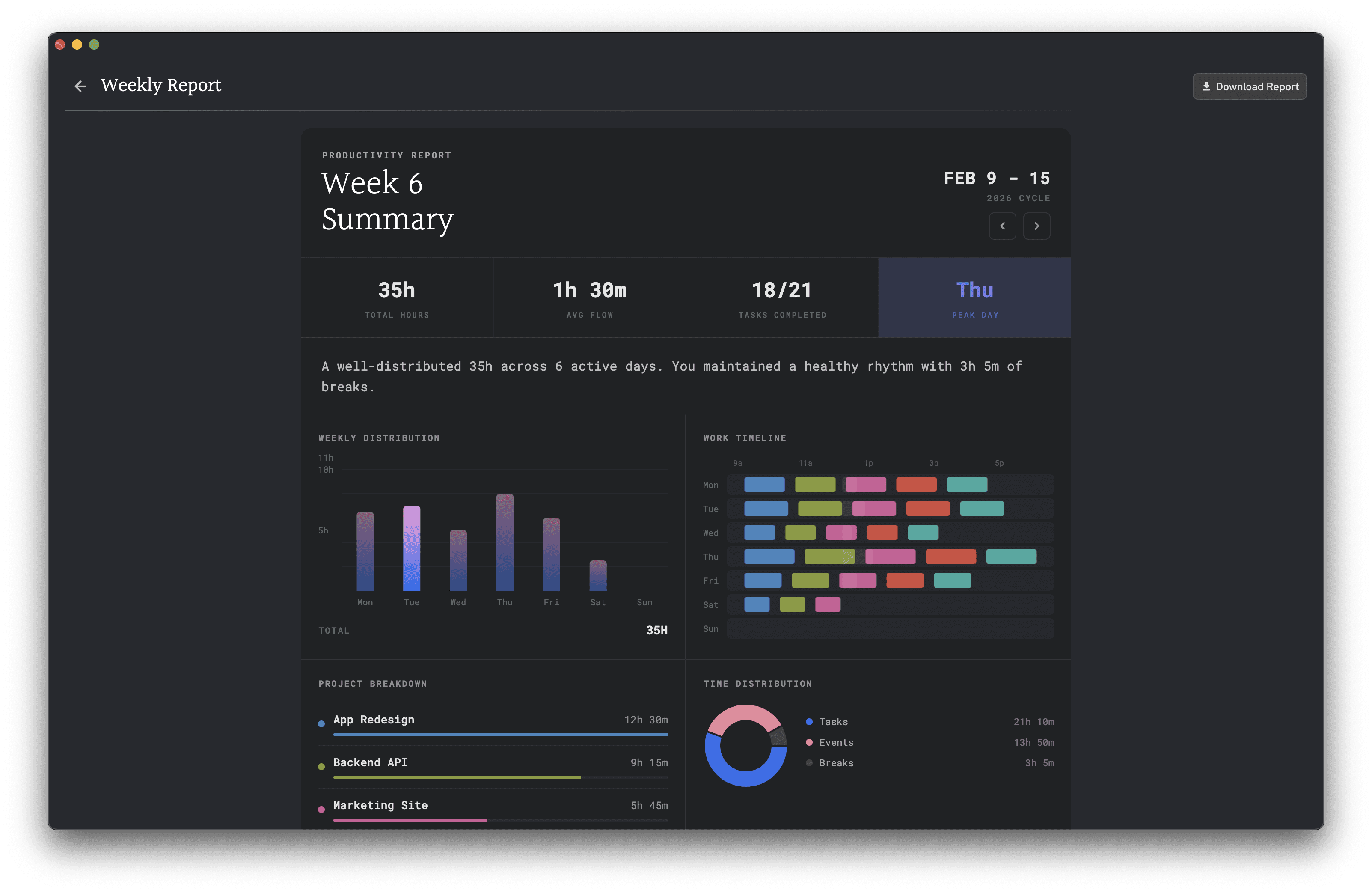
Time blocking is Aftertone's core interaction. You drag tasks from your inbox directly onto the calendar to give them a specific time slot. Tasks without a time block sit in the inbox; tasks with one appear on the calendar and feed into Focus Mode in sequence. The Planning View (Shift+P) and week view (Cmd+7) let you block time across the full week before it fills itself.
How To Start Tomorrow
Tomorrow morning, before you open your inbox, open your calendar and block time for your top two or three priorities - treat them like meetings you can't skip. Give each block a title that includes the first action, not just the project name. Protect those blocks. Notice how different the day feels when important work has a reserved slot before the reactive work begins.
Related Principles
Implementation Intentions - time blocking is if-then planning in calendar form
Attention Residue - blocks protect focus by reducing task switching
Deep Work / Protected Focus Blocks - time blocks create the conditions for deep work
Planning Fallacy - blocks must account for time estimation bias
Related Reading
Best Time Blocking Apps — The practical tools built around the scheduling research covered here.
Best Mac Calendar Apps for Time Blocking — The best Mac calendar apps with time blocking as a first-class feature.
Best Deep Work Scheduling Apps — Tools that combine time blocking with protected focus — the most effective pairing.
How to Time Block Your Day — The practical guide to implementing the scheduling research covered here.
Planned vs Actual: The Data Nobody Collects — How to close the feedback loop that makes time blocking improve over time.
Frequently Asked Questions
What is time blocking?
Time blocking is the practice of scheduling specific tasks into specific calendar slots — assigning not just what you intend to do, but when. Rather than working from a to-do list and deciding in the moment, time blocking converts tasks into commitments with defined start times, making follow-through significantly more likely.
How much does time blocking improve follow-through?
Gollwitzer's implementation intention research — the mechanism behind time blocking — found completion rates of 91% for tasks with specific when-where-what plans versus 35% for vague goal intentions, across 94 studies. That's approximately 2.6x more likely. The 2006 meta-analysis reported an effect size of d = 0.65 (medium-to-large). A 2024 updated meta-analysis across 642 tests confirmed the effect holds. The act of assigning a specific time converts an intention into a prospective memory cue the brain acts on automatically.
What's the difference between time blocking and a to-do list?
A to-do list captures what needs to happen. A time block decides when it will happen. The difference matters because "complete the report" requires a fresh decision every time you look at it, while a 9–11am block on Tuesday converts that decision into a commitment. The cognitive overhead of deciding is eliminated.
Is time blocking worth the effort of setup?
Yes, for most knowledge workers — and the Aeon, Faber & Panaccio (2021) meta-analysis of 158 studies confirms it, finding that time management behaviours correlate with job performance (r ≈ .25) and with life satisfaction (r = .43). The wellbeing effect is larger than the performance effect: the feeling of being in control of your time is itself a significant outcome. The key insight from the research: one or two well-defended deep work blocks per day produces more benefit than a fully mapped schedule, because what matters is protecting important work from reactive demands, not micromanaging every minute.
Why do time blocks collapse in practice?
The most common failure modes are underestimating task duration (the planning fallacy), scheduling without buffer between blocks, and failing to protect blocks from meeting requests and interruptions. Time blocking creates the intention — protecting the block is a separate, structural challenge that requires removing competing signals during the block.
Further Reading
Gollwitzer, P. M., & Sheeran, P. (2006). Implementation intentions and goal achievement: A meta‐analysis of effects and processes. Advances in Experimental Social Psychology, 38, 69-119. DOI: 10.1016/S0065-2601(06)38002-1
Aeon, B., Faber, A., & Panaccio, A. (2021). Does time management work? A meta-analysis. PLOS ONE, 16(1), e0245066. DOI: 10.1371/journal.pone.0245066