The Principle
Friday afternoon arrives and you're not sure what actually got done this week. There are tasks you started and didn't finish, commitments you half-remember making, a vague unease that something important slipped through. You carry that feeling into the weekend, and by Sunday evening it's turned into low-grade dread about Monday. The week ended but never really closed.
A weekly review is the practice of deliberately closing that loop - a short structured ritual where you process what happened, capture what's still open, and set clear priorities for the week ahead. The research on planning behaviour consistently shows that people who review and plan regularly feel more in control, sleep better at weekends, and approach the following week with greater clarity. The review doesn't change how much you did. It changes how you carry it.

Definition
A weekly review is when you step back from daily tasks to process loose ends, check progress on goals, and plan the week ahead. It prevents the accumulation of unfinished mental business that erodes focus and sleep quality throughout the week.
What The Research Shows
No RCT has tested 'weekly review' as a standalone intervention. The best available evidence comes from broader planning research: Parke et al. (2018) found daily planning improves performance through increased work engagement, though benefits weaken under frequent interruptions.
Claessens et al. (2010) showed employees who planned more completed more tasks, especially when autonomy was high.
Claessens et al. (2007) reviewed 32 studies finding planning behavior positively relates to perceived control and satisfaction.
Aeon et al. (2021) meta-analyzed 158 studies showing time management relates to wellbeing (r = .31) more than performance (r = .25). Limitation: no dedicated weekly-review RCT exists; evidence extrapolated from daily planning and time management research.

What This Means
People who regularly review the past week and plan the next feel more in control, experience less anxiety about unfinished work, and sleep better over weekends. The review does not change how much you did - it changes how you carry it.
What Most People Get Wrong
The weekly review is often skipped because it feels unproductive compared to doing actual work.
This inverts the value. Without a review, unfinished tasks accumulate as mental background noise, planning mistakes repeat because no feedback loop closes, and the following week starts without clear priorities. The review is not separate from productivity. It is what makes the system improve over time.
When it Fails…
Chaotic schedules resist fixed rituals. A weekly rhythm requires enough schedule stability to reliably protect 20 minutes at the same time each week.
A large backlog can activate anxiety. If the review surfaces many unresolved items without a clear path forward, it can feel like an audit rather than a reset.
What This Means For You…
Most people end the week by stopping, not finishing. There's a difference. Stopping means the week just runs out of time and you carry the open loops forward. Finishing means you've looked at what happened, captured what's unresolved, and made a deliberate decision about what the next week will focus on. Unreviewed weeks accumulate as background noise that erodes focus and bleeds into your recovery time. A weekly review converts five days of activity into a coherent picture you can actually set down for the weekend.
How Aftertone Implements It.
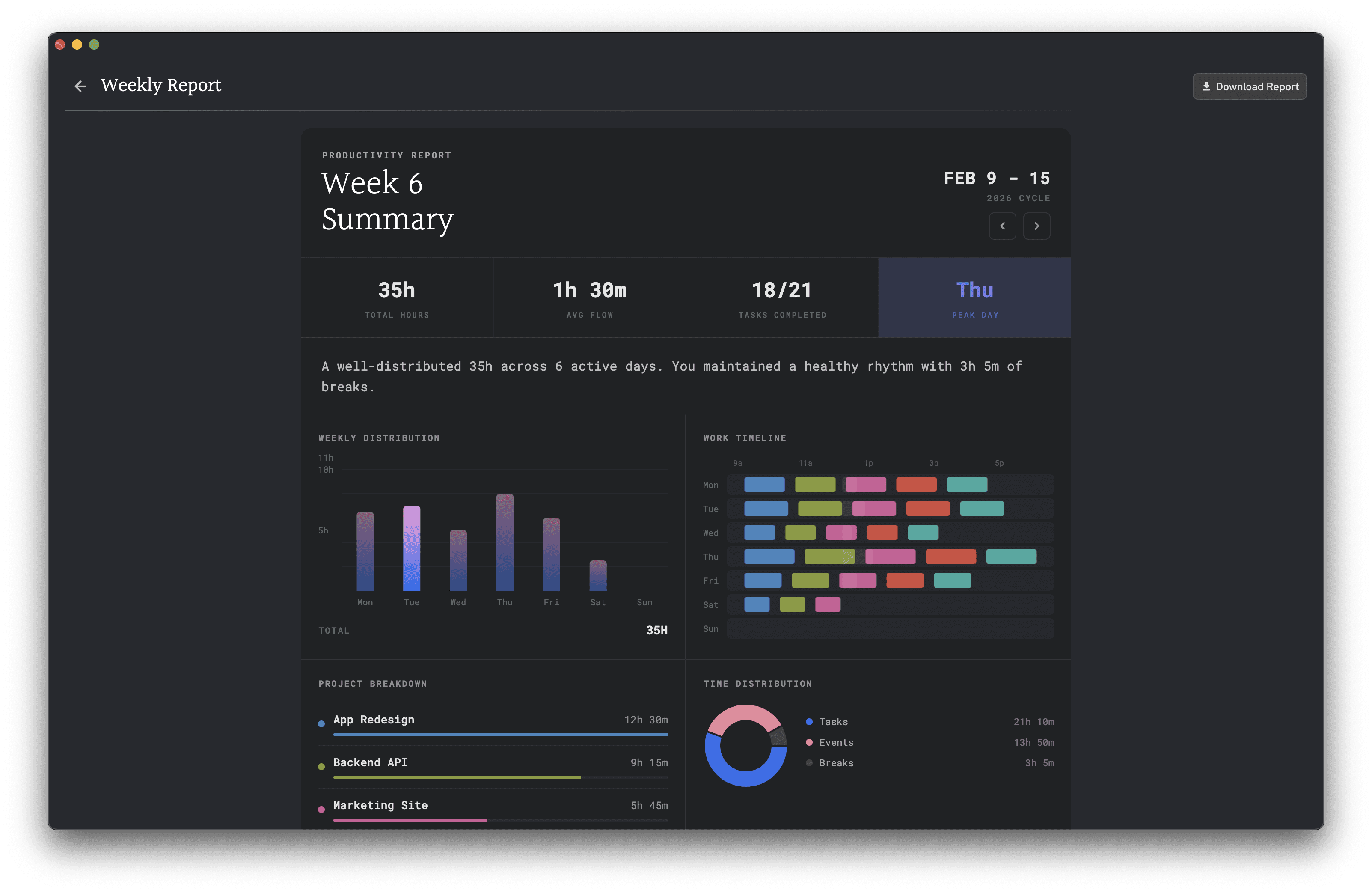
The Weekly Report (accessed from the top right of the Focus Screen) shows flow sessions, peak day, streak, longest focus period, tasks completed by project, and a colour-coded work timeline. The weekly planning session builds directly on this data: review the report first, then open the Planning View with Shift+P to triage the inbox, set three priorities for the week, and block them on the calendar before anything else. The structure ensures planning is grounded in what actually happened, not how the week felt.
How To Start Tomorrow
This Friday, block 20 minutes before you finish. Write down everything still open from this week. Identify the three most important things for next week. Then close your laptop with those written down somewhere you'll see them Monday. Notice whether your weekend feels different when the week has been deliberately closed rather than just abandoned.
Related Principles
Cognitive Offloading - the review captures loose ends
Bedtime To-Do Lists and Sleep - Friday closure prevents weekend rumination
Moral Licensing - review must emphasize action, not just planning
Self-Monitoring - the review is a weekly self-monitoring checkpoint
Related Reading
Best Weekly Review Apps — Apps built specifically for a structured weekly review — some with AI to do the analysis for you.
Best Mac Calendar Apps for Weekly Reviews — Mac calendar apps that support weekly planning as part of their core workflow.
Best AI Weekly Planning Tools — AI tools that surface what happened last week so your review takes minutes, not an hour.
Frequently Asked Questions
What is a weekly review and why does it matter?
A weekly review is a structured ritual — typically 30–60 minutes — for closing out the previous week and planning the next. It matters because productivity systems decay without maintenance. The weekly review is that maintenance: processing unfinished tasks, reviewing patterns, and setting clear priorities before new reactive demands arrive.
What does the research say about weekly planning rituals?
Research on planning rituals shows they reduce unfinished task burden and improve next-week performance. The mechanism is consistent with implementation intention research: decisions made in advance, in a fresh state, produce better outcomes than decisions made reactively throughout the week. The ritual also acts as a peak-end intervention — giving the week a designed ending.
How often should a weekly review happen?
Weekly is the research-supported cadence. Less frequent and the planning horizon becomes too long — tasks drift, patterns are harder to see, and the fresh-start motivational effect of Monday is missed. More frequent and the overhead of the review itself becomes a burden. The Sunday evening or Monday morning slot is most consistent with temporal landmark research.
What should a weekly review actually include?
At minimum: clearing your task inbox (processing everything captured during the week), reviewing what was planned versus what happened, identifying the top priorities for the coming week, and blocking time for the most important work. The cognitive offloading component — ensuring nothing is left as an open loop — is as important as the forward planning.
Further Reading
Claessens, B. J. C., et al. (2007). A review of the time management literature. Personnel Review, 36(2), 255-276. DOI: 10.1108/00483480710726136
Aeon, B., Faber, A., & Panaccio, A. (2021). Does time management work? A meta-analysis. PLOS ONE, 16(1), e0245066. DOI: 10.1371/journal.pone.0245066