The Principle
You spend an hour building the perfect weekly plan. Every task is categorised, prioritised, and time-blocked. The system is beautiful. You close it feeling satisfied - accomplished, even. And then, subtly, that satisfaction leaks into the rest of the day as permission to take it slightly easier. You earned a break. You did something good. The planning counts as work.
Moral licensing is the well-documented tendency for past virtuous behaviour to grant unconscious permission for subsequent less virtuous behaviour. Applied to planning: the effort and attention of a thorough planning session can satisfy enough of the productivity drive that the actual execution becomes less urgent. A meta-analysis of 91 studies found a meaningful licensing effect across a wide range of domains. The more effortful and visible the planning, the stronger the license it generates.

Definition
After spending time carefully organizing your day, you might feel a satisfying sense of accomplishment - even though you haven't actually done anything yet. This is moral licensing: past 'good' behavior (planning) gives you unconscious permission to slack off on the follow-through.
What The Research Shows
Blanken, van de Ven & Zeelenberg (2015) meta-analyzed 91 studies (N = 7,397) and found a moral licensing effect of d = 0.31. The effect means that people who have recently behaved virtuously are subsequently more likely to behave less virtuously. Applied to productivity: the act of planning can substitute for doing. The effect is stronger when the planning is visible to others or feels effortful. Limitation: most studies are lab-based with short time horizons; the specific application to planning-as-licensing is extrapolated from the broader effect.

What This Means
The act of making a thorough plan generates a feeling of accomplishment that can reduce the urgency to execute it. The more effortful and visible the planning session, the stronger the license it produces to coast afterward.
What Most People Get Wrong
Planning feels like progress because it involves real cognitive effort and produces a tangible output.
The research on moral licensing finds that this feeling is not neutral. It actively reduces the urgency to follow through by satisfying some of the drive that was meant to produce execution. The more elaborate and effortful the planning session, the stronger the license it generates to coast afterward.
When it Fails…
The effect is moderate and may be inflated by publication bias. Not everyone experiences planning as a license to coast - some find it creates momentum.
Strongest for effortful, visible planning. A quick five-minute daily plan is unlikely to generate significant licensing; an elaborate weekly system is more likely to.
What This Means For You…
Planning is not doing. This sounds obvious, but the psychological experience of planning is often sufficiently rewarding that it partially substitutes for the reward of doing - which means it reduces the motivation to follow through. The fix is not to stop planning but to treat the plan as the beginning of the work, not the work itself. Tracking execution separately from planning, and measuring yourself on completed blocks rather than populated calendars, keeps the focus on what actually moved rather than what was intended.
How Aftertone Implements It.
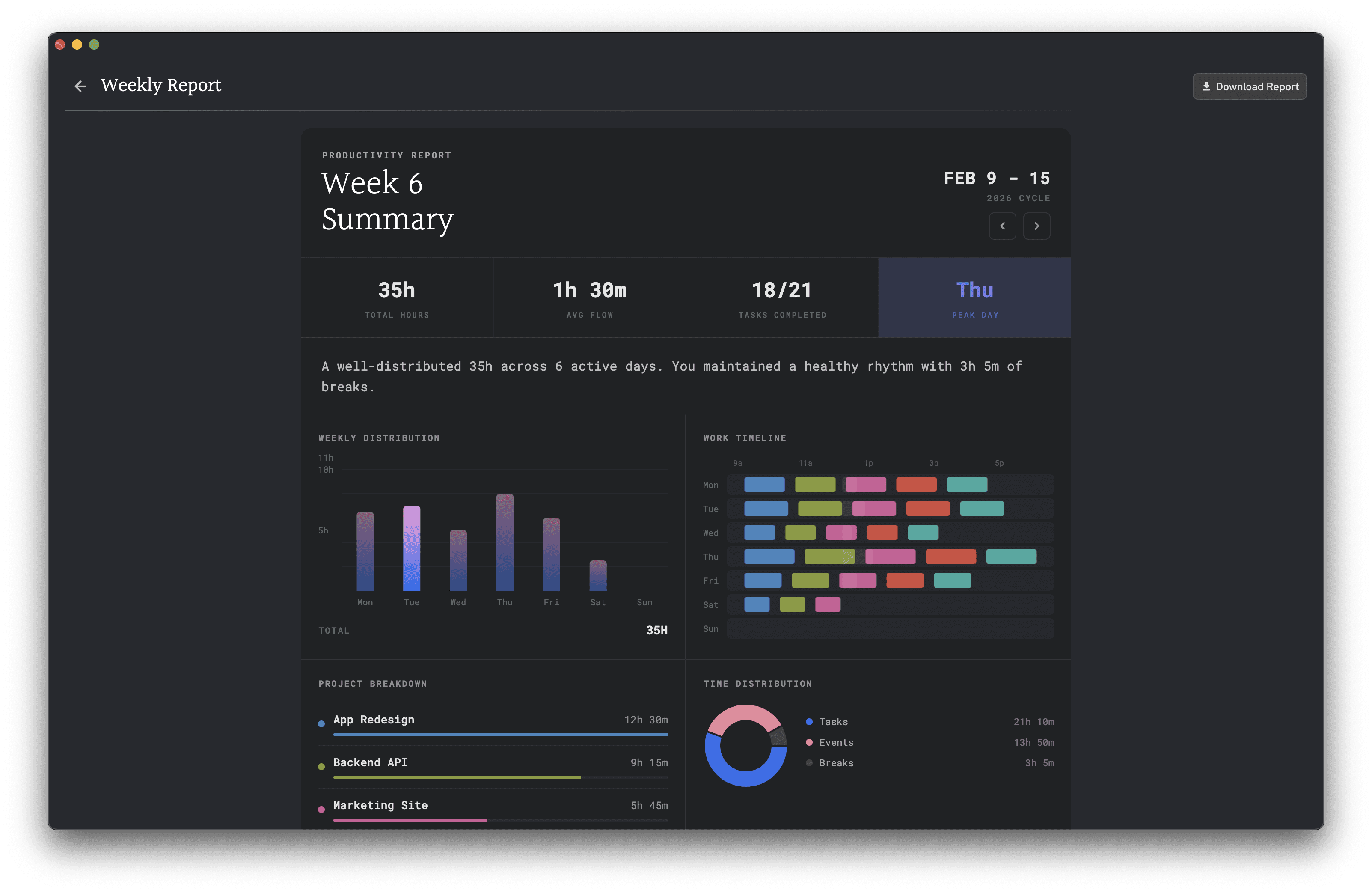
The weekly report distinguishes between what was planned and what was completed. The work timeline shows completed tasks in green - so the record of the week is a record of execution, not a record of planning. Tasks remain in the inbox or on the calendar until they are completed; planning them does not move them out of the system.
How To Start Tomorrow
After your next planning session, write down one specific thing you will complete - not plan, not start, but finish - before the end of today. Treat that completion as the actual measure of the session's success, not the quality of the plan itself. Notice whether anchoring success to execution rather than planning changes how you approach the hours that follow.
Related Principles
Implementation Intentions - the solution to moral licensing is specific if-then plans that bridge to action
Self-Monitoring - monitoring execution (not just plans) counters the licensing effect
Weekly Review - reviews should compare planned vs. completed, not just celebrate planning
Cognitive Offloading - offloading is valuable for reducing mental load, but must lead to action
Related Reading
Best Time Blocking Apps — Time blocking converts planning into committed action — the most direct structural fix.
Best Weekly Review Apps — A weekly review that surfaces the gap between plans made and actions taken.
Best Productivity Systems for High Performers — Systems that link planning to execution rather than treating them as separate activities.
Frequently Asked Questions
What is moral licensing?
Moral licensing is the phenomenon where doing something virtuous — or even just planning to — gives people implicit permission to behave less virtuously afterwards. In the context of productivity, making a plan can create a felt sense of progress that reduces the motivation to actually execute it. The plan feels like partial credit for the work it represents.
Why does planning feel like progress even when nothing gets done?
Planning activates similar cognitive processes to doing — you rehearse the steps, imagine the outcome, and experience a version of goal engagement. This produces genuine psychological satisfaction that the brain registers as partial goal completion. The result is reduced drive to continue, because the felt distance to the goal has narrowed without any real action taken.
How do you get the benefits of planning without the licensing effect?
The key is treating planning as the activation step that leads immediately into execution, not as an achievement in itself. Keeping planning brief — enough to clarify the first action, not enough to feel like the work is done — reduces the licensing effect. Implementation intentions that specify the first physical action rather than just the goal also help, because they keep the gap between planning and doing as small as possible.
Is moral licensing the same as procrastination?
They overlap but are distinct. Procrastination is the avoidance of a task, often through emotion regulation. Moral licensing is a specific mechanism where a preceding virtuous act reduces subsequent effort. You can experience moral licensing without procrastinating in the usual sense — you made the plan, you feel good about it, and now you do something else without the usual guilt of avoidance.
Further Reading
Blanken, I., van de Ven, N., & Zeelenberg, M. (2015). A meta-analytic review of moral licensing. Personality and Social Psychology Bulletin, 41(4), 540-558. DOI: 10.1177/0146167215572134
Merritt, A. C., Effron, D. A., & Monin, B. (2010). Moral self-licensing: When being good frees us to be bad. Social and Personality Psychology Compass, 4(5), 344-357. DOI: 10.1111/j.1751-9004.2010.00263.x