The Principle
You've been at your desk for two hours. You haven't stopped - you've been working, making progress, staying focused. But somewhere in the last thirty minutes the quality of your thinking has quietly declined. You're still producing, but you're slower, less creative, more prone to small errors. You don't feel exhausted. You just feel slightly blunted. You push through anyway.
Micro-breaks - pauses of ten minutes or less during the workday - reliably reduce fatigue and increase subjective energy. A meta-analysis by Albulescu and colleagues across 22 samples found clear wellbeing benefits from short breaks, though the cognitive performance benefits were less pronounced for very brief pauses. The practical implication is that breaks of ten minutes or less are effective recovery tools for how you feel, while longer breaks of 15 minutes or more are needed to meaningfully restore cognitive performance on demanding work.

Definition
Micro-breaks help you feel better, even if they don't always make you think better. Taking brief pauses during demanding work reduces fatigue and increases vigor, though the cognitive performance benefits are less clear. For deep thinking, you may need longer breaks.
What The Research Shows
Albulescu et al. (2022) meta-analyzed 22 samples (N = 2,335) on micro-breaks (<=10 minutes) and found they reduce fatigue (d = 0.35) and increase vigor (d = 0.36), but cognitive performance effects were non-significant (d = 0.16). Longer breaks within the micro-break range showed greater performance benefits, suggesting a dose-response relationship. The wellbeing benefits are clear; the performance benefits require breaks of 10+ minutes for demanding cognitive work.

What This Means
Short breaks of ten minutes or less reliably reduce fatigue and increase subjective energy - but they do not meaningfully restore cognitive performance on demanding work. Micro-breaks are good for how you feel. Breaks of 15 minutes or more are needed for how you think.
What Most People Get Wrong
Breaks are commonly treated as productivity costs rather than productivity tools.
The research finds the opposite for wellbeing outcomes: regular short breaks reduce fatigue and increase energy throughout the day. The nuance is that very short breaks restore how you feel but may not restore how you think on demanding tasks. Match break length to what you are trying to recover.
When it Fails…
Insufficient for cognitive restoration on demanding work. Breaks of under 10 minutes reduce fatigue but do not meaningfully restore analytical or creative performance.
Disruptive during flow states. A break prompt mid-flow can cost more than the break recovers - the value depends heavily on timing.
Optimal break length and activity vary by person. There is no universal prescription for what constitutes a restorative micro-break.
What This Means For You…
The instinct to push through fatigue as a sign of discipline is counterproductive. Fatigue degrades the quality of your thinking before you notice it - you become slower and less accurate while feeling like you're still working at full capacity. Regular short breaks don't interrupt your productivity. They protect it. The key distinction from the research is between wellbeing recovery (short breaks work well) and cognitive performance recovery (you need longer). If you're doing demanding analytical or creative work, a five-minute stretch won't fully restore your thinking. A genuine 15-20 minute break will.
How Aftertone Implements It.
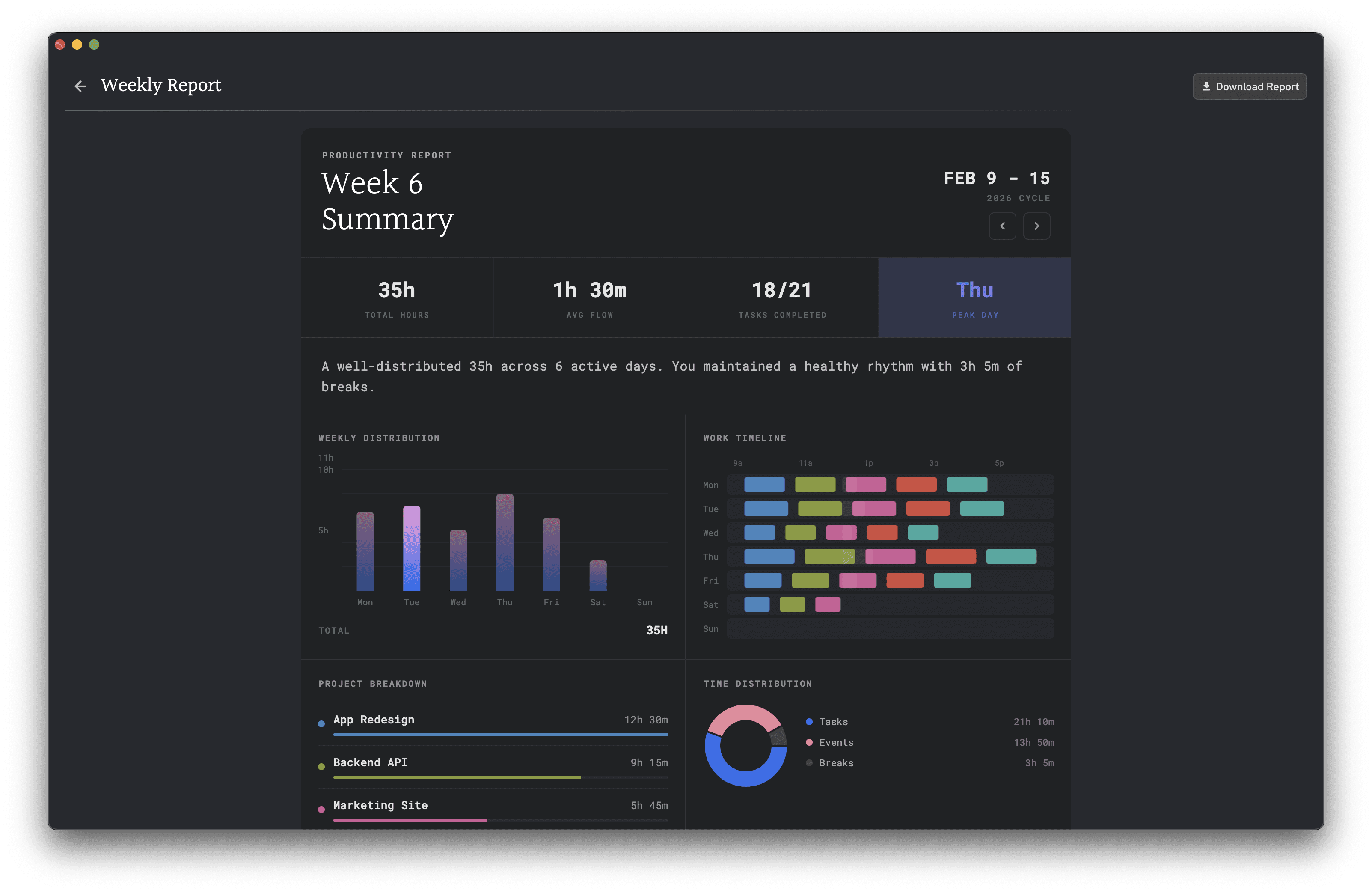
Press B at any point in Focus Mode to take a break. The break is added to your calendar automatically and Focus Mode resumes when it ends - you do not lose your place or have to navigate back in. The break appears as grey on the work timeline in the weekly report.
How To Start Tomorrow
In your next 90-minute work session, set a timer for 75 minutes. When it goes off, take a genuine 15-minute break - away from your screen, ideally outside or moving. When you return, notice the quality of your thinking in the first ten minutes back compared to the ten minutes before the break. That difference is what you've been working without.
Related Principles
Recovery and Detachment - micro-breaks are within-day recovery; detachment is between-day recovery
Deep Work / Protected Focus Blocks - breaks should fall between focus blocks, not during them
Ultradian Rhythms - the 90-minute cycle myth relates to when breaks should occur
Sleep Deprivation - micro-breaks cannot compensate for sleep deprivation
Related Reading
Best Deep Work Apps — Focus apps that build break structure into the session, not as interruptions but as design.
Best Deep Work Scheduling Apps — Scheduling tools that treat recovery time as non-negotiable alongside focus blocks.
Best AI Tools to Protect Deep Work Time — AI tools that manage the rhythm of focus and rest so you don't have to track it manually.
Frequently Asked Questions
What is a micro-break?
A micro-break is a brief, voluntary rest period taken during work — typically between 30 seconds and 10 minutes — without leaving the work context. They are distinct from lunch breaks or full rest periods. Examples include stretching at your desk, looking away from the screen, or briefly stepping outside. The research examines whether these brief interruptions to work restore performance or simply interrupt it.
Do micro-breaks actually improve performance?
The evidence is mixed and more nuanced than popular coverage suggests. Micro-breaks consistently improve wellbeing and reduce fatigue during the workday. Their effect on cognitive performance is less clear — some studies show modest benefits for sustained attention tasks, while others find no measurable effect on output quality. They appear to help most with emotional recovery and fatigue management, less so with direct cognitive restoration.
How long should a micro-break be to be effective?
Research does not support a single optimal duration, as it depends on what the break is for. For reducing eye strain and physical tension, even 20–30 seconds away from the screen helps. For emotional recovery from a stressful interaction, longer micro-breaks of 5–10 minutes show more benefit. The key variable appears to be whether the break involves genuine disengagement from work content, not the duration itself.
Are micro-breaks better than longer, less frequent breaks?
Different break structures serve different purposes. Micro-breaks prevent the accumulation of fatigue and tension throughout a session. Longer breaks — including lunch and post-work recovery — allow deeper restoration of depleted resources. Research by Trougakos and colleagues suggests that both are necessary: micro-breaks manage short-term fatigue, while longer detachment periods enable the deeper recovery that determines next-day performance.
Further Reading
Albulescu, P., et al. (2022). Give me a break! A systematic review and meta-analysis on the efficacy of micro-breaks for increasing well-being and performance. PLOS ONE, 17(8), e0272460. DOI: 10.1371/journal.pone.0272460
Trougakos, J. P., & Hideg, I. (2009). Momentary work recovery: The role of within-day work breaks. Research in Occupational Stress and Well-being, 7, 37-84. DOI: 10.1108/S1479-3555(2009)0000007005