The Principle
You got five hours of sleep. You feel okay - a bit tired, but functional. You have coffee. You get to work. What you don't have access to is an accurate read of how impaired you actually are. Sleep-deprived people consistently overestimate their own cognitive performance. The feeling of being fine and the reality of being fine have diverged, and you can't tell from the inside.
The research on sleep deprivation and cognitive performance is among the most robust in neuroscience. Williamson and Feyer demonstrated that after 17 to 19 hours awake, cognitive performance is equivalent to a blood alcohol level of 0.05% - impaired enough to be illegal behind the wheel in most jurisdictions. After 24 hours, it reaches 0.10%. The effects on attention, working memory, and decision-making are measurable and significant. No amount of caffeine, motivation, or willpower fully compensates.

Definition
Sleep deprivation doesn't just make you tired - it makes you measurably impaired. The research is unequivocal: losing sleep degrades attention, decision-making, and reaction time to levels comparable to legal intoxication. No amount of caffeine or willpower fully compensates.
What The Research Shows
Williamson & Feyer (2000) found that after 17-19 hours awake, performance equals BAC 0.05%; after 24 hours, it reaches BAC 0.10% (legal limit), with response speeds slowed up to 50%.
Lim & Dinges (2010) meta-analyzed the impact of short-term sleep deprivation and found the largest effect was g = -0.78 (not -1.55 as sometimes cited) for lapses in simple attention. Note: the original compilation cited d = -1.55, which is roughly double the actual value.
Pilcher & Huffcutt (1996) found mood is more affected than cognitive or motor performance, and partial sleep deprivation has more profound effects than total deprivation.

What This Means
After 17 to 19 hours awake, cognitive performance is equivalent to a blood alcohol level of 0.05% - legally impaired in most countries. Sleep-deprived people consistently overestimate their own performance, which means the impairment is invisible from the inside.
What Most People Get Wrong
The most persistent myth about sleep is that high performers can function well on less of it.
Sleep-deprived people consistently rate their own performance as adequate while objective measures show significant impairment. The subjective feeling of being fine does not track the actual cognitive deficit. This disconnect is one of the most dangerous aspects of sleep deprivation: you cannot feel the full extent of how impaired you are.
When it Fails…
Genuine short sleepers exist. Roughly 1% of the population carries a genetic variant that allows full cognitive function on significantly less sleep - but this is rare.
Individual sleep needs vary. The 7-9 hour recommendation applies to most adults but the optimal window differs meaningfully between individuals.
Sleep tracking can increase anxiety. For people who already struggle with insomnia, close monitoring of sleep duration can worsen the problem rather than help.
What This Means For You…
Sleep is not a productivity variable to be optimised - it's the foundation everything else rests on. The popular idea that successful people sleep less is survivorship bias at its most dangerous: the people who function well on five hours are genuinely rare genetic outliers, not a model to emulate. For the vast majority of people, chronic sleep restriction degrades the quality of every hour of work that follows it, in ways that are invisible from the inside. Protecting your sleep is not laziness. It's the highest-leverage productivity decision you can make.
How Aftertone Implements It.
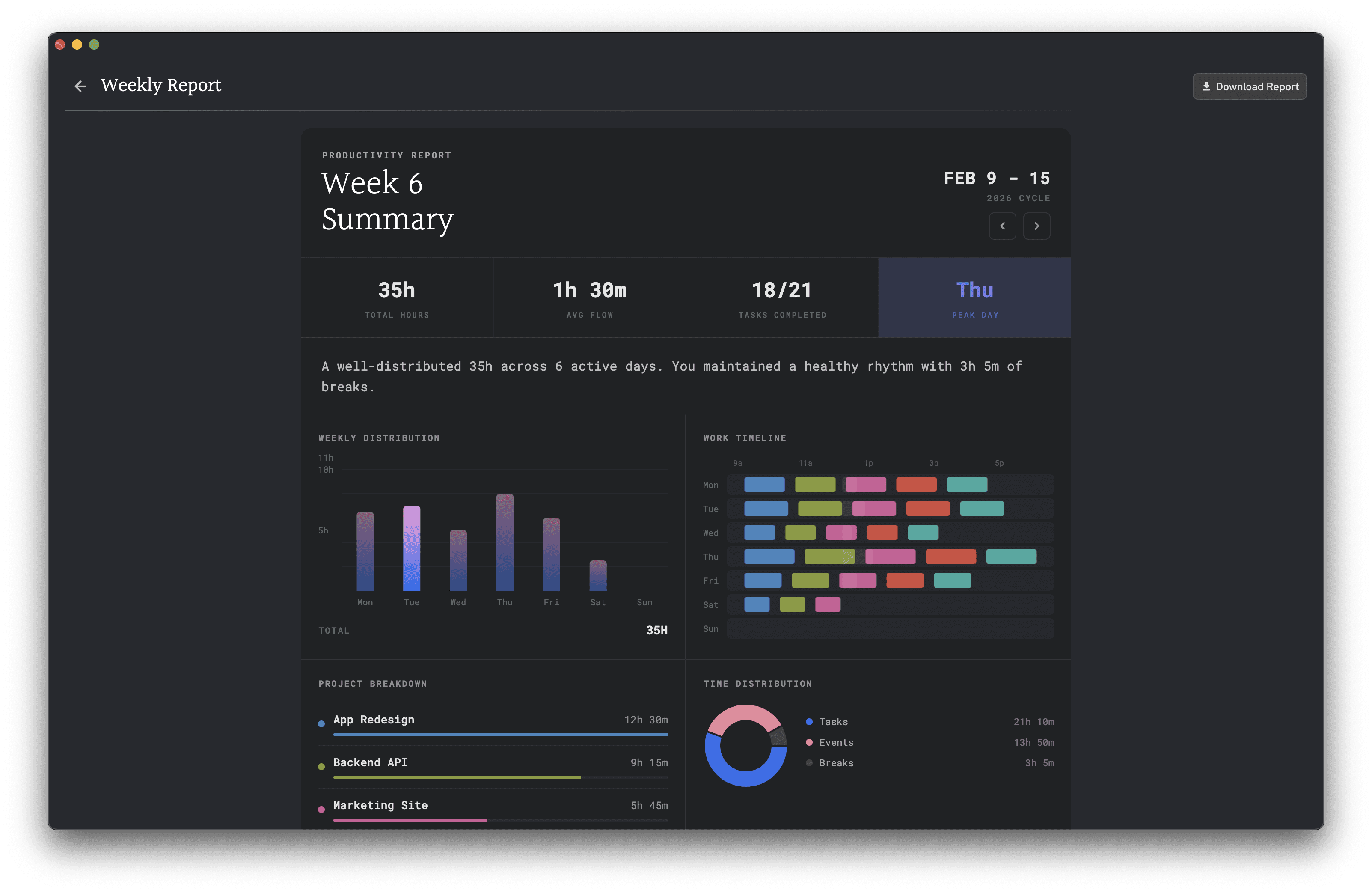
The work timeline in the weekly report shows your actual output patterns across the day and week. Days where little completed despite being "on" are visible in the gaps between green blocks. That record is the data that makes the connection between rest and performance legible - you can see which days produced real work and which did not.
How To Start Tomorrow
For one week, track both your sleep duration and your subjective sense of how well you worked each day. At the end of the week, compare the two columns. For most people the correlation is clear - but the more important finding is usually the days where you felt fine but the data shows you were running short. That gap between felt performance and actual performance is the most important thing the research warns about.
Related Principles
Recovery and Detachment - sleep is the most fundamental form of recovery
Micro-Breaks - breaks cannot compensate for chronic sleep deprivation
Planning Fallacy - sleep deprivation worsens time estimation accuracy
Bedtime To-Do Lists - evening planning supports better sleep onset
Related Reading
Best Deep Work Apps — If sleep is limited, protecting your peak hours matters even more — these apps help.
Best AI Daily Planning Tools — Planners that front-load cognitive work to when you're actually sharp.
Best Deep Work Scheduling Apps — Tools that schedule demanding work when your cognitive capacity is highest, not just when a slot is free.
Frequently Asked Questions
How much does sleep deprivation affect cognitive performance?
The effects are substantial. Van Dongen et al. found that two weeks of sleeping six hours per night produces cognitive deficits equivalent to 48 hours of total sleep deprivation. Crucially, people in the study did not perceive their own impairment — they rated their sleepiness as only slightly elevated while their performance on objective tests declined dramatically. This combination of real impairment and lack of awareness is particularly hazardous.
What cognitive functions are most affected by sleep deprivation?
Sustained attention is among the most sensitive — the ability to maintain focus over time degrades rapidly with sleep restriction. Working memory, decision-making quality, emotional regulation, and creative problem-solving are all impaired. The functions most critical to knowledge work are precisely those most vulnerable to sleep deprivation, making adequate sleep a direct productivity variable rather than merely a health one.
Can you adapt to getting less sleep over time?
You can adapt to feeling less sleepy — subjective sleepiness diminishes with chronic restriction as the brain recalibrates its baseline. Objective cognitive performance, however, does not adapt in the same way. People who have been chronically sleep-restricted feel less impaired than they are. This is the hidden danger: the subjective experience of adaptation masks continued objective deficit.
How much sleep is enough?
Most adults require 7–9 hours for optimal cognitive performance, with significant individual variation. The research does not support the common belief that some people genuinely function well on 5–6 hours — studies that appear to find this often involve people who have adapted to feeling less impaired rather than people who are performing at full capacity. Genetic variants that allow true short-sleep exist but are extremely rare.
Further Reading
Williamson, A. M., & Feyer, A. M. (2000). Moderate sleep deprivation produces impairments in cognitive and motor performance equivalent to legally prescribed levels of alcohol intoxication. Occupational and Environmental Medicine, 57(10), 649-655. DOI: 10.1136/oem.57.10.649
Lim, J., & Dinges, D. F. (2010). A meta-analysis of the impact of short-term sleep deprivation on cognitive variables. Psychological Bulletin, 136(3), 375-389. DOI: 10.1037/a0018883