The Principle
You remember the last project taking about two weeks. It took six. You remember the meeting running about an hour. It was two. You remember last Thursday being a productive day, though if you checked the calendar you'd find it was mostly reactive work with one 45-minute block of real output. Memory for time is not a recording - it's a reconstruction, and it reconstructs in systematically biased ways.
Time estimation bias is broader than the planning fallacy. We don't just underestimate future durations - we also misremember past ones, and we lose track of time differently depending on whether we're watching it pass or reconstructing it afterward. These biases compound in daily planning: we build schedules based on optimistic future estimates informed by unreliable past memories, producing plans that are wrong in predictable directions before the day has even begun.

Definition
Time estimation bias goes beyond the planning fallacy. We misjudge duration in multiple directions: we underestimate how long future tasks will take, overestimate how long unpleasant tasks lasted, and lose track of time during engaging work. These biases compound in daily planning.
What The Research Shows
Buehler, Griffin & Ross (1994) established that optimistic prediction is the default mode - people's 'realistic' estimates match their best-case scenarios. The planning fallacy is the most studied time estimation bias but sits within a broader family of temporal distortions.
Roy, Christenfeld & McKenzie (2005) showed people also misremember how long past tasks took, creating unreliable reference points for future estimates.
Block & Zakay (1997) demonstrated that prospective time estimation (tracking time as it passes) and retrospective time estimation (remembering how long something took) involve different cognitive processes and produce different biases.

What This Means
People produce time predictions that are statistically indistinguishable from their best-case scenarios, even when asked for realistic estimates and even when they know about the bias. Experience alone does not correct it - only external data does.
What Most People Get Wrong
The instinct is to treat poor time estimation as a skill that improves with experience and effort.
Research finds that even experienced professionals in their own domains show the same bias, and that simply trying harder to estimate accurately does not correct it. External data, tracking actual durations and using them as reference points, is more effective than any amount of careful mental estimation.
When it Fails…
Reference class data takes time to accumulate. New users cannot benefit from personalised suggestions until enough comparable tasks have been tracked.
Highly variable task types resist calibration. If your work is rarely repeated in a similar form, historical data provides weaker correction.
Strongest on novel and complex tasks. For simple, frequently repeated work, time estimation is usually already well-calibrated.
What This Means For You…
The implication is that you cannot fix time estimation through effort or intention alone - your brain's temporal distortions are not a skill deficit, they're a cognitive feature. What works is external data. Tracking actual durations over time, comparing them to estimates, and building reference classes of "tasks like this usually take me X" gives you a correction mechanism that intuition alone can't provide. Over weeks and months of tracking, your estimates become genuinely more accurate - not because you got better at guessing, but because you stopped guessing and started referencing.
How Aftertone Implements It.
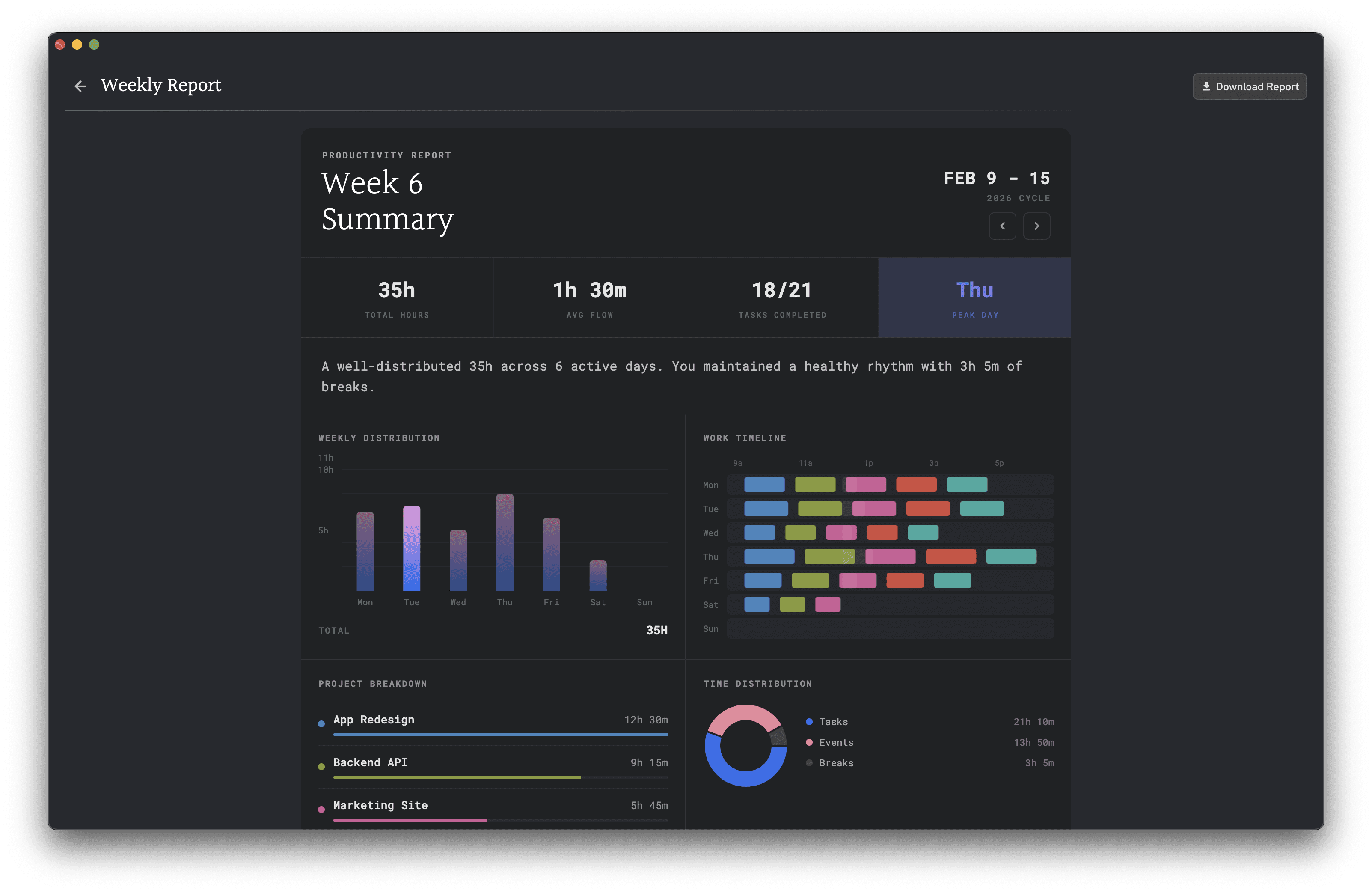
Every task has a duration field you set when planning it. The work timeline in the weekly report shows how long tasks actually took by displaying completed blocks against the calendar. Over time the gap between your planned durations and your actual completion times becomes visible, which is the external correction mechanism the research identifies as more effective than estimating more carefully.
How To Start Tomorrow
This week, before starting any significant task, write down how long you think it will take. When you finish, write how long it actually took. Do this for every task for five days. Don't try to improve your estimates - just collect the data. By Friday you'll have a clear picture of your personal estimation bias and in which direction it runs most strongly.
Related Principles
Planning Fallacy - the most studied form of time estimation bias
Parkinson's Law - overestimation creates slack that Parkinson's Law fills
Time Blocking - accurate time estimation is essential for effective blocking
Self-Monitoring - tracking actual durations is a form of self-monitoring that improves estimates
Related Reading
Best Time Blocking Apps — Time blocking surfaces estimation errors fast — you can't deceive yourself when it's on the calendar.
Best AI Time Audit Tools — Tools that track actual time spent so the gap between estimate and reality becomes data.
Best AI Daily Planning Tools — AI planners that build in buffer time automatically rather than letting optimism fill the schedule.
Frequently Asked Questions
What is time estimation bias?
Time estimation bias is the systematic tendency to underestimate how long tasks will take, closely related to the planning fallacy. Research finds people underestimate task duration by 25–50% on average, even on tasks they have completed many times before. The bias persists because estimates are generated from a best-case mental simulation of the task rather than from historical base rates of similar tasks.
Why do experts and experienced people still underestimate?
Experience improves absolute skill but does not reliably correct estimation bias, because the inside view that generates the estimate does not automatically incorporate historical data. An experienced developer still imagines the clean version of the task rather than the version with its typical complications. The reference class of 'how long this type of task usually takes' requires deliberate effort to consult.
What's the most effective way to improve time estimates?
Reference class forecasting is the most evidence-supported approach: rather than estimating from the plan, look at how long similar tasks have actually taken and use that distribution. Keeping a log of planned versus actual duration over several weeks creates a personal reference class that is more accurate than intuition. Adding a 25–50% buffer to initial estimates is a practical heuristic for those without historical data.
Is time estimation bias the same as the planning fallacy?
They describe closely related phenomena. The planning fallacy, named by Kahneman and Tversky, specifically refers to underestimating time, cost, and risk for future projects while knowing that similar past projects ran over. Time estimation bias is the broader pattern of systematic underestimation in task duration estimates. The planning fallacy is a specific, well-studied instance of time estimation bias applied to project planning.
Further Reading
Buehler, R., Griffin, D., & Ross, M. (1994). Exploring the planning fallacy: Why people underestimate their task completion times. Journal of Personality and Social Psychology, 67(3), 366-381. DOI: 10.1037/0022-3514.67.3.366
Roy, M. M., Christenfeld, N. J. S., & McKenzie, C. R. M. (2005). Underestimating the duration of future events: Memory incorrectly used or memory bias? Psychological Bulletin, 131(5), 738-756. DOI: 10.1037/0033-2909.131.5.738