The Principle
You have all morning to write the brief. By lunchtime, you've written it - but it took the whole morning, even though if you'd been given 90 minutes you'd probably have written it in 90 minutes. The work didn't require the full morning. It just expanded to fill it, and you didn't notice because being busy with something feels like working on something.
Parkinson's Law - that work expands to fill the time available - was originally a satirical observation about bureaucracy but has since been supported by experimental evidence. When people are given more time than a task requires, they use it: the pace slows, tangents get explored, revisions multiply. The time block boundary itself acts as an implicit goal. Tighter (but realistic) blocks don't just create urgency - they create a stopping point that prevents the natural drift of open-ended time.

Definition
If you give yourself all day to write an email, it'll take all day. Parkinson's Law describes the tendency for work to expand to fill whatever time is allocated to it. Setting slightly tight (but realistic) deadlines can counteract this drift.
What The Research Shows
Bryan & Locke (1967) showed subjects given 2× the needed time used more of it, and the effect was mediated by goal-setting - different time limits produce different implicit goals.
Aronson & Landy (1967) found subjects given 15 minutes for a 5-minute task took significantly longer than those given 5 minutes.
Brannon, Hershberger & Brock (1999) provided the most methodologically rigorous test across four replications: when participants learned a fourth task was cancelled, they significantly prolonged work on the third task. Limitation: only 3 small experiments from 1967-1999; no large-scale RCT or meta-analysis exists.
Ariely & Wertenbroch (2002) found externally imposed, evenly spaced deadlines produced the best performance, though a 2025 replication found negligible effects.

What This Means
When people are given more time than a task requires, they use it - the pace slows and the work expands to fill the available slot. Tighter but realistic blocks focus effort by creating a stopping point that open-ended time does not provide.
What Most People Get Wrong
Parkinson's Law is sometimes taken to mean that deadlines should be as tight as possible.
The research does not support aggressive deadline setting as a universal strategy. Realistic but bounded time blocks focus effort by providing a stopping point. Unrealistically tight deadlines increase stress and can reduce quality. The useful insight is that open-ended time is not an efficient resource, not that pressure is inherently productive.
When it Fails…
Too-tight deadlines backfire. Unrealistically short blocks increase stress and can reduce quality - the goal is accurate constraints, not pressure.
Anxiety disorders interact badly with countdown timers. Visible time pressure can be activating rather than focusing for some users.
The evidence base is thin. Only a handful of small studies from the 1960s and 1990s directly test the effect - it is plausible but under-researched.
What This Means For You…
The practical implication is not to give yourself artificially tight deadlines that create stress and reduce quality - that's a different problem. It's to avoid giving tasks unlimited time. When you block 45 minutes for a task that might genuinely take 45 minutes, the block boundary does useful work: it creates a soft constraint that focuses effort and prevents the diffuse, slightly unproductive work that fills open-ended sessions. The goal is accurate blocks, not pressurising ones. Accurate blocks happen when you correct for the planning fallacy - which means adding time, not subtracting it.
How Aftertone Implements It.
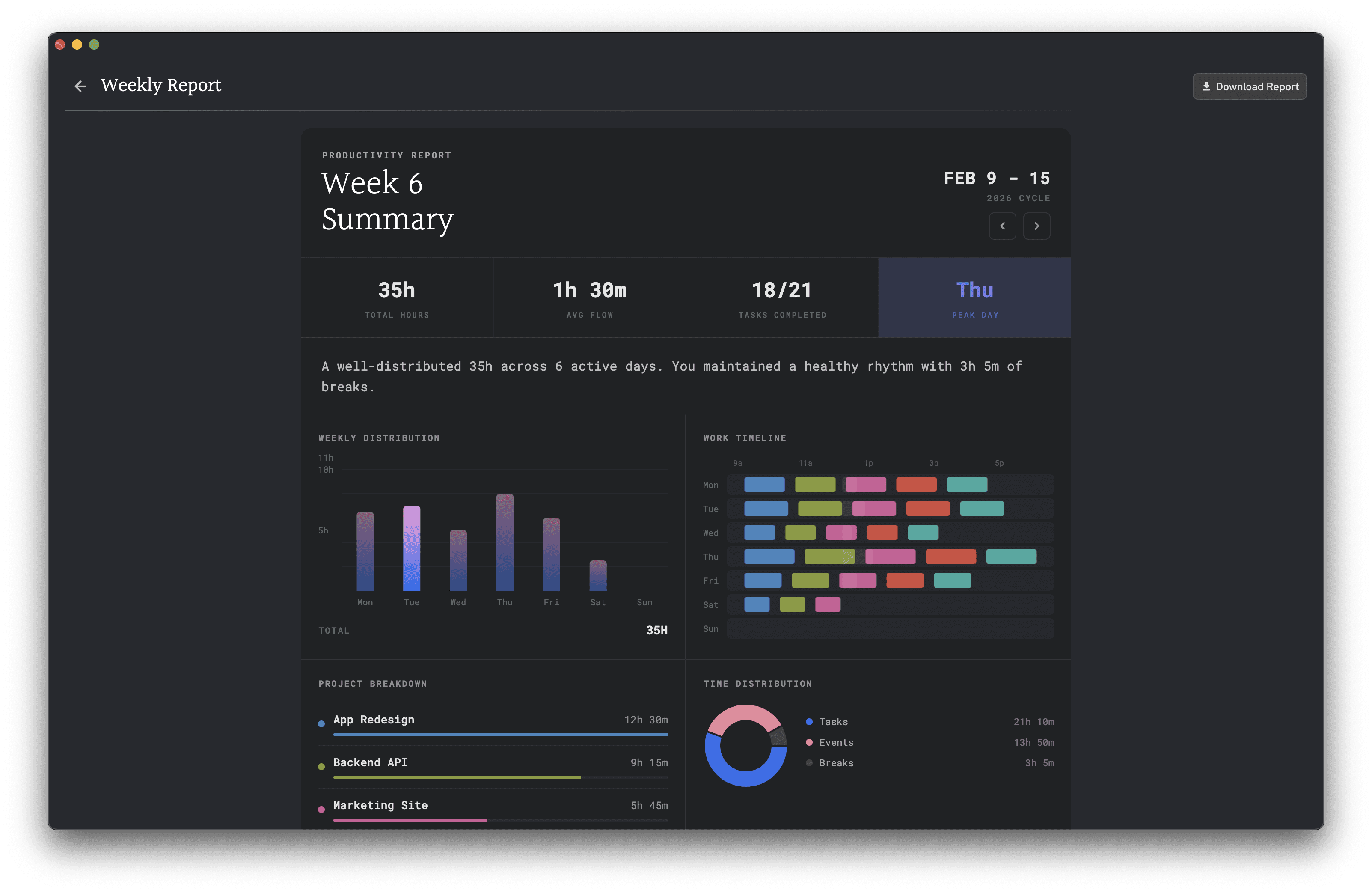
Every task in Aftertone has a time block with a defined end. When the block ends in Focus Mode, you see an overdue tag and can choose to extend, complete, or add more time - from the focus screen without going back to the calendar. The block boundary is a real structural constraint rather than a mental note.
How To Start Tomorrow
Pick a task you've been letting sprawl across large blocks of open time. Estimate how long it would take if you genuinely focused. Set a timer for that duration. Work on only that task until the timer ends. Notice whether the output at the end of the focused block is meaningfully worse than what you'd produce in an open-ended session - for most tasks, it isn't.
Related Principles
Planning Fallacy - the planning fallacy leads to underestimation; Parkinson's Law leads to overuse of available time
Time Blocking - blocks naturally create Parkinson's Law boundaries
Goal Setting Side Effects - aggressive time constraints can trigger goal-setting side effects
Overplanning - over-detailed time allocation can trigger both Parkinson's Law and overplanning paralysis
Related Reading
Best Time Blocking Apps — Time boxing is the structural antidote to Parkinson's Law — these are the tools that apply it.
Best Deep Work Scheduling Apps — Scheduling tools that set fixed windows for tasks rather than leaving them open-ended.
Best Productivity Systems for High Performers — High-performer systems that use constraints deliberately to drive output.
Frequently Asked Questions
What is Parkinson's Law?
Parkinson's Law states that work expands to fill the time available for its completion. Originally articulated by Cyril Northcote Parkinson in a 1955 Economist essay as a satirical observation about bureaucracy, it has been found to describe a genuine psychological phenomenon: when more time is available for a task, people spend more of it — not necessarily productively — until the deadline arrives.
Why does work expand to fill available time?
Several mechanisms contribute. Without a binding constraint, tasks tend to be refined, revisited, and over-elaborated beyond the point of meaningful improvement. The absence of urgency removes the psychological pressure that forces prioritisation within a session. Parkinson also noted that bureaucratic work specifically generates its own complexity — more time produces more meetings, more checking, more process — a dynamic that applies in some form to knowledge work as well.
How can you use Parkinson's Law to your advantage?
By deliberately constraining the time available for tasks. Setting shorter deadlines — even artificial ones — activates focus by creating a binding constraint that forces prioritisation within the session. Time boxing tasks to a fixed duration rather than working until done produces this effect. The mere urgency effect research confirms that time constraints shift attention toward task completion in ways that open-ended sessions do not.
Does Parkinson's Law apply to all types of work?
It applies most strongly to work with flexible scope — tasks that can be done at varying levels of elaboration. Writing, analysis, and planning are all susceptible. It applies less to tasks with fixed, discrete outputs — either the bug is fixed or it is not, either the package has shipped or it has not. Creative and cognitive knowledge work, with its inherently expandable scope, is the domain where Parkinson's Law bites hardest.
Further Reading
Brannon, L. A., Hershberger, P. J., & Brock, T. C. (1999). Timeless demonstrations of Parkinson's first law. Psychonomic Bulletin and Review, 6(1), 148-156. DOI: 10.3758/BF03210823
Ariely, D., & Wertenbroch, K. (2002). Procrastination, deadlines, and performance: Self-control by precommitment. Psychological Science, 13(3), 219-224. DOI: 10.1111/1467-9280.00441