The Principle
You start using a planning system to get more done. After a few months, you notice something unexpected: you're not necessarily producing dramatically more, but you feel significantly better. Less scattered. More in control. The anxiety that used to follow you through the day - the low-grade awareness of everything you might be forgetting - has quietened. You didn't optimise your output. You changed your relationship with your time.
A large meta-analysis by Aeon, Faber and Panaccio across 158 studies found that time management has a moderate positive relationship with job performance, but a substantially stronger relationship with life satisfaction and reduced stress. The wellbeing effect is nearly twice the size of the performance effect. This reframes what planning tools should actually optimise for: not maximum output, but a sustainable sense of control that makes work feel manageable rather than overwhelming.

Definition
Here's a counterintuitive finding: the biggest benefit of time management isn't getting more done - it's feeling better. The wellbeing effects (reduced stress, higher life satisfaction) are substantially larger than the performance effects. This reframes what productivity tools should optimize for.
What The Research Shows
Aeon, Faber & Panaccio (2021) meta-analyzed 158 studies (N = 53,957) and found time management correlates with job performance at r = .25 but with life satisfaction at r = .43 and wellbeing at r = .31. The wellbeing relationship is nearly twice as strong as the performance relationship. This suggests time management works primarily by increasing perceived control and reducing stress, with performance gains as a secondary benefit. Limitation: mostly correlational designs; high heterogeneity across studies.

What This Means
Time management has a moderate positive relationship with job performance but a substantially stronger relationship with life satisfaction and reduced stress. The wellbeing benefit is nearly twice the size of the performance benefit - the primary gift of good time management is felt control, not output.
What Most People Get Wrong
Time management is almost always framed as a performance tool, a way to get more done.
The largest meta-analysis on the topic found that the wellbeing benefits, reduced stress and increased life satisfaction, are substantially larger than the performance benefits. Optimising your planning system purely for output is optimising for the smaller of the two main benefits.
When it Fails…
Conscientiousness moderates the effect. People lower in conscientiousness may struggle to adopt time management behaviours regardless of the tool or system.
The evidence is mostly correlational. Better wellbeing and better time management may both be caused by a third factor like personality, rather than one causing the other.
Already well-organised people see smaller gains. The marginal benefit of a new system diminishes when someone already has a functional approach.
What This Means For You…
If you've been measuring your planning system by how much more you produce, you may be optimising for the wrong thing. The research suggests the primary gift of good time management is not output but felt control - the experience of knowing what you're doing and why, of not carrying a constant background anxiety about what's being missed. That feeling is worth pursuing independently of productivity gains, and it's more achievable. You don't need to get dramatically more done. You need to feel like the things that matter are being handled.
How Aftertone Implements It.
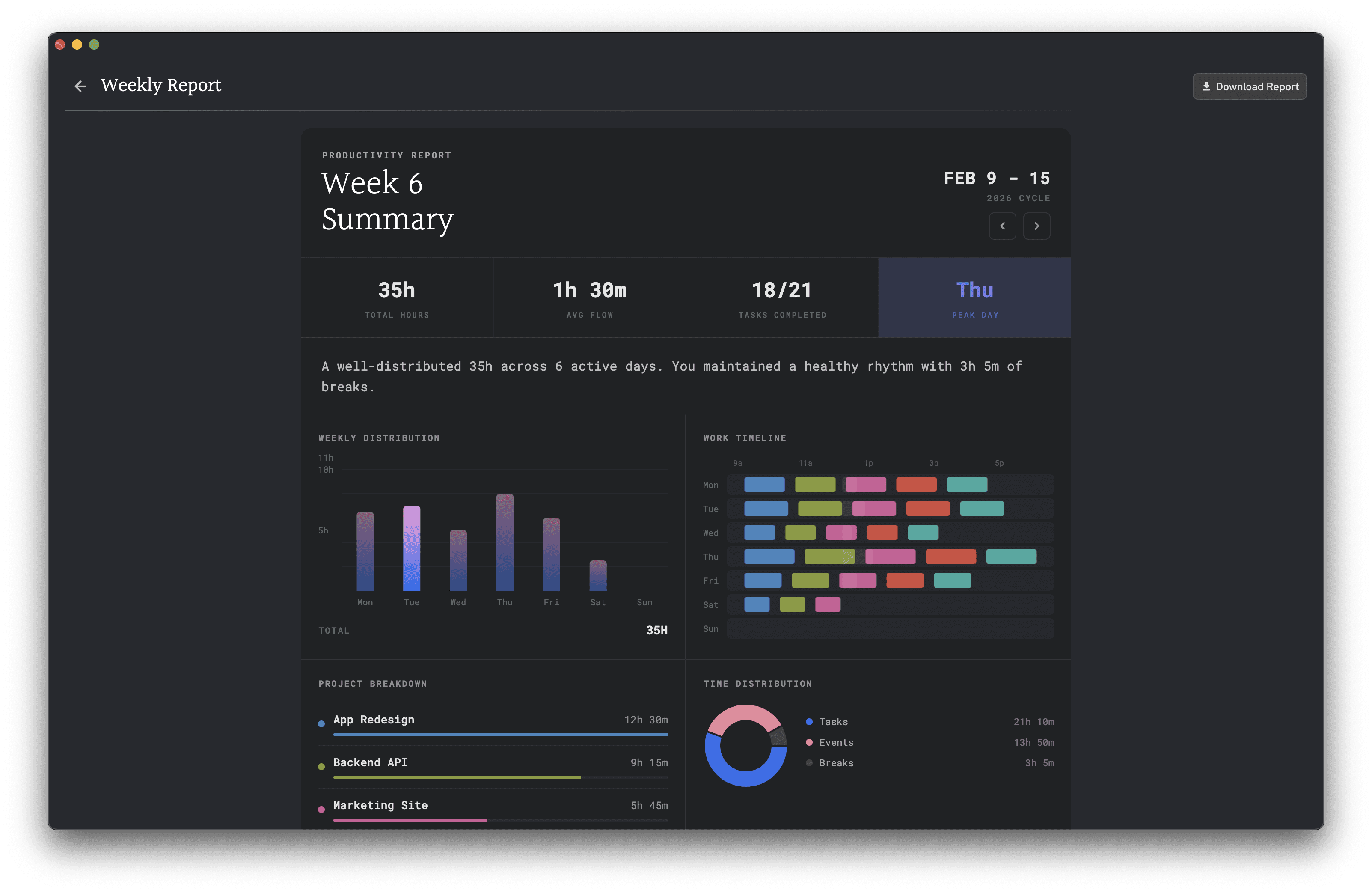
The weekly report shows flow sessions and the work timeline - what actually happened - rather than a productivity score. The structure of Aftertone is built around the planning view, focus mode, and weekly review: three distinct modes that separate planning, execution, and reflection rather than collapsing them into a continuous task list that never closes.
How To Start Tomorrow
At the end of each day this week, rate two things on a scale of 1 to 10: how much you accomplished, and how in-control you felt. After five days, compare the two columns. Most people find the control score is more closely tied to their overall sense of a good day than the output score. That's what you're actually managing when you manage your time.
Related Principles
Recovery and Detachment - wellbeing requires active recovery, not just efficient work
Autonomy and Intrinsic Motivation - perceived control (a wellbeing driver) requires autonomy
Goal Setting Side Effects - optimizing for pure output can undermine wellbeing
Overplanning - the wellbeing benefit disappears if time management becomes another source of stress
Related Reading
Best Productivity Systems for High Performers — Systems that measure output quality, not hours — the distinction this research supports.
Best AI Time Audit Tools — Tools that surface how your time actually maps to output, not just how much of it you used.
Best Productivity Apps for Solopreneurs — For solopreneurs, sustainable output beats maximum output every time — these apps reflect that.
Frequently Asked Questions
Does time management actually improve wellbeing?
Yes — and more reliably than it improves job performance. Claessens et al.'s meta-analysis found a stronger relationship between time management and life satisfaction (r = 0.43) than between time management and job performance (r = 0.22). The wellbeing benefits come from reduced stress, greater sense of control, and the experience of completing what matters rather than just being busy.
Why does time management improve wellbeing more than performance?
Performance is constrained by many factors outside an individual's control — task complexity, resources, collaboration, organisational systems. Wellbeing is more directly affected by the subjective experience of time: whether you feel in control, whether you finish what you set out to do, and whether you have meaningful rest. Time management interventions have more direct purchase on these subjective experiences than on objective output metrics.
Can poor time management harm health?
Chronically poor time management — persistently feeling overwhelmed, unable to complete planned work, and lacking recovery time — is associated with higher stress, worse sleep quality, and lower life satisfaction in the research. The mechanism is partly cognitive (ongoing open loops and unfinished tasks generate mental noise) and partly physiological (chronic time pressure activates stress responses that have health costs over time).
Does working longer hours compensate for poor time management?
Rarely. Research on working hours consistently finds diminishing returns above around 50 hours per week, with cognitive performance and output quality declining with extended hours. Poor time management that produces overwork creates a compounding problem: more hours with less efficiency, more fatigue, and less recovery — each of which further degrades the performance that longer hours were intended to produce.
Further Reading
Aeon, B., Faber, A., & Panaccio, A. (2021). Does time management work? A meta-analysis. PLOS ONE, 16(1), e0245066. DOI: 10.1371/journal.pone.0245066