The Principle
The task is important, so you want to do it well. Because you want to do it well, the stakes feel high. Because the stakes feel high, starting feels risky - what if the output isn't good enough? So you don't start, or you start and stop, or you do peripheral work around the task while the task itself sits untouched. The perfectionism that was meant to drive quality has become the reason nothing gets done.
Research by Sirois, Molnar and Hirsch across 43 studies found that perfectionistic concerns - specifically the fear of making mistakes and worry about others' evaluation - reliably predict procrastination. The mechanism is emotional: perfectionism generates anxiety about falling short, and avoidance provides short-term relief from that anxiety. Rigid all-or-nothing planning systems can amplify this, because they create conditions where anything less than perfect execution registers as failure.

Definition
If you've ever avoided starting a task because you couldn't do it 'right,' you've experienced the perfectionism-procrastination link. The fear of falling short of impossibly high standards leads to avoidance, and rigid, all-or-nothing planning systems can make this worse.
What The Research Shows
Sirois, Molnar & Hirsch (2017) meta-analyzed 43 studies (N ~ 10,000) and found perfectionistic concerns predict procrastination at r = .23. Socially prescribed perfectionism (feeling others demand perfection from you) was a stronger predictor than self-oriented perfectionism. The relationship is mediated by negative emotions - perfectionism creates anxiety about falling short, which triggers avoidance. This has direct implications for productivity app design: all-or-nothing mechanics (streaks, 100% completion badges) can activate the perfectionism-procrastination cycle in vulnerable users.

What This Means
Perfectionistic concerns - specifically the fear of making mistakes and worry about others' evaluation - reliably predict procrastination across tens of thousands of participants. The mechanism is emotional: perfectionism generates anxiety about falling short, and avoidance provides immediate relief.
What Most People Get Wrong
Perfectionists are often assumed to be highly productive because of their high standards.
Research on how perfectionism actually affects behaviour shows a more complicated picture. Perfectionist strivings can sometimes drive performance. Perfectionist concerns, fear of making mistakes and worry about others's evaluation, reliably predict avoidance. It is the second type, not the first, that most commonly leads to procrastination.
When it Fails…
Not all perfectionism is harmful. Perfectionist strivings - high personal standards - can sometimes drive strong performance. It is perfectionist concerns that reliably predict avoidance.
Anti-perfectionism framing is not for everyone. Users without perfectionist tendencies do not need reassurance about partial completion and may find it patronising.
What This Means For You…
Perfectionism and procrastination feel like opposites - one is about high standards, the other about not doing the work - but the research shows they're closely linked. The same concern that drives perfectionist standards also makes starting feel too risky when conditions aren't ideal. The practical implication is that good-enough is often the highest-leverage standard available: good-enough work done consistently outperforms perfect work that never gets started or finished. Building in explicit permission for imperfect execution - a first draft, a rough version, a placeholder - is not lowering your standards. It's removing the psychological barrier that perfectionism creates.
How Aftertone Implements It.
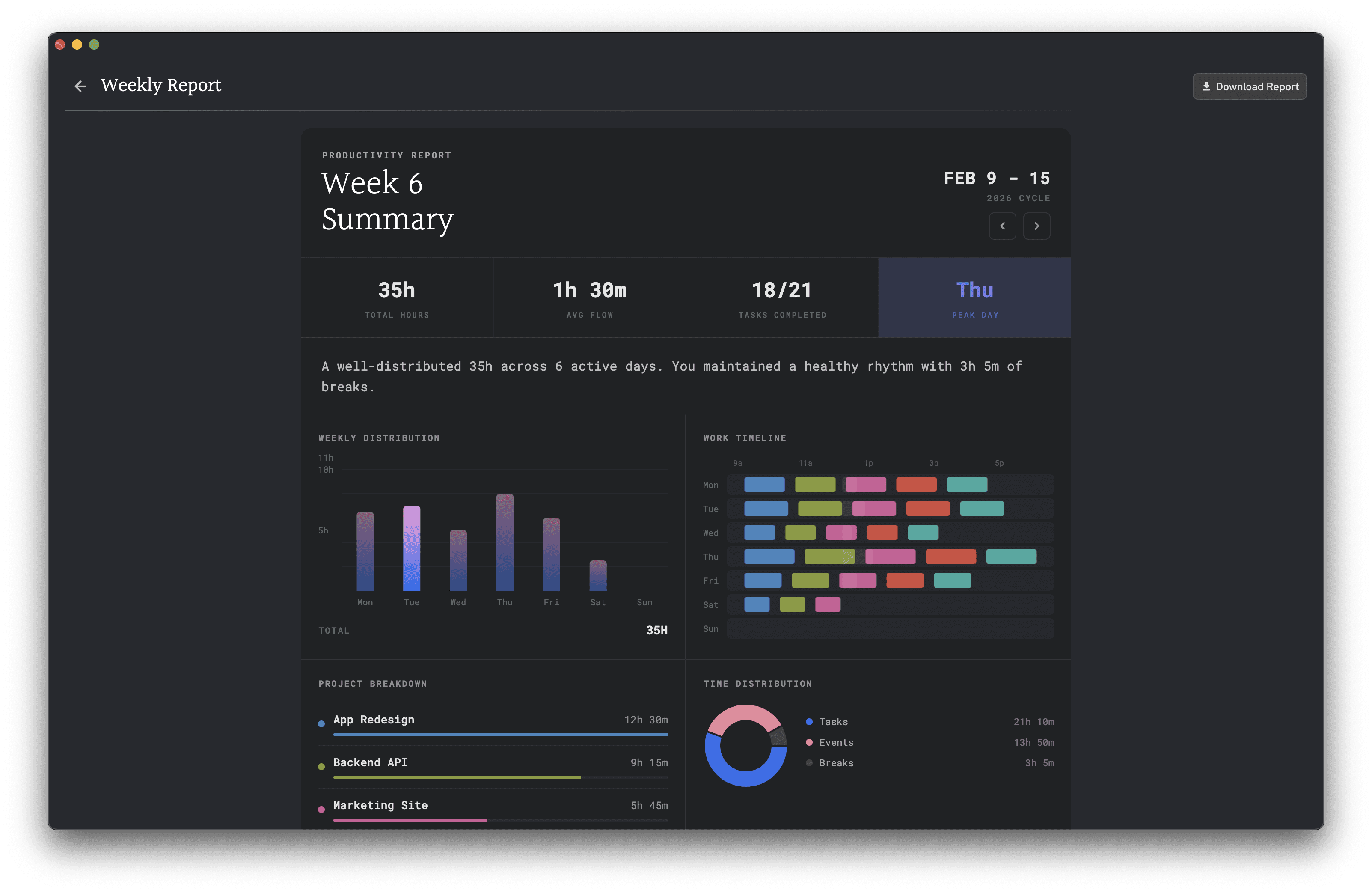
Tasks in Aftertone remain in the inbox as neutral items - they do not accumulate visual pressure or overdue indicators designed to create anxiety. An unfinished task can be replanned with P to a new date at any point. The weekly report shows what was completed; it does not surface what was not completed as a failure metric.
How To Start Tomorrow
Identify a task you've been avoiding that you suspect perfectionism is involved in. Set a timer for 20 minutes and produce the worst acceptable version of it - not good, not polished, just done. At the end of 20 minutes, look at what you produced. For most tasks, the worst acceptable version is closer to the finished product than you expected. The gap between "done badly" and "done well" is usually smaller than the gap between "not started" and "done badly."
Related Principles
Streak Mechanics - broken streaks trigger perfectionism-driven disengagement
Goal Setting Side Effects - aggressive goals activate perfectionistic concerns
ADHD and Rigid Scheduling - ADHD + perfectionism is a particularly challenging combination
Moral Licensing - perfectionism and moral licensing are opposite failure modes of the same system
Related Reading
Best AI Daily Planning Tools — Daily planning tools that make starting the smallest version of a task the default move.
Best Productivity Systems for High Performers — Systems that define done before you start, so perfectionism has a boundary.
Best AI Productivity Apps for ADHD — The perfectionism-procrastination loop is especially common in ADHD — these tools address it directly.
Frequently Asked Questions
Why do perfectionists procrastinate more?
Perfectionism raises the psychological stakes of starting — if the work must be perfect, any imperfect version is a failure. This makes beginning feel riskier, because starting is what makes performance evaluable. Procrastination protects the perfectionist from that evaluation: work that has not been done cannot be judged. The avoidance is emotionally rational even when it is practically self-defeating.
Is perfectionism the same as having high standards?
No — the research distinguishes between healthy pursuit of excellence and maladaptive perfectionism. Having high standards means caring about quality and working to achieve it. Maladaptive perfectionism means equating anything short of perfect with failure, being unable to complete work without anxiety, and letting fear of imperfection prevent starting or finishing. The first is associated with achievement; the second consistently predicts procrastination and burnout.
What types of perfectionism are most linked to procrastination?
Frost et al.'s perfectionism research identifies several dimensions. Concern over mistakes — the tendency to interpret errors as personal failures — is most strongly linked to procrastination. Doubts about actions — persistent uncertainty about whether one has done enough — is also significantly predictive. High personal standards alone, without the concern over mistakes, show a much weaker relationship with procrastination.
How do you break the perfectionism-procrastination cycle?
The most evidence-supported approaches involve separating starting from finishing — making the first draft explicitly imperfect by design — and addressing the underlying evaluation threat through cognitive reframing or, in more entrenched cases, through evidence-based therapy approaches like CBT. Recognising that the avoidance is protecting against evaluation, not protecting quality, shifts the frame in a way that makes starting less psychologically costly.
Further Reading
Sirois, F. M., Molnar, D. S., & Hirsch, J. K. (2017). A meta-analytic and conceptual update on the associations between procrastination and multidimensional perfectionism. European Journal of Personality, 31(2), 137-159. DOI: 10.1002/per.2098