The Principle
You've planned your day every morning for 23 days. Then you miss one. The streak counter resets to zero. Something shifts - not just disappointment, but a specific kind of deflation that makes starting again feel disproportionately hard. The rational part of you knows 23 days of progress hasn't disappeared. The emotional part has already started negotiating reasons to skip tomorrow too.
Streaks are a double-edged tool. Research by Silverman and Barasch found that intact streaks reliably increase subsequent engagement - the consistency itself becomes motivating. But broken streaks trigger disengagement that is disproportionate to the actual setback, particularly in people who tend toward self-blame. The streak doesn't just track behaviour. It creates an all-or-nothing frame around it, and all-or-nothing frames are fragile in exactly the conditions - travel, illness, a difficult week - when you most need your habits to be resilient.

Definition
Maintaining a consecutive streak (e.g., '7 days in a row') can be a powerful motivator. But the research shows a double-edged sword: while active streaks boost persistence, breaking a streak triggers disengagement that's disproportionate to the actual setback - especially for people who blame themselves.
What The Research Shows
Silverman & Barasch (2023) conducted seven studies showing intact streaks increase subsequent engagement, but broken streaks cause disengagement independent of actual past behavior - amplified when consumers blame themselves for the break.
Silverman, Barasch & Small (2023) found across nine preregistered studies that streaks increase perceived commitment and predicted persistence, but can also reduce perceived need for external support (overconfidence risk). Mehr et al. (2025) demonstrated across six preregistered studies (N = 4,493) that streak incentives outperformed larger stable incentives for persistence. This is a rapidly developing literature (2023-2025).

What This Means
Active streaks reliably increase engagement, but broken streaks trigger disengagement that is disproportionate to the actual setback. The psychological response to a broken streak has more to do with all-or-nothing thinking than with the real impact of one missed day.
What Most People Get Wrong
Streaks feel like pure motivation.
The risk is the asymmetry between how streaks build and how they collapse. Building a streak creates gradual positive reinforcement. Breaking one often triggers disproportionate disengagement, particularly in people who tend toward all-or-nothing thinking. A streak mechanic that works well for most days can become the reason someone abandons a habit entirely after one imperfect week.
When it Fails…
Perfectionist users are most at risk. People with all-or-nothing thinking are most likely to experience disproportionate disengagement after a broken streak.
Shifts motivation from intrinsic to extrinsic. Over time, streaks can replace genuine interest in the behaviour with a drive not to break the count - which is more fragile.
What This Means For You…
Whether streaks help or hurt depends heavily on your psychological relationship with them. For some people they're genuinely motivating - the consistency becomes a source of identity and momentum. For others, particularly those with perfectionist tendencies, a broken streak doesn't just end a run - it becomes a reason to abandon the behaviour entirely. The research suggests that consistency metrics framed as percentages ("you've planned 11 of the last 14 days") are more resilient than consecutive counts, because they survive an imperfect day without resetting to zero. Progress is better measured as a pattern than a chain.
How Aftertone Implements It.
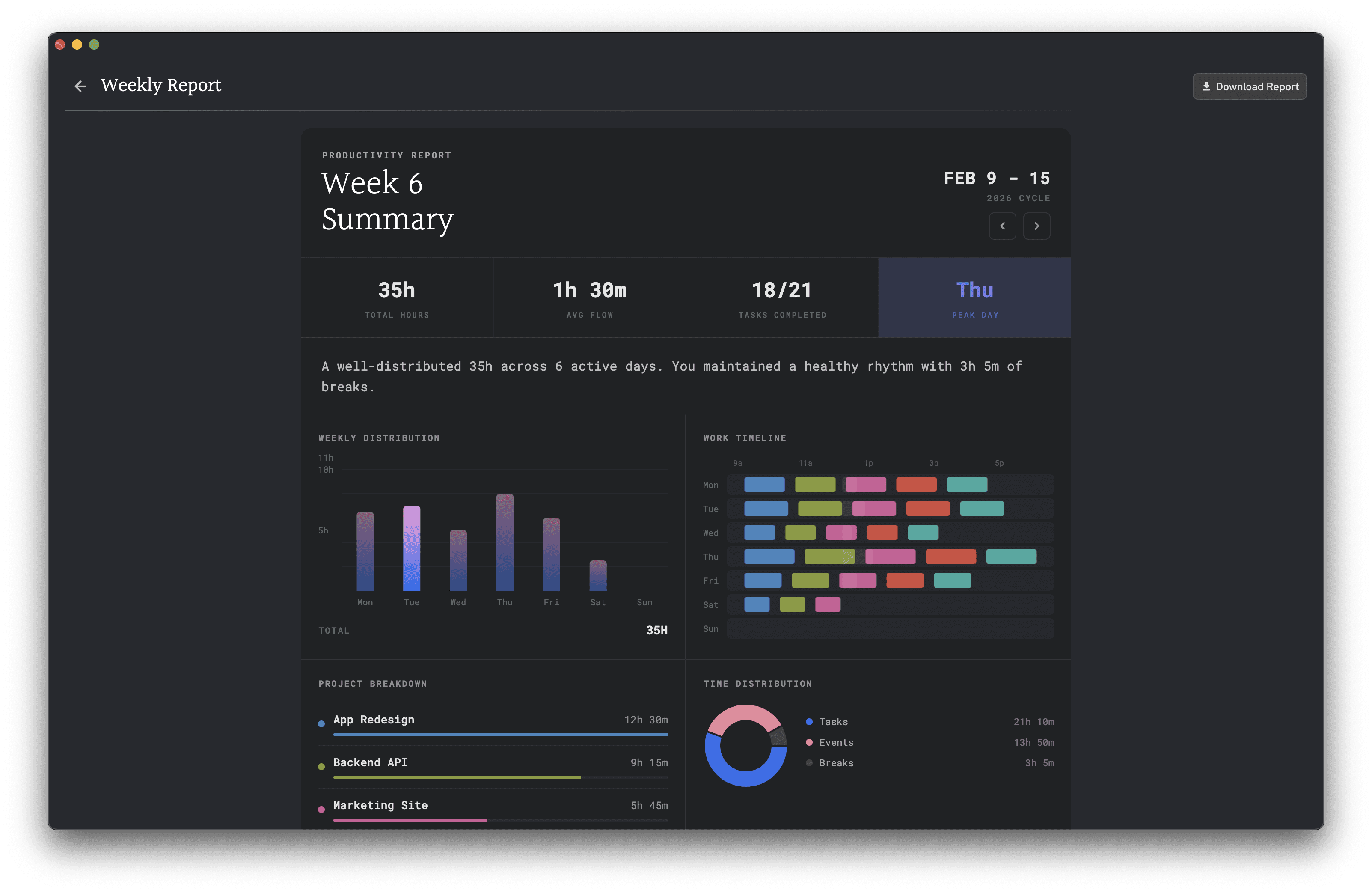
The streak in the weekly report counts days with at least one completed task. It sits alongside flow sessions, peak day, and the work timeline - so it is one data point among several rather than the primary measure of success. The work timeline is usually the more revealing view: you can see full days of activity versus days where nothing completed, which gives richer context than a consecutive count.
How To Start Tomorrow
If you currently track a daily habit with a streak counter, try switching to a percentage for two weeks - count how many days out of the last 14 you performed the habit. Notice whether a missed day feels different when it's "13 out of 14" versus "streak broken: start over." The information is the same. The psychological effect is not.
Related Principles
Habit Formation - streaks support the repetition phase but can undermine long-term intrinsic motivation
Perfectionism-Procrastination Link - broken streaks trigger perfectionism-driven avoidance
Gamification Risks - streaks are a form of gamification with documented backfire potential
Autonomy and Intrinsic Motivation - rigid streaks shift motivation from intrinsic to extrinsic
Related Reading
Best Habit Tracking Apps — High-performer habit trackers that use streaks without making them the whole point.
Best Streaks App Alternatives — Alternatives to Streaks that offer streak mechanics with more flexibility.
Best Habitify Alternatives — Apps that track consistency without punishing the occasional miss.
Frequently Asked Questions
What are streak mechanics in habit tracking?
Streak mechanics are features that track and display consecutive days of completing a behaviour, typically with a visual counter or flame icon. They create a form of loss aversion — the longer the streak, the more painful it becomes to break — which can motivate consistency in the short to medium term.
Do streaks actually improve habit consistency?
They can in the short term. The psychological cost of breaking a streak creates a motivation to maintain it, and that motivation is real. However, the research also shows that streak mechanics can undermine intrinsic motivation over time — when the streak becomes the goal, the underlying behaviour becomes contingent on the external reward rather than intrinsically valued.
What are the risks of using streaks to track habits?
The main risks are perfectionism and all-or-nothing thinking. When missing a day feels catastrophic because it resets the streak, people often abandon the habit entirely after a single miss rather than continuing. Streaks can also shift motivation from intrinsic (I value this behaviour) to extrinsic (I need to maintain the number), which is more fragile when the streak is eventually broken.
Are there better alternatives to streaks for habit tracking?
Research suggests that tracking consistency rates (percentage of days completed over a rolling period) is more resilient than streak counts. A 90% consistency rate over a month is a more accurate and less fragile representation of habit strength than a streak counter that resets on day 31. Progress-based tracking that celebrates overall pattern rather than perfect continuity tends to produce better long-term outcomes.
Further Reading
Silverman, J., & Barasch, A. (2023). On or off track: How (broken) streaks affect consumer decisions. Journal of Consumer Research, 49(6), 1089-1108. DOI: 10.1093/jcr/ucad002
Mehr, K. S., et al. (2025). Streak incentives increase persistence in goal pursuit. Psychological Science. DOI: 10.1177/09567976241299329