The Principle
You use a productivity system someone else designed. It has rules, required steps, a specific way of doing things. At first it feels structured and reassuring. After a few weeks, it starts to feel like a chore. You begin resenting the system itself - not because it's poorly designed, but because following someone else's rules for your own work creates a kind of quiet friction that slowly drains the motivation it was supposed to support.
Self-Determination Theory, developed by Deci and Ryan, identifies three psychological needs that sustain motivation: autonomy (feeling like your actions are your own choice), competence (feeling capable of what you're attempting), and relatedness (feeling connected to something meaningful). Of these, autonomy is the most powerful predictor of sustained motivation and wellbeing at work. Systems that tell you exactly what to do and when erode it. Systems that support your own choices amplify it.

Definition
Self-Determination Theory says we're most motivated when we feel autonomous (choosing what and how), competent (capable of succeeding), and connected to others. Of these, autonomy and intrinsic interest are the strongest predictors of sustained effort and wellbeing at work.
What The Research Shows
Van den Broeck et al. (2021) meta-analyzed 124 samples and found intrinsic motivation is the strongest predictor of employee well-being, while identified regulation (valuing the task) is strongest for performance.
Slemp et al. (2018) meta-analyzed 72 studies (N = 32,870) showing leader autonomy support strongly predicts autonomous motivation and well-being. Cross-sectional designs predominate, which limits causal claims. The findings are consistent across cultures and job types.

What This Means
Intrinsic motivation - doing something because it is genuinely interesting or meaningful - is a stronger and more durable predictor of sustained effort than any external reward. Systems that feel like obligations rather than choices gradually erode the motivation they are supposed to support.
What Most People Get Wrong
The standard productivity framing emphasises discipline and willpower as the path to sustained effort.
The research on motivation finds that systems and environments which support autonomy, the feeling that your actions are genuinely your own choice, produce more durable engagement than those that apply external pressure. Willpower is finite and depletable. Intrinsic motivation is not.
When it Fails…
Complete beginners may need more structure. Autonomy is most beneficial once someone has sufficient competence to make good choices - early learners sometimes benefit from more guidance.
Some people prefer prescriptive systems. During high-stress periods or life transitions, autonomy-supportive design can feel less reassuring than being told what to do.
Cross-cultural variation exists. Autonomy support is strongly beneficial in most contexts studied, but the effect varies across cultural backgrounds.
What This Means For You…
The best productivity system is not the most sophisticated one. It's the one you actually use - and you're most likely to use one that feels like yours. This means the features, defaults, and framing of a tool matter as much as its functionality. A tool that presents every feature as a requirement, uses guilt-based language about missed tasks, or optimises for engagement over your wellbeing will gradually undermine the motivation it was supposed to support. You should be able to use any planning system in a way that reflects how you actually work - not in a way that makes you feel like you're failing the system.
How Aftertone Implements It.
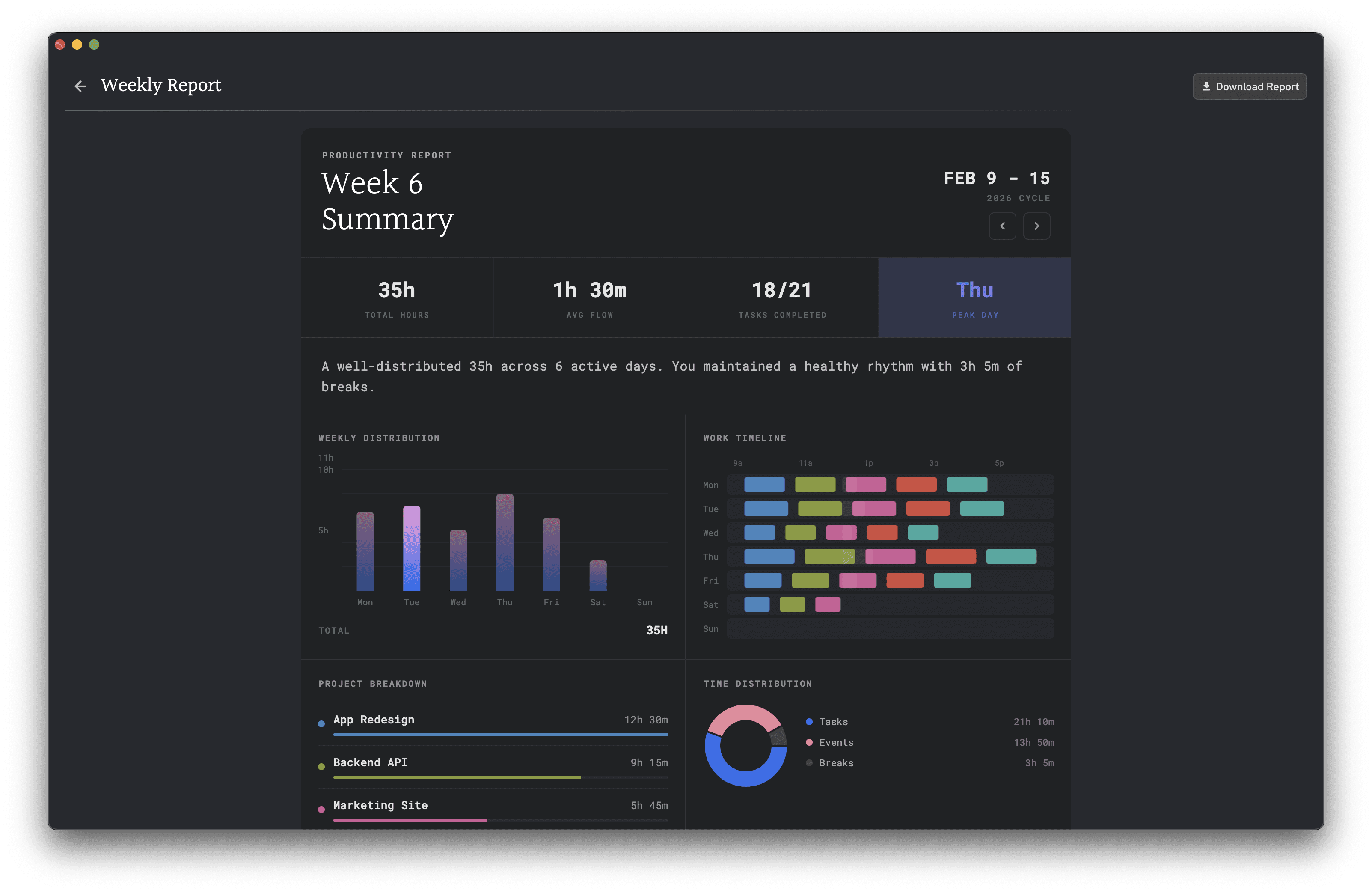
Every feature in Aftertone is optional. You choose your block durations, whether to use projects and tags, whether to use the Planning View or just the Calendar, whether to run weekly reviews. The keyboard-first design means the friction of using the app is low - you are not navigating menus to do basic things. The default view opens on today's calendar, not a backlog, so the first thing you see is forward-looking.
How To Start Tomorrow
Look at whatever planning system or tool you currently use. Identify one rule or feature that feels like an obligation rather than a choice - something you do because the system expects it, not because it genuinely helps you. Remove it or skip it for two weeks. Notice whether your relationship with the rest of the system improves when you're using it on your own terms.
Related Principles
Gamification Risks - extrinsic rewards can undermine intrinsic motivation
Goal Setting Side Effects - overprescribed goals reduce autonomy and intrinsic motivation
Streak Mechanics - rigid streaks shift motivation from intrinsic to extrinsic
Recovery and Detachment - autonomy over recovery is essential for sustainable performance
Related Reading
Best Productivity Apps for Founders — Founders operate with high autonomy — these apps are built for people who structure their own day.
Best Productivity Apps for Solopreneurs — Solopreneurs need tools that support self-directed work without imposing rigid systems.
Best Productivity Systems for High Performers — Productivity systems for people who care about doing meaningful work, not just more of it.
Frequently Asked Questions
What is Self-Determination Theory?
Self-Determination Theory (SDT) is a framework developed by Deci and Ryan that identifies three universal psychological needs: autonomy (feeling in control of your choices and actions), competence (feeling effective and capable), and relatedness (feeling connected to others). When these needs are met, intrinsic motivation — doing something because it is inherently interesting or meaningful — is most likely to flourish.
Why is autonomy the most important motivator according to SDT?
SDT research consistently finds autonomy to be the strongest predictor of intrinsic motivation and sustained engagement. When people feel they have genuine choice over how they work — not just what they do, but how they do it — they invest more, persist longer, and report higher wellbeing. Controlling environments, even with good intentions, undermine this and shift motivation from internal to external.
What's the difference between intrinsic and extrinsic motivation?
Intrinsic motivation comes from within — doing something because it is interesting, meaningful, or personally valued. Extrinsic motivation comes from external factors — rewards, pressure, deadlines, evaluation. SDT research shows that introducing external rewards for intrinsically motivated tasks can actually reduce intrinsic motivation, a phenomenon known as the overjustification effect.
How does autonomy affect knowledge workers specifically?
Knowledge work is particularly autonomy-sensitive because it requires sustained creative and cognitive engagement that cannot be compelled. Research consistently shows that knowledge workers given discretion over when, where, and how they work outperform those in more controlled environments on both output quality and wellbeing measures. Micromanagement is not just unpleasant — it is structurally counterproductive for this type of work.
Further Reading
Van den Broeck, A., et al. (2021). Beyond intrinsic and extrinsic motivation: A meta-analysis on self-determination theory. Organizational Psychology Review, 11(3), 240-273. DOI: 10.1177/20413866211006173
Slemp, G. R., et al. (2018). Leader autonomy support in the workplace: A meta-analytic review. Motivation and Emotion, 42(5), 706-724. DOI: 10.1007/s11031-018-9698-y
