The Principle
The app gives you points for completing tasks. You find yourself doing easier tasks first - not because they're more important, but because they're quicker to complete and each completion adds to the count. The satisfaction of the number going up has quietly become the motivation, and the motivation has quietly decoupled from the work that actually matters.
A landmark meta-analysis by Deci, Koestner and Ryan across 128 studies found that tangible, expected rewards undermine intrinsic motivation - the genuine interest and satisfaction that sustains effort over time. The effect is consistent and meaningful. When you introduce external rewards for a behaviour, you shift the perceived reason for doing it from "because it's interesting and meaningful" to "because I get something for it." Remove the reward, and the motivation often goes with it. Points, badges, and leaderboards are not neutral features. They change the relationship between you and your work.

Definition
Gamification elements like streaks, badges, and leaderboards can make apps feel fun and engaging - at first. But research consistently shows that tangible, expected rewards can actually undermine your natural motivation to do the task for its own sake, turning an activity you enjoyed into a chore you do for points.
What The Research Shows
Deci, Koestner & Ryan (1999) meta-analyzed 128 studies and found tangible, expected rewards undermine intrinsic motivation at d = -0.28 to -0.40 depending on contingency type, while positive verbal feedback enhanced motivation at d = 0.33.
Lepper, Greene & Nisbett (1973) showed children who expected rewards spent ~50% less time drawing in subsequent free play - the landmark overjustification study.
Hanus & Fox (2015) found in a 16-week longitudinal study that gamified courses produced less motivation, less satisfaction, and lower final exam scores than non-gamified courses.
Sailer & Homner (2020) meta-analysis found effects are real but small (g = 0.25-0.49) and unstable for motivation in rigorous studies.

What This Means
Tangible, expected rewards reduce intrinsic motivation by shifting the perceived reason for doing something from genuine interest to external incentive. When the reward is removed, the motivation often goes with it.
What Most People Get Wrong
Gamification is presented as a straightforward engagement booster.
The research on intrinsic motivation finds that it works in the short term but produces systematic costs over time. When external rewards become the reason for doing something, the intrinsic interest in that thing declines. Remove the rewards and the motivation often goes with them. Apps optimised for engagement are not always optimised for the user's actual goals.
When it Fails…
Informational feedback does not carry the same risk. Showing progress without evaluative judgment - "you completed 4 of 5 blocks" - does not undermine intrinsic motivation.
The effect is strongest for expected, tangible rewards. Unexpected rewards and verbal feedback can actually enhance motivation - the type of reward matters.
Some users are genuinely motivated by gamification. Individual differences are real - for some people, streaks and badges are effective without causing the documented downsides.
What This Means For You…
The most durable motivation is intrinsic - caring about the work for its own sake, or for its connection to something that matters to you. Gamification substitutes an external reward loop for that intrinsic connection, and in doing so gradually erodes it. The apps that keep you most engaged are not necessarily the ones helping you do your best work - they're the ones that have most successfully replaced your intrinsic motivation with an external one that keeps you coming back. Informational feedback ("you completed 4 of 5 priorities today") is different from evaluative reward ("you earned a gold star") - the former supports awareness, the latter replaces motivation.
How Aftertone Implements It.
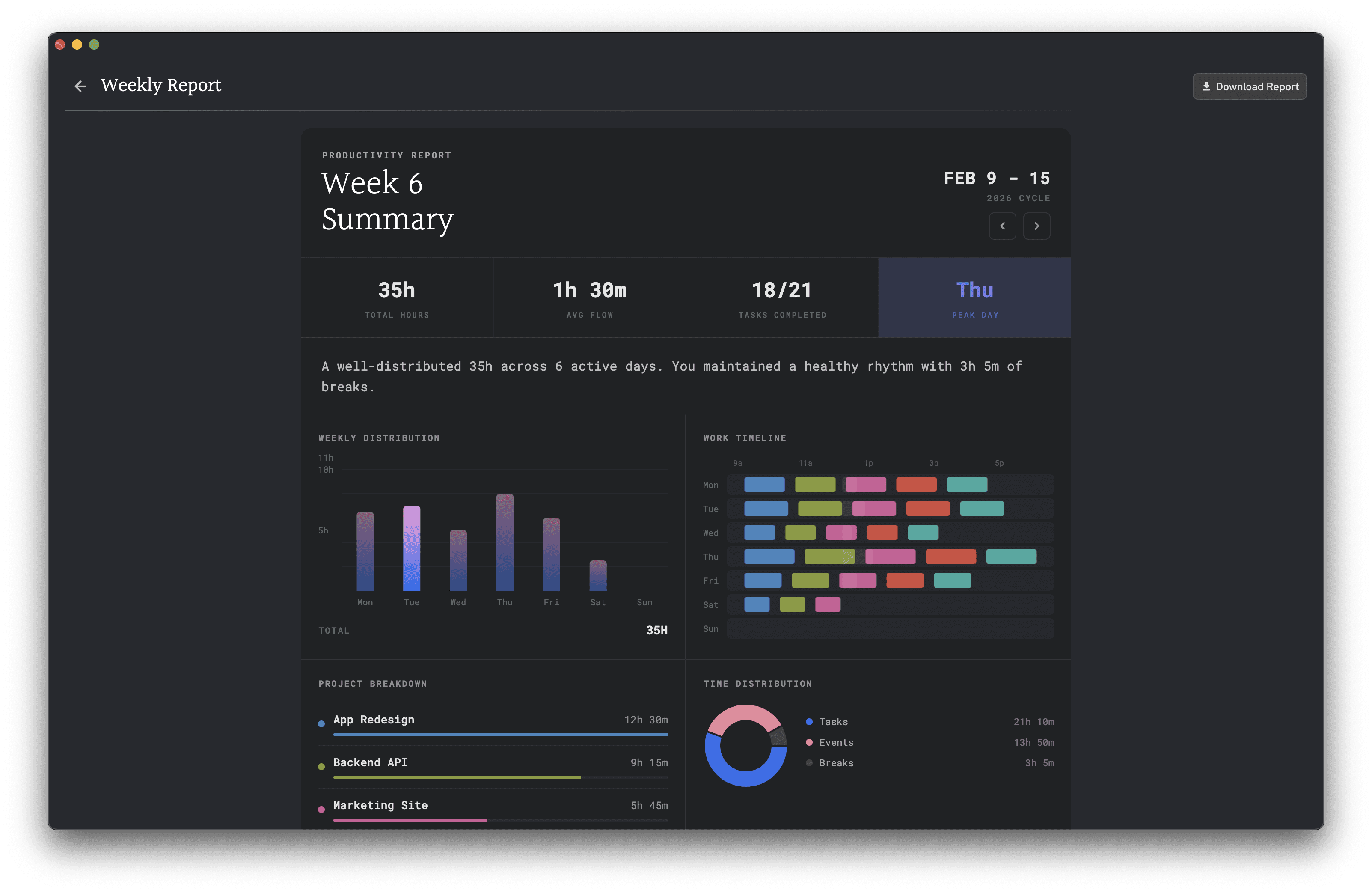
The weekly report in Aftertone shows flow sessions, peak day, streak, and the work timeline. None of these are scores or comparisons against other users. The streak tracks days with at least one completed task - a consistency indicator, not a competitive metric. There are no badges, points, or leaderboards anywhere in the app.
How To Start Tomorrow
If you currently use a tool with points, badges, or streaks, try one week without tracking any of those metrics - just do your work and note at the end of each day what you completed and how it felt. Notice whether your motivation to do the work changes when the external reward is removed. If it does, that's useful information about where your motivation has been coming from.
Related Principles
Autonomy and Intrinsic Motivation - gamification can undermine the autonomy that drives intrinsic motivation
Streak Mechanics - streaks are a specific form of gamification with documented risks
Self-Monitoring - monitoring should be informational, not evaluative or reward-based
Moral Licensing - gamification rewards for planning can trigger licensing to skip execution
Related Reading
Best Habit Tracking Apps — Trackers that use light gamification without letting it replace the actual goal.
Best Streaks App Alternatives — Alternatives to streak-heavy apps for people who've found the mechanic counterproductive.
Best Habitify Alternatives — Apps with more flexibility around metrics that can become ends in themselves.
Frequently Asked Questions
What is gamification in productivity?
Gamification is the application of game design elements — points, streaks, levels, badges, leaderboards, and rewards — to non-game contexts like habit tracking, task completion, and productivity systems. The intention is to make routine behaviours more engaging by attaching immediate feedback and reward signals to them.
When does gamification help and when does it hurt?
Gamification tends to help with behaviours that lack immediate intrinsic reward and where engagement is the primary barrier — early habit formation, repetitive tasks, and behaviours where the long-term benefit is too distant to motivate action. It tends to hurt when the external reward replaces rather than supplements intrinsic motivation, or when gamification mechanics — particularly streaks — trigger perfectionism and all-or-nothing responses to failure.
What is the overjustification effect and why does it matter for gamification?
The overjustification effect is the finding that introducing external rewards for an intrinsically motivated behaviour can reduce intrinsic motivation for that behaviour. When you start earning points for something you previously did because you valued it, the activity becomes about the points. If the points disappear, so does the motivation. For productivity systems, this means gamification should be designed to fade as behaviours become established, not to persist indefinitely.
How do you use gamification without undermining motivation?
Use it selectively for behaviours that genuinely lack intrinsic pull, keep rewards informational rather than controlling — feedback that tells you how you are doing rather than pressure to perform — and design off-ramps so the external scaffolding can be removed as the behaviour becomes habit. Avoid attaching high-stakes rewards to streak mechanics, which combines the risk of perfectionism with the risk of external motivation dependency.
Further Reading
Deci, E. L., Koestner, R., & Ryan, R. M. (1999). A meta-analytic review of experiments examining the effects of extrinsic rewards on intrinsic motivation. Psychological Bulletin, 125(6), 627-668. DOI: 10.1037/0033-2909.125.6.627
Hanus, M. D., & Fox, J. (2015). Assessing the effects of gamification in the classroom: A longitudinal study on intrinsic motivation, satisfaction, effort, and academic performance. Computers and Education, 80, 152-161. DOI: 10.1016/j.compedu.2014.08.019