The Principle
You set the goal in January. By March you're not sure where you stand. You've been busy - things have happened, some related to the goal, some not - but without a record of progress it all blurs together. You can't tell if you're on track, ahead, or quietly drifting. The goal is still technically active. The pursuit of it has stalled.
Self-monitoring is the practice of regularly observing and recording your progress toward a goal. A large meta-analysis by Harkin and colleagues found that monitoring consistently promotes goal attainment - not because the monitoring itself does anything, but because it creates a feedback loop. You see what's working, you notice when you're drifting, and the visibility of progress (or lack of it) re-engages you with the goal. The effect is stronger when progress is physically recorded and stronger still when it's reported to someone else.

Definition
When you regularly check how you're doing against a goal, you're more likely to reach it. The act of monitoring creates a feedback loop - you see what's working, adjust what isn't, and stay engaged with the goal rather than forgetting about it.
What The Research Shows
Harkin et al. (2016) meta-analyzed 138 effect sizes and found self-monitoring promotes goal attainment at d = 0.40 (95% CI [0.32, 0.48], N = 19,951). Note: the original compilation cited d = 0.79, which referred to increased monitoring frequency, not goal attainment - the corrected figure is d = 0.40. Effects were larger when progress was physically recorded or reported publicly. The effect is still meaningful - a medium effect across nearly 20,000 participants - but represents a moderate rather than large benefit.

What This Means
Regularly recording progress toward a goal increases the probability of achieving it - the effect is consistent across nearly 20,000 participants in 138 studies. The mechanism is the feedback loop: you see what is working, notice drift early, and stay engaged between setting the goal and completing it.
What Most People Get Wrong
Progress tracking is sometimes cited with inflated effect sizes.
The corrected figure from the most comprehensive meta-analysis is a meaningful but moderate benefit, not a dramatic one. The effect is real and worth using, but it is strongest for quantifiable goals where progress is easy to see, and weaker for vague or qualitative goals where what constitutes progress is unclear.
When it Fails…
Works best for quantifiable goals. Monitoring "write 500 words" is easier and more motivating than monitoring "make progress on the report."
Can increase anxiety in self-critical users. Tracking failures visibly can feel worse than not tracking at all for people already prone to self-judgment.
The effect is moderate, not dramatic. The corrected meta-analytic figure is d = 0.40 - meaningful but not the large effect sometimes claimed.
What This Means For You…
Most people set goals but don't track them, which means they're operating without feedback. Without feedback, small drifts go unnoticed until they've become large ones. The act of tracking - even something as simple as a weekly note of what moved and what didn't - creates the visibility that keeps goals alive between the moment you set them and the moment you either achieve them or abandon them. The key is tracking execution, not just plans. A plan is not progress. A completed block is.
How Aftertone Implements It.
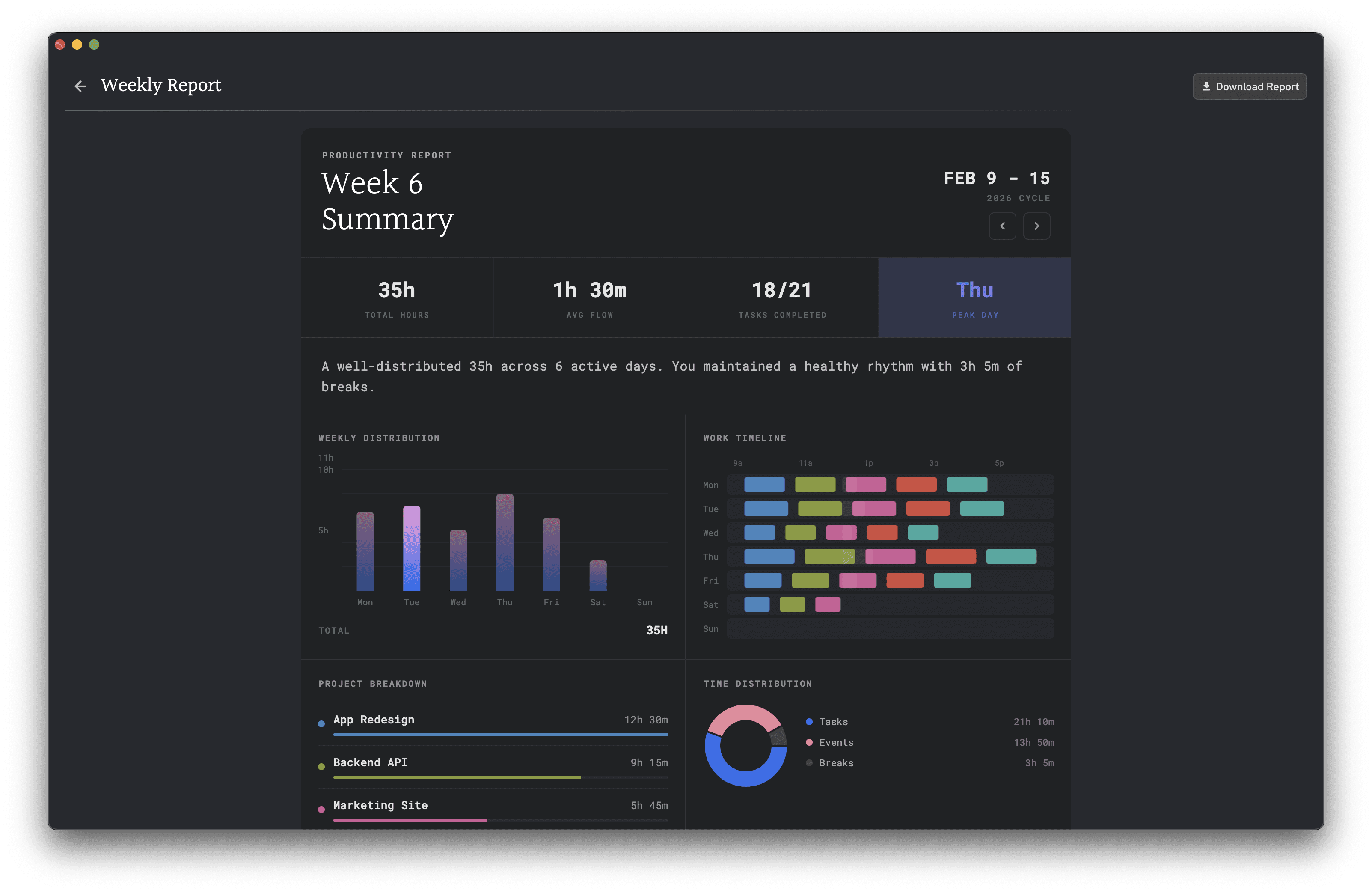
The weekly report tracks flow sessions, tasks completed by project, peak day, and longest focus period. The work timeline shows every completed task (green), event (blue), and break (grey) across the week. The Planning View shows what is in your inbox versus what is scheduled. These are the monitoring loops - not a score, but a concrete record of what moved and what did not.
How To Start Tomorrow
Pick one goal you're working toward. At the end of each week for the next month, write two sentences: what specific progress happened this week, and what didn't happen that you expected to. Do nothing else with that data - just record it. After four weeks, read back through all four entries. Notice what the record reveals about your actual patterns that your memory alone would have missed.
Related Principles
Implementation Intentions - monitoring tracks whether if-then plans were executed
Goal Setting Side Effects - monitoring should include wellbeing indicators, not just task completion
Moral Licensing - monitoring execution (not just planning) counters the licensing effect
Weekly Review - the weekly review is a structured self-monitoring ritual
Related Reading
Best Habit Tracking Apps — Apps that make self-monitoring frictionless — the key variable in whether it sticks.
Best AI Time Audit Tools — AI tools that track how your time actually went versus how you planned it.
Best Weekly Review Apps — Weekly review apps that surface your own patterns so the monitoring does something useful.
Frequently Asked Questions
What is self-monitoring in the context of productivity?
Self-monitoring is the practice of deliberately tracking your own behaviour, progress, or outputs against a goal or baseline. It includes time tracking, task completion logs, habit trackers, and any system that creates visible feedback on what you are actually doing versus what you intended to do. The act of tracking itself changes behaviour.
How much does tracking progress improve goal attainment?
A meta-analysis by Harkin et al. (2016) across 138 studies found that monitoring progress towards a goal increases attainment by 33% compared to setting goals without tracking. The effect is stronger when progress is made public or reported to another person, and when tracking frequency is higher.
Why does tracking improve performance even without accountability?
Tracking makes progress visible and concrete, which activates what Teresa Amabile calls the progress principle — the finding that perceiving forward movement is the strongest daily motivator. Invisible progress does not produce the same motivational effect. Tracking also surfaces gaps between intention and reality that would otherwise remain invisible, enabling course correction.
What are the most effective things to track for productivity?
The most useful tracking typically involves planned versus actual task completion, time allocation across different work types (deep work, meetings, admin), and weekly output on high-priority projects. Tracking these creates the feedback loop between intention and reality that makes planning systems genuinely improve over time rather than just feel organised.
Further Reading
Harkin, B., et al. (2016). Does monitoring goal progress promote goal attainment? A meta-analysis of the experimental evidence. Psychological Bulletin, 142(2), 198-229. DOI: 10.1037/bul0000025