The Principle
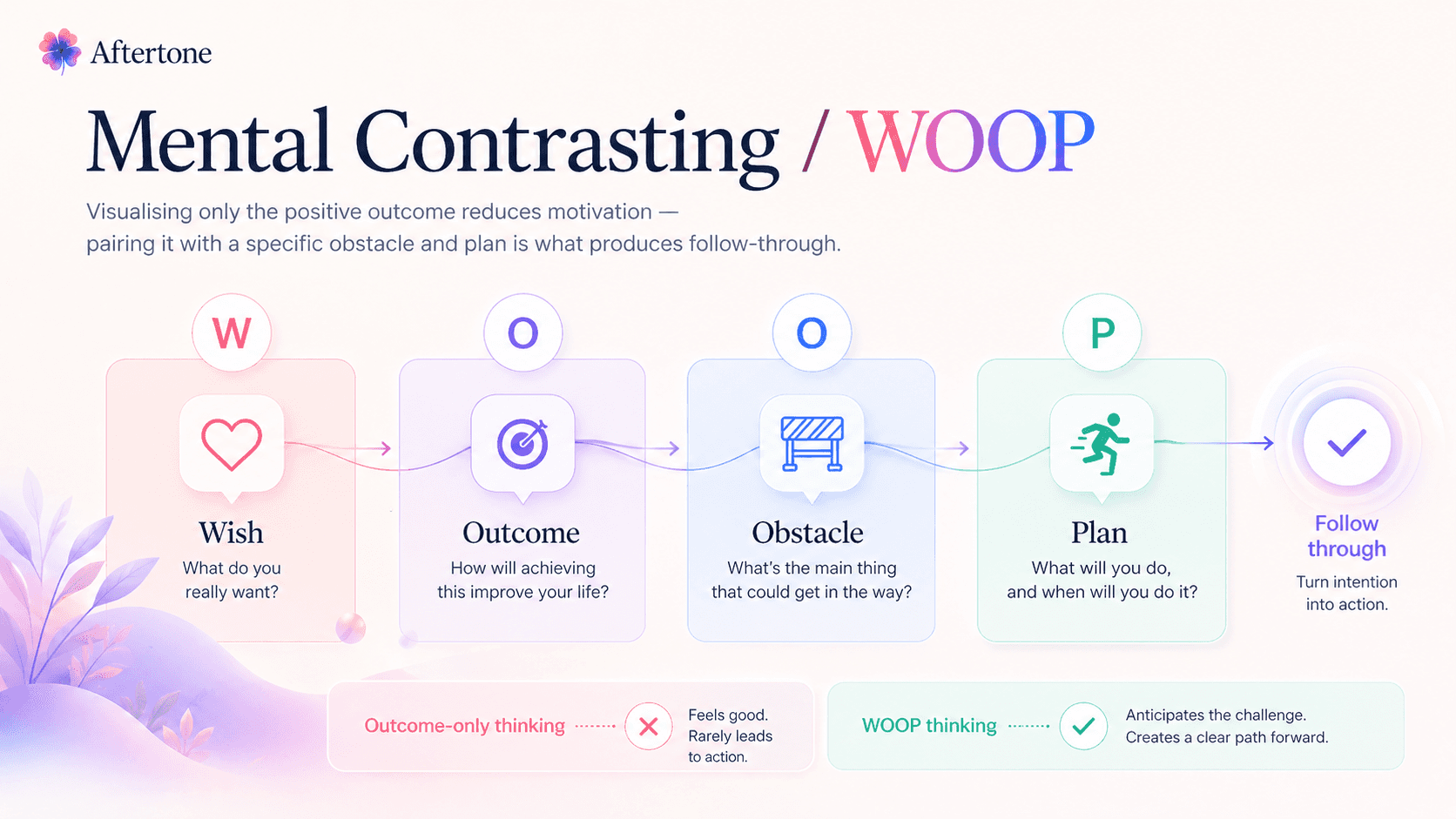
You visualise achieving the goal. You imagine how it will feel, what will be different, the version of yourself on the other side. It feels good. Motivating, even. And then, research shows, your brain partially registers the goal as already achieved - the positive feeling of the imagined outcome reduces the drive to pursue the actual one. Pure positive visualisation, it turns out, is not just unhelpful. It can actively undermine motivation.
Mental contrasting is the evidence-based alternative. Developed by Gabriele Oettingen, it pairs positive visualisation with immediate identification of the main obstacle standing in your way, followed by a specific if-then plan for overcoming it. The full sequence - Wish, Outcome, Obstacle, Plan - is known as WOOP. A meta-analysis across 24 studies found meaningful improvements in goal attainment compared to positive thinking alone, with guided implementation producing stronger effects than self-directed attempts.

Definition
Dreaming about success feels good but doesn't actually help you get there - and can even reduce motivation. What works is mental contrasting: vividly imagining your desired outcome and then immediately identifying the main obstacle standing in your way, followed by an if-then plan to overcome it.
What The Research Shows
Wang et al. (2021) meta-analyzed 24 studies (N = 15,907) and found MCII (Mental Contrasting with Implementation Intentions) produced g = 0.336 overall, with experimenter-led interventions stronger at g = 0.465. Adjusted for publication bias, the effect was g = 0.242. Duckworth et al. (2013) demonstrated MCII improved grades, attendance, and behavior in a school-based RCT with N = 77 fifth graders. Note: the paper uses 'MCII,' not 'WOOP' - the WOOP branding was introduced later by Oettingen (2014). Limitation: small number of studies; more effective in individualist cultures; guided implementation stronger than self-directed.

What This Means
Pure positive visualisation can reduce motivation by letting the brain partially register the goal as already achieved. Pairing the vision with immediate obstacle identification - and a specific if-then plan - produces meaningfully better goal attainment.
What Most People Get Wrong
Positive visualisation is widely promoted as a motivation tool.
Research found that purely positive fantasising about an outcome can actually reduce motivation by allowing the brain to partially register the goal as already achieved. The positive feeling of the imagined success satisfies some of the drive that was meant to produce actual effort. Combining visualisation with obstacle identification corrects this.
When it Fails…
Pure positive visualisation without the obstacle step is counterproductive. It can reduce motivation by letting the brain partially register the goal as already achieved.
Guided implementation outperforms self-directed. The research shows stronger effects when the WOOP process is facilitated - a simple checkbox form produces weaker results.
Weaker in collectivist cultural contexts. The effect is somewhat smaller in cultures where individual goal pursuit is less normatively central.
What This Means For You…
The practical implication of this research is that how you think about your goals matters as much as the goals themselves. Vague aspiration ("I want to be more productive") combined with positive fantasising about the outcome is a recipe for inaction. What works is a brief, structured process: name what you want, imagine the best outcome specifically, identify the single most likely obstacle, and make a concrete if-then plan for that obstacle. This takes five minutes and converts an aspiration into a plan with a built-in contingency. It works best for goals that feel important but where you've previously stalled.
How Aftertone Implements It.
The task notes field in Aftertone is where goal-related thinking lives. Before a high-priority task session, you can use the notes field to write the specific outcome you want, the main obstacle you anticipate, and the first action that moves through it. This is a manual practice the app supports through structure - a note that is visible when Focus Mode opens the task.

How To Start Tomorrow
Pick one goal you've been meaning to pursue but haven't made real progress on. Write four sentences: (1) What do you wish for? (2) What would the best outcome feel like? (3) What is the main obstacle - internal or external - that has stopped you before? (4) If that obstacle arises, what specifically will you do? That four-sentence exercise is WOOP. Notice whether the goal feels more concrete and actionable after doing it than it did before.
Related Principles
Implementation Intentions - the 'Plan' step in WOOP is an implementation intention
Specificity Effect - WOOP requires concrete, specific obstacle and plan identification
Goal Setting Side Effects - WOOP provides a healthier alternative to raw goal-setting
Self-Monitoring - tracking progress on WOOP goals closes the feedback loop
Related Reading
Best AI Daily Planning Tools — Daily planning tools that build in obstacle thinking, not just goal setting.
Best Productivity Systems for High Performers — Systems used by high performers that go beyond listing goals to planning for the obstacles.
Best Time Blocking Apps — Time blocking is the 'Plan' step in WOOP made concrete — these are the tools that make it practical.
Frequently Asked Questions
What is mental contrasting?
Mental contrasting is a goal-achievement technique that involves first imagining a desired positive outcome, then immediately identifying the key obstacle standing in the way. This pairing — positive vision followed by realistic obstacle — produces better goal attainment than positive thinking alone, which tends to reduce motivation by creating premature satisfaction.
What does WOOP stand for?
WOOP stands for Wish, Outcome, Obstacle, Plan. It is a four-step implementation of mental contrasting developed by Gabriele Oettingen. Wish: identify the goal. Outcome: imagine the best possible result. Obstacle: identify the most significant internal obstacle. Plan: form an if-then implementation intention for when the obstacle arises.
How much does WOOP improve goal achievement?
Research by Oettingen and colleagues found that mental contrasting with implementation intentions improves goal achievement by around 34% compared to positive thinking alone in controlled studies. The effect has been replicated across health behaviour, academic performance, and professional goal contexts.
Why does positive visualisation alone not work?
Positive visualisation — imagining achieving the goal without also identifying the obstacle — tends to reduce motivation rather than increase it. The brain partially registers the imagined success as real progress, which reduces the tension that drives action. Mental contrasting preserves that tension by pairing the positive vision with a clear obstacle that needs to be overcome.
Further Reading
Wang, G., Wang, Y., & Gai, X. (2021). A meta-analysis of the effects of mental contrasting with implementation intentions on goal attainment. Frontiers in Psychology, 12, 565202. DOI: 10.3389/fpsyg.2021.565202
Oettingen, G. (2014). Rethinking Positive Thinking: Inside the New Science of Motivation. Current. ISBN: 978-1591846871