The Principle
The planning session started as 15 minutes and has become an hour. You've categorised every task, colour-coded every project, built a detailed system for handling every possible scenario. The plan is comprehensive and satisfying. It is also, at this point, preventing you from doing any of the work it describes - because you're still planning it, and because the weight of all that structure has made starting feel more complicated than it should be.
Planning has real benefits up to a point, after which more structure creates diminishing returns and eventually negative ones. Research on choice overload shows that beyond a certain number of options or decisions, cognitive performance degrades rather than improves - the system becomes harder to use than working without one. Applied to planning: a task list with 40 items, a system with 12 categories, a weekly plan mapped to 15-minute increments doesn't guide action. It creates paralysis.

Definition
Planning has real benefits, but it has diminishing returns. At some point, adding more detail, more structure, or more options to your plan stops helping and starts hindering - creating analysis paralysis, rigidity, and the illusion of control without the reality of action.
What The Research Shows
No study has directly tested 'overplanning' as a standalone construct. The best converging evidence comes from choice overload research: Iyengar & Lepper (2000) showed 30% purchased from 6 choices vs. only 3% from 24 choices - a 10× difference. Chernev et al. (2015) meta-analyzed 53 experiments confirming choice overload is real but context-dependent, occurring most when preferences are unclear and options are complex. Dijksterhuis et al. (2006) suggested complex choices benefit from unconscious processing over extensive deliberation, though subsequent replications have been mixed. Applied to planning: too many task options, too much detail, or too rigid a structure can trigger the same paralysis.

What This Means
Beyond a certain level of structure, additional planning degrades performance rather than improving it. A system that requires too many decisions, categories, or layers of organisation becomes harder to use than working without one.
What Most People Get Wrong
More planning intuitively seems like it should produce better results.
The research on choice overload and cognitive load suggests there is a threshold beyond which additional structure reduces performance rather than improving it. A planning system that requires too many decisions, too many categories, or too many layers of organisation can become harder to maintain than the problems it was meant to solve.
When it Fails…
Some users genuinely need more structure. People with ADHD or very complex projects may benefit from more detailed planning than the average user.
The choice overload analogy is imperfect. The research is primarily about consumer choices, not task planning - the parallel is theoretically sound but not directly tested.
What This Means For You…
The best planning system is the lightest one that reliably guides your day. Three clear priorities each morning is almost always more useful than a comprehensively planned schedule, because three priorities are actionable and a comprehensive schedule is fragile. Every additional layer of structure you add to a planning system is a layer that has to be maintained - and maintece effort is effort not spent on the work. If you spend more time planning your tasks than doing them, the system has inverted its purpose.
How Aftertone Implements It.
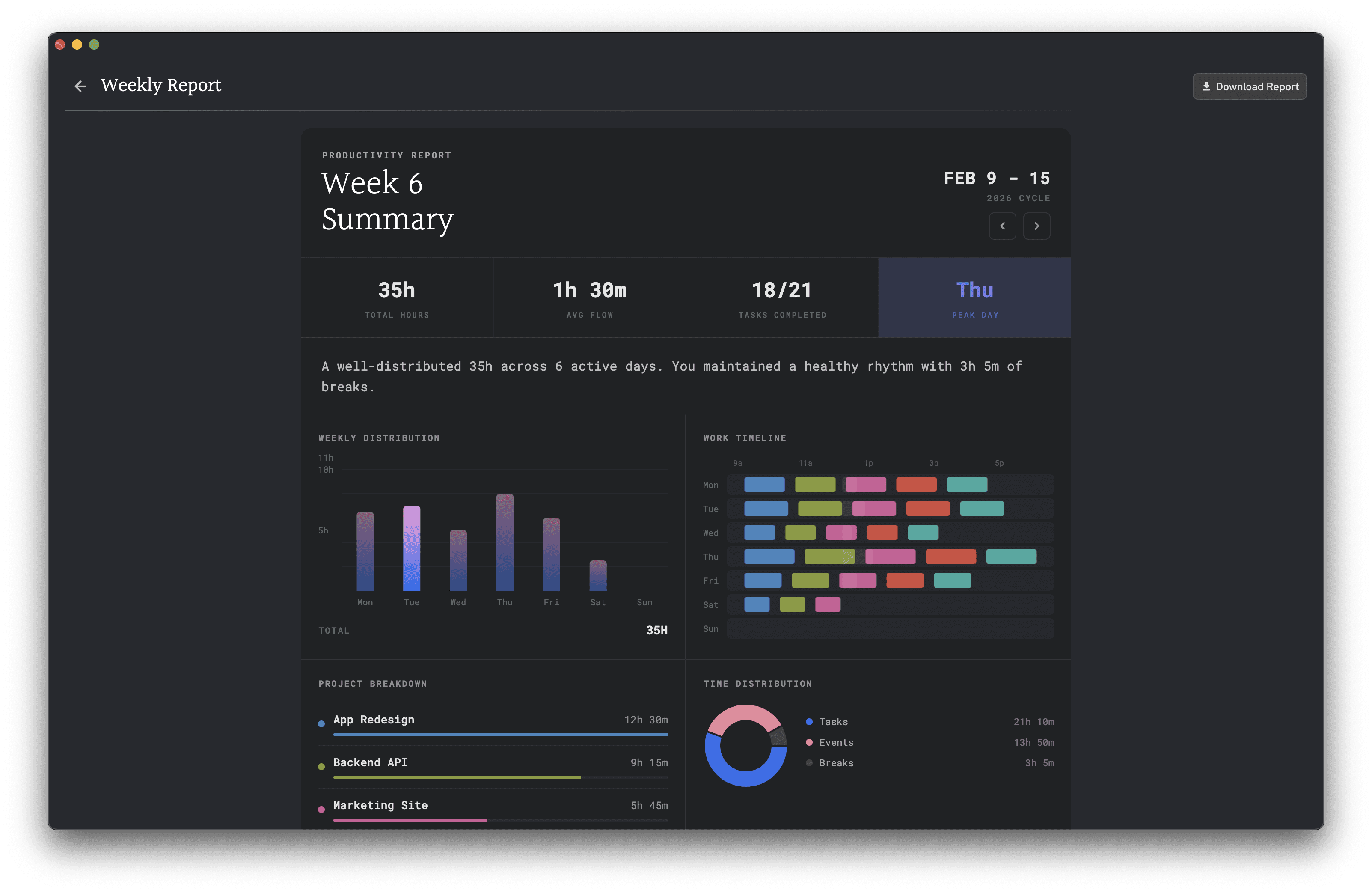
The weekly planning ritual in Aftertone recommends setting three priorities for the week, not a comprehensive task schedule. The guidance explicitly says to leave 20% of the calendar empty. The Planning View (Shift+P) is for triaging the inbox and assigning dates - not for scheduling every task to a precise slot.
How To Start Tomorrow
For one week, simplify your planning to the bare minimum: each morning, write down the three things that matter most today, and the specific first action for each. Nothing else. No categories, no priorities matrix, no detailed time-blocking. At the end of the week, compare your output and sense of control to your normal system. Most people find the simpler version is at least as effective and considerably less draining.
Related Principles
Planning Fallacy - overplanning amplifies the fallacy because each sub-task is also underestimated
Moral Licensing - extensive planning can substitute for action
ADHD and Rigid Scheduling - paradoxically, ADHD users may need more structure but also suffer more from over-rigid structure
Autonomy and Intrinsic Motivation - overplanning removes autonomy from the execution phase
Related Reading
Best Time Blocking Apps — Time blocking apps that make it easy to plan enough — and easy to stop there.
Best Productivity Systems for High Performers — Systems that distinguish planning from execution and protect against conflating the two.
Best AI Daily Planning Tools — AI planners that generate a schedule so you don't have to — removing the temptation to over-engineer it.
Frequently Asked Questions
Can you spend too much time planning?
Yes. Planning has diminishing returns: beyond a certain point, additional planning produces more rigidity, more anxiety, and more time away from execution without meaningfully improving outcomes. Research on overplanning finds it can become a form of procrastination — detailed planning feels productive while deferring the harder work of actually doing.
What is the optimal amount of planning?
The research does not produce a universal figure, as it depends on task complexity and uncertainty. A useful heuristic is to plan until you know your next three to five concrete actions and when you will take them — then stop and execute. The point of diminishing returns is roughly where additional planning refines decisions that execution would resolve faster.
How does overplanning cause procrastination?
Planning provides the psychological experience of working toward a goal without the risk of failing at the actual work. Detailed planning — organising, categorising, building systems, refining lists — activates goal-related cognition and produces a mild version of goal satisfaction without requiring the performance the goal demands. This is moral licensing applied to planning specifically.
What are the signs that you are overplanning?
You spend more time on your task management system than on the tasks themselves. You re-review plans without adding new information. You feel busy but cannot point to concrete outputs at the end of the week. You feel anxious when you cannot plan further before acting. Each of these indicates that planning has crossed from useful preparation into avoidance dressed as productivity.
Further Reading
Iyengar, S. S., & Lepper, M. R. (2000). When choice is demotivating: Can one desire too much of a good thing? Journal of Personality and Social Psychology, 79(6), 995-1006. DOI: 10.1037/0022-3514.79.6.995
Chernev, A., Bockenholt, U., & Goodman, J. (2015). Choice overload: A conceptual review and meta-analysis. Journal of Consumer Psychology, 25(2), 333-358. DOI: 10.1016/j.jcps.2014.08.002