The Principle
You estimate the report will take two hours. You've estimated that before and been wrong. You know you tend to underestimate. And you still estimate two hours - because this time feels different. This task, with this level of focus, in these conditions, will go faster. It doesn't. It takes four hours, the same as always, and your afternoon falls apart around it.
This is the planning fallacy - the stubborn tendency to predict best-case durations even when past experience contradicts it. Identified by Kahneman and Tversky and extensively studied by Buehler, Griffin and Ross, who found that people's "realistic" estimates are statistically indistinguishable from their best-case scenarios. The bias affects everyone - not just poor planners, not just optimists, but experts with decades of domain experience. Knowing about the bias does not eliminate it. External correction does.

Definition
The planning fallacy is our stubborn tendency to predict that tasks will take less time than they actually do, even when we've been late before. We focus on the specific task ahead ('this time will be different') instead of looking at how long similar tasks took in the past.
What The Research Shows
Buehler, Griffin & Ross (1994) demonstrated that people's 'realistic' predictions were statistically indistinguishable from their best-case scenarios, and only 45% finished tasks by their '99% probability' deadline. The effect is robust across cultures and task types and has been extensively replicated. Outside observers predict more accurately than actors because they use base rates rather than optimistic scenario thinking. Reference class forecasting (asking 'how long did similar tasks take?') helps but does not eliminate the bias completely.

What This Means
Only 45% of people finish tasks by the deadline they were 99% certain they would meet. The bias affects almost everyone, including domain experts - it is structural, not personal.
What Most People Get Wrong
The instinct is to attribute chronic lateness to poor organisation or weak discipline.
The research points elsewhere. Almost everyone, including experienced professionals who know about this bias, consistently underestimates task duration. It is not a personal failing. It is a structural feature of how the brain constructs predictions. Understanding it as a cognitive bias rather than a character flaw changes how you correct for it.
When it Fails…
Reference class correction helps but does not eliminate the bias. Even with historical data, people still underestimate on novel or complex tasks.
Conservative estimators may resist adding time. People who already pad their estimates heavily may find automatic inflation counterproductive.
Strongest on unfamiliar work. The bias is smallest for simple, highly repetitive tasks where duration is already well-calibrated.
What This Means For You…
If your days regularly fall apart by early afternoon, the planning fallacy is likely the culprit - not poor discipline, not poor prioritisation. Just systematically optimistic time estimates that make your schedule structurally impossible before the day begins. The fix is not trying harder to estimate accurately. Research shows that doesn't work. What does work is a simple rule - add 50% to whatever you initially estimate - and tracking actual versus estimated durations over time so data can correct what intuition won't. A one-hour task probably takes 90 minutes. Build your day around that reality.
How Aftertone Implements It.
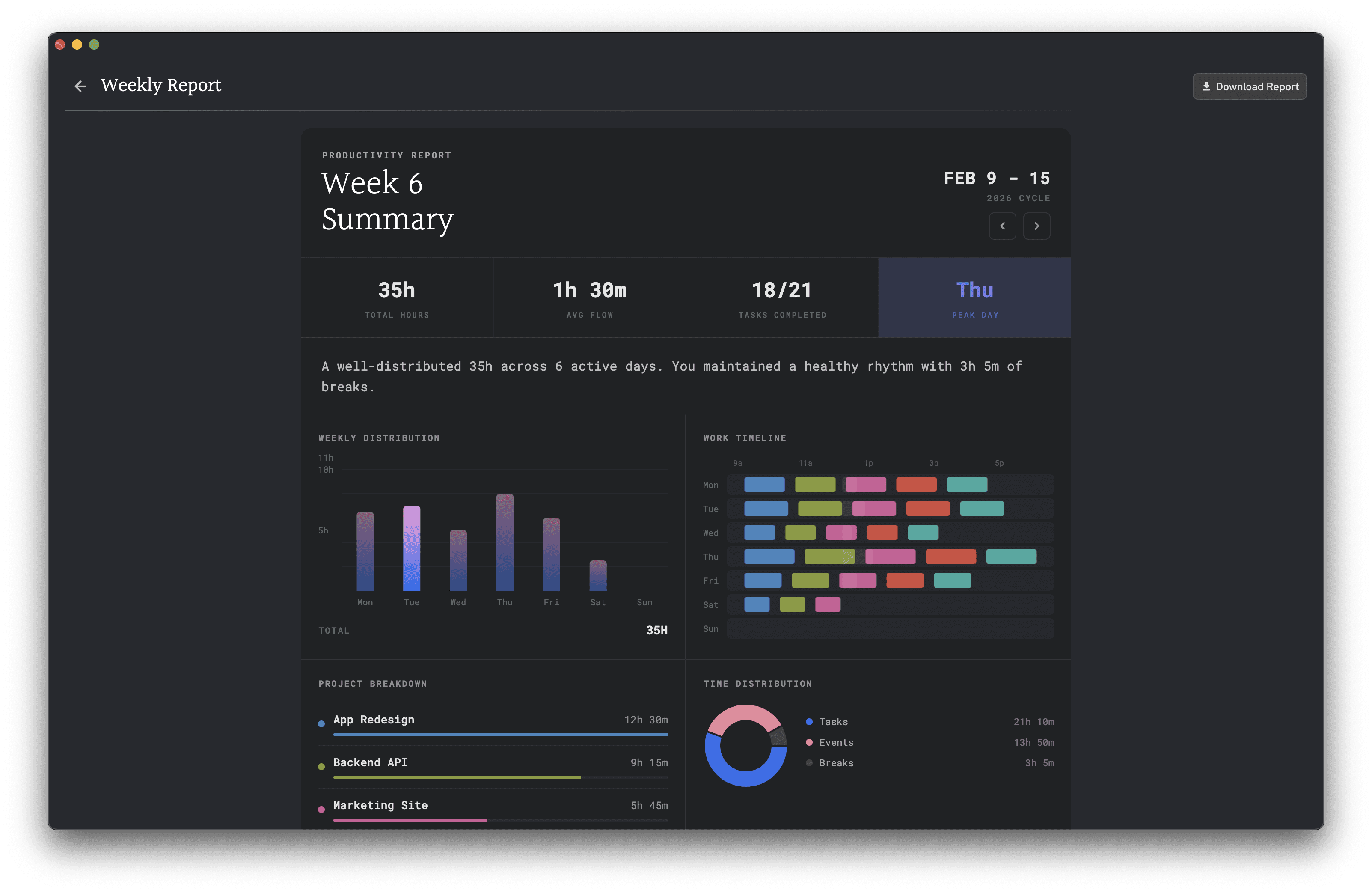
Every task in Aftertone has a duration field you set when creating or planning the block. The weekly report's work timeline shows in green exactly which tasks were completed and when - so over time you can see the gap between how long you planned and how long work actually took. That record is the external data the research says is more effective than trying to estimate more carefully.
How To Start Tomorrow
For the next week, write your time estimate for each task before you start it. When you finish, write how long it actually took. By Friday you'll have a clearer picture of your personal planning fallacy than any amount of self-reflection would give you. Then start adding 50% to your estimates and see what happens to your afternoons.
Related Principles
Time Blocking - blocks must account for the planning fallacy
Parkinson's Law - tight deadlines counteract time expansion, but too-tight deadlines cause stress
Overplanning - over-detailed plans amplify the fallacy because each sub-task is also underestimated
Related Reading
Best Time Blocking Apps — Time blocking forces you to confront how long things actually take — the practical antidote to optimism bias.
Best AI Time Audit Tools — Tools that track planned versus actual time, so the gap becomes visible.
Best AI Daily Planning Tools — AI planners that build in buffers automatically rather than letting you over-schedule by default.
Frequently Asked Questions
What is the planning fallacy?
The planning fallacy is the tendency to underestimate how long tasks will take, how much they will cost, and how many obstacles will arise — even when you have direct experience of similar tasks running over. It was named by Kahneman and Tversky in 1979 and has been replicated across construction projects, software development, academic work, and personal planning.
Why do people underestimate even when they know they tend to underestimate?
The planning fallacy persists because estimates are generated from an "inside view" — focusing on the specific plan and its best-case unfolding — rather than an "outside view" that considers how long similar tasks have actually taken. Even knowing about the bias does not reliably correct for it, because the inside view feels more relevant and specific than historical base rates.
How can you correct for the planning fallacy?
The most effective correction is reference class forecasting: instead of estimating from the plan, estimate from how long similar tasks have actually taken in the past. Adding a buffer of 25–50% to initial estimates is a practical heuristic. Breaking tasks into smaller components improves accuracy somewhat, but does not eliminate the bias entirely.
Does the planning fallacy affect professionals as much as novices?
Yes — experience does not reliably reduce the bias. Research shows that professionals, including engineers, architects, and project managers, consistently underestimate task duration even with extensive prior experience. The inside-view mechanism operates regardless of expertise, which is why structural interventions like historical tracking outperform simply trying to estimate more carefully.
Further Reading
Buehler, R., Griffin, D., & Ross, M. (1994). Exploring the planning fallacy: Why people underestimate their task completion times. Journal of Personality and Social Psychology, 67(3), 366-381. DOI: 10.1037/0022-3514.67.3.366