The Principle
The time-blocking system made sense when you set it up. Specific slots for specific tasks, everything accounted for, the day mapped out. By 10am it's already fallen apart - not because you're not trying, but because the system assumed a relationship with time that ADHD disrupts. A 9am slot means nothing when 9am doesn't feel different from 8:47am. A 45-minute block has no natural boundary when time blindness makes duration invisible from the inside.
ADHD is characterised by impairments in executive function - the set of cognitive processes that enable planning, time perception, and self-regulation. Time blindness is a core feature: the difficulty not just of estimating how long things take, but of sensing how much time has passed while doing them. Rigid scheduling systems are built on accurate time perception. For people with ADHD traits, they don't just fail to help - they create a new source of failure and self-blame on top of the underlying difficulty.

Definition
People with ADHD often experience 'time blindness' - difficulty sensing how much time has passed or how long tasks will take. Rigid minute-by-minute schedules assume accurate time perception, which is exactly what ADHD disrupts. Flexible, energy-based planning works better for these users.
What The Research Shows
Fabio & Caprì (2017) examined executive functions in adults with ADHD and found significant impairments in planning and time management compared to controls. The broader ADHD literature consistently identifies 'time blindness' as a core feature - difficulty estimating durations, sensing time passing, and meeting time-based commitments. No single RCT has tested 'ADHD-friendly scheduling' as an intervention, but the convergent evidence from executive function research is clear: systems that assume consistent time perception, sequential planning ability, and sustained motivation fail for ADHD users. Limitation: direct evidence for alternative scheduling approaches in ADHD is limited; recommendations are based on clinical understanding rather than RCTs.

What This Means
ADHD involves significant impairment in time perception and the executive functions that enable planning and estimation - and rigid scheduling systems assume precisely the capabilities that ADHD disrupts. They do not just fail to help; they create a recurring experience of failure that compounds the underlying difficulty.
What Most People Get Wrong
Time-blocking is widely recommended as a productivity tool without qualification.
For people with ADHD traits, rigid scheduling can be actively counterproductive. The system assumes consistent time perception and the ability to transition between tasks at planned moments. These are precisely the functions that ADHD disrupts. A system that works well for most users can become a repeated source of failure and self-blame for a meaningful minority.
When it Fails…
Not all ADHD users struggle with structure. Some find external time constraints helpful rather than stressful - the response is genuinely individual.
The ADHD-friendly label can oversimplify. ADHD is a diverse condition and no single scheduling approach works for everyone who has it.
Evidence for alternative approaches is clinical rather than experimental. The recommendations are based on clinical understanding rather than controlled trials of specific scheduling methods.
What This Means For You…
If rigid time-blocking consistently fails you despite genuine effort, the problem is probably not discipline or motivation - it's that the system requires a relationship with time that your brain doesn't reliably provide. Flexible, energy-based planning tends to work better: instead of assigning tasks to specific clock times, assign them to energy states - high, medium, low - and do them in the corresponding windows of your day. Visual timers, generous buffer time, and very short task commitments (15-minute blocks rather than 90-minute ones) also reduce the gap between what the system expects and what ADHD-affected time perception can deliver.
How Aftertone Implements It.
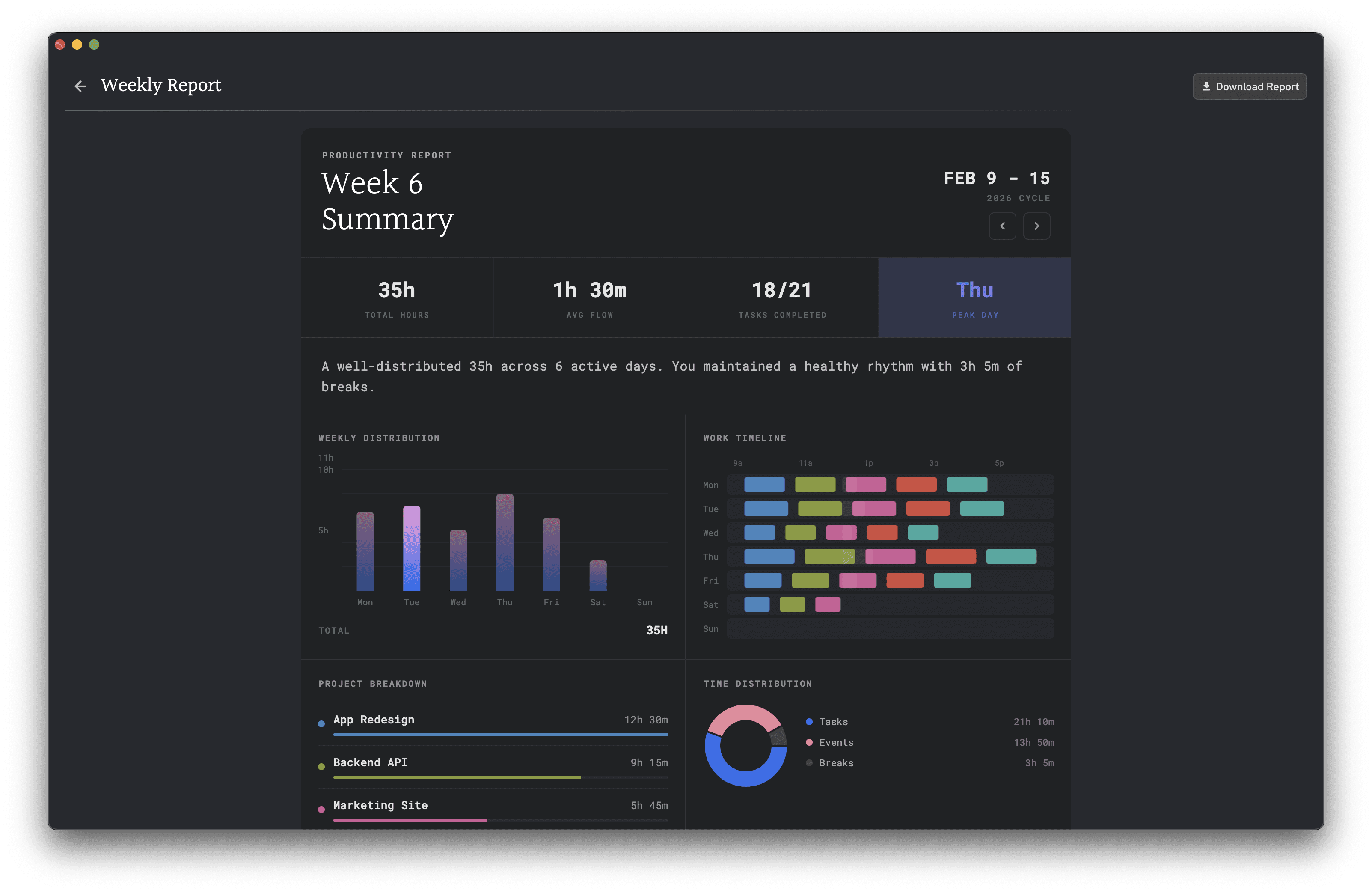
Slots in Aftertone let you protect time for a category of work without committing to a specific task in advance. A "deep work" slot from 9-11am is a real time block on the calendar - visible in Google Calendar, protected from meetings - but the specific task is decided when you sit down. This gives structure without requiring accurate advance task planning for every moment of the day.
How To Start Tomorrow
If you have ADHD traits and struggle with time-blocking, try energy-based planning for one week. Instead of scheduling tasks at specific times, label each task as high, medium, or low energy. Each morning, look at how you feel and match tasks to your energy state rather than the clock. At the end of the week, compare how many tasks you completed versus a typical time-blocked week.
Related Principles
Time Blocking - ADHD users need a modified approach to time blocking
Planning Fallacy - time estimation bias is amplified in ADHD
Perfectionism-Procrastination Link - ADHD + perfectionism is an especially challenging combination
Autonomy and Intrinsic Motivation - autonomy is especially important for ADHD users who often rebel against rigid external systems
Related Reading
Best Mac Calendar Apps for ADHD — Mac calendar apps reviewed specifically for ADHD users — flexibility over rigidity.
Best AI Scheduling Apps for ADHD — AI scheduling tools that adapt when the plan changes, rather than collapsing.
Best AI Productivity Apps for ADHD — The full landscape of ADHD-suited productivity apps, with the science of why each works or doesn't.
Frequently Asked Questions
Why do standard productivity systems fail for ADHD?
Standard productivity systems are designed around a reliable internal clock, consistent working memory capacity, and predictable energy levels. ADHD involves time blindness — difficulty perceiving and tracking the passage of time — along with variable attention and executive function that shifts with interest, urgency, novelty, and emotional state. A system that assumes stable capacity across the day will consistently fail anyone whose capacity fluctuates this significantly.
What does ADHD-adapted scheduling actually look like?
It prioritises flexibility over rigidity: energy-based planning rather than fixed time slots, shorter task blocks with more frequent transitions, external cues and body doubling rather than internal motivation, and systems with low capture friction so tasks are not lost when attention shifts. It also accepts non-linear work patterns rather than forcing a conventional sequence that the ADHD brain will resist.
Is time blocking useful for people with ADHD?
In modified form, yes. The problem with standard time blocking for ADHD is the assumption that a person will start and stop a task at the scheduled moment through internal regulation alone. ADHD-adapted time blocking uses external alarms, visual timers, and environmental cues to do the prompting work that ADHD brains cannot do reliably from within. The structure helps — the rigidity does not.
Does ADHD affect everyone's productivity the same way?
No — ADHD presents very differently between individuals and even within the same person across different days, tasks, and environments. Hyperfocus — intense, sustained engagement with genuinely interesting work — is also an ADHD trait that can produce exceptional output under the right conditions. The challenge is designing systems that can accommodate both the hyperfocus and the time blindness, rather than assuming uniform incapacity.
Further Reading
Fabio, R. A., & Capri, T. (2017). The executive functions in a sample of Italian adults with ADHD. Mediterranean Journal of Clinical Psychology, 5(3). DOI: 10.6092/2282-1619/2017.5.1636