The Principle
Flow is the most productive and subjectively rewarding cognitive state available to knowledge workers — and Csikszentmihalyi's research found it occurs more frequently during work than leisure, because work provides the structured challenge and feedback conditions that flow requires. It is engineerable, not accidental. Three conditions are necessary: challenge matched to skill level, clear goals, and uninterrupted concentration. Without all three simultaneously, flow is significantly less likely.
There are hours where everything works. The work comes easily, time disappears, and at the end you look up and find you've produced more - and better - than you expected. It doesn't feel like willpower. It feels effortless in a way that hard work rarely does. These hours are not accidents. They have conditions, and those conditions can be created deliberately.
Flow - the state of complete absorption in a challenging activity - was identified and studied by Mihaly Csikszentmihalyi across decades of research. The conditions that produce it are consistent: the task must be challenging enough to require full attention but not so difficult as to trigger anxiety. There must be clear goals. There must be immediate feedback. And there must be uninterrupted concentration. Remove any of these and flow becomes significantly less likely. Restore all of them and it becomes reliably accessible.
Csikszentmihalyi identified nine characteristics of the flow experience: challenge-skill balance, clear goals, unambiguous feedback, concentration on the task at hand, a sense of control, loss of self-consciousness, transformation of time, the merging of action and awareness, and autotelic experience (the activity is intrinsically rewarding). The first three are conditions you can engineer before a session. The remaining six are what emerges when those conditions are met.

Definition
Flow is a state of deep absorption where you lose track of time and perform at your best. It occurs when task difficulty matches your skill level. Clear goals, immediate feedback, and uninterrupted focus are the other key ingredients.
What The Research Shows
Csikszentmihalyi (1990) established the foundational model of flow through decades of experience-sampling research across thousands of participants, identifying the challenge-skill balance as the central condition.
Csikszentmihalyi & LeFevre (1989) found, counterintuitively, that flow occurs more frequently during work than during leisure activities — because work naturally provides the structured challenges, clear goals, and feedback mechanisms that leisure rarely does. The implication: the workplace is not the enemy of flow; fragmented, interruption-heavy work organisation is.
Nakamura and Csikszentmihalyi (2002) refined the conditions required: clear goals, immediate feedback, and a match between challenge and skill level.
Engeser and Rheinberg (2008) confirmed in a field study of 61 participants that flow peaks when challenge and skill are both high and balanced. A meta-analysis by Fong and colleagues (2015) across 28 studies found flow is associated with performance at r = 0.16 and with wellbeing at r = 0.27. Limitation: much of the foundational research relies on self-report experience-sampling; experimental induction of flow is methodologically difficult.
Drexel University Creativity Research Lab (2024) used neuroimaging on jazz musicians in creative flow and identified two key neural factors: extensive experience building specialised neural networks, and a "letting go" that allows those networks to operate with minimal conscious supervision. This provides a mechanistic account of why flow feels effortless despite high performance — conscious deliberation steps back once expertise has automated the component skills.

What This Means
Flow emerges consistently when three conditions are present: the task is challenging enough to require full attention but not so hard it produces anxiety, there are clear goals, and concentration is uninterrupted. It is not a gift - it is a state with reproducible prerequisites.
What Most People Get Wrong
Flow is commonly described as rare, mysterious, or reserved for exceptional performers.
Research on the conditions that produce it suggests otherwise. Flow emerges reliably when specific, reproducible conditions are present: appropriate challenge, clear goals, and uninterrupted concentration. It is not a gift. It is a state with prerequisites, and the prerequisites are largely within your control.
When it Fails…
Requires a baseline level of skill. A task that exceeds your current ability produces anxiety rather than flow - you cannot engineer flow on work you are not yet capable of.
Fragmented environments make flow structurally inaccessible. Without interruption protection, the conditions for flow cannot exist regardless of how well the other factors are managed.
High anxiety disrupts the challenge-skill balance. Even when the task difficulty is appropriate, elevated background anxiety can prevent flow from activating.
What This Means For You…
Flow is not a mysterious gift that arrives unpredictably. It's a state that emerges reliably when specific conditions are met - and those conditions are largely within your control. The practical work is: choosing tasks that sit at the edge of your current ability (hard enough to engage fully, not so hard you freeze), defining clearly what done looks like before you start, and protecting the block from interruption. The challenge-skill balance is the most important variable. Routine tasks that are too easy produce boredom, not flow. Tasks that exceed your current ability produce anxiety, not flow. The sweet spot in between is where the best work happens.
How Aftertone Implements It.
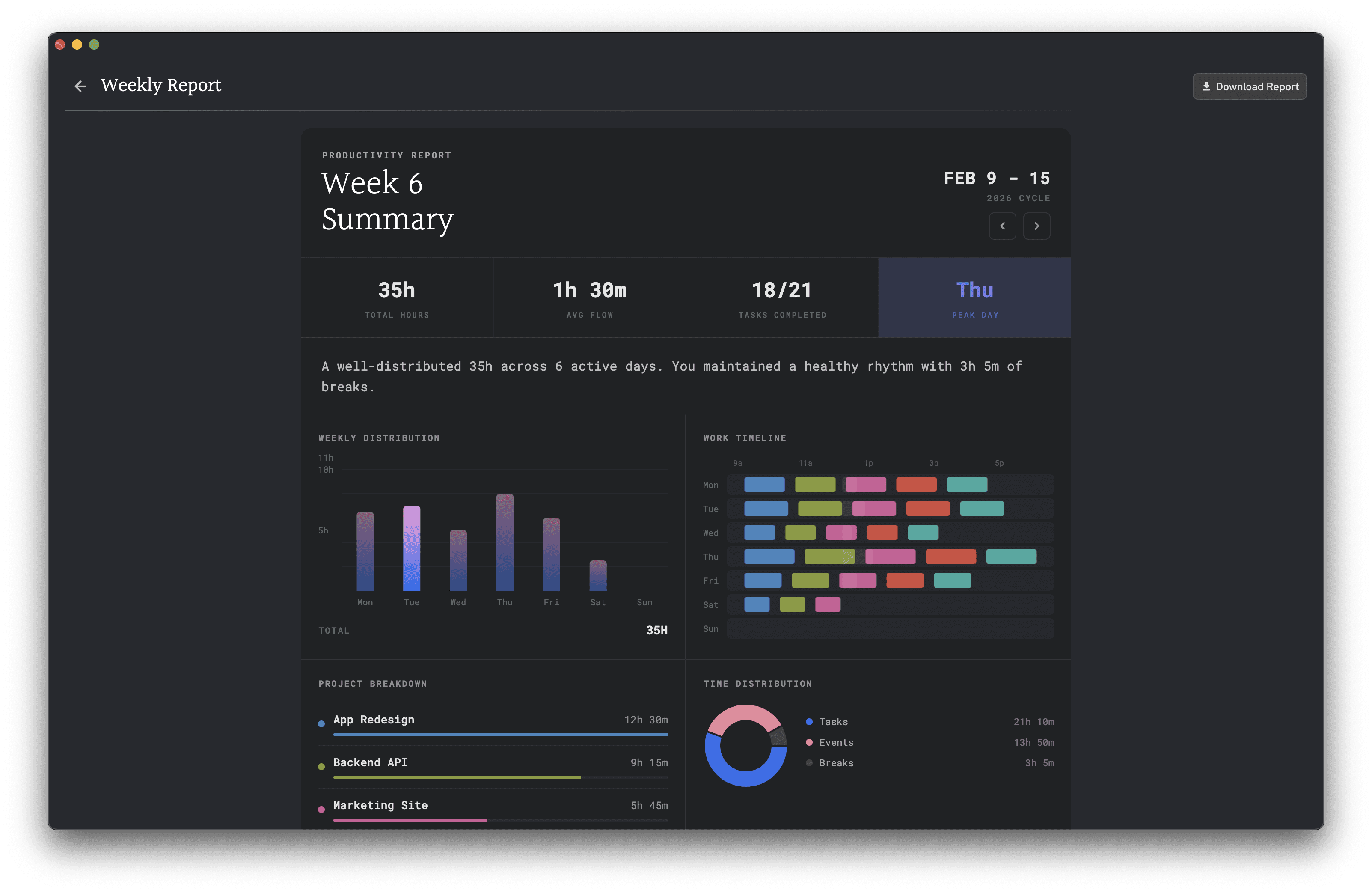
Focus Mode (Tab) removes everything from the screen except the current task and its time block. The background blurs. Completing a task with Enter immediately surfaces the next one. Press B for a break at any point. These are the structural conditions for sustained focus - single task, no navigation decisions, no visible distractions - that the research identifies as prerequisites for flow.
How To Start Tomorrow
Before your next focused work session, spend two minutes on setup: write down what you're trying to achieve in the session (clear goal), identify the specific first action, and rate the task difficulty against your current skill level - is it genuinely stretching you, or is it routine? If it's routine, find the version of it that requires more from you. Then protect the block from interruption and notice whether the quality of engagement differs from an unstructured session.
Related Principles
Deep Work - flow requires uninterrupted conditions
Attention Residue - switching destroys flow
Micro-Breaks - recovery between flow sessions
Autonomy - flow is intrinsically motivating
Related Reading
Best Deep Work Apps — Apps designed to create the conditions for flow: single task, no interruptions, appropriate challenge.
Best Deep Work Scheduling Apps — Scheduling tools that protect the unbroken blocks flow requires.
Best AI Tools to Protect Deep Work Time — AI tools that defend the session conditions flow depends on.
Does the Pomodoro Technique Work? — Why 25-minute intervals are often too short for flow and what to use instead.
Energy Management for Productivity — Scheduling flow sessions during biological peak windows is the highest-leverage combination.
Frequently Asked Questions
What is a flow state?
Flow is a state of optimal experience identified by Mihaly Csikszentmihalyi in which a person is fully absorbed in a challenging activity, losing awareness of time and self-consciousness. It is characterised by effortless concentration, intrinsic enjoyment, and a sense of control. Csikszentmihalyi's research identified it as one of the most reliably positive experiences humans report.
What conditions are required to enter flow?
Csikszentmihalyi's research identified the primary condition as a balance between challenge and skill: the task must be demanding enough to require full engagement but not so difficult as to produce anxiety. Additional conditions include clear goals, immediate feedback, and absence of interruption. Distraction-free environments, sufficient task expertise, and intrinsic motivation all support flow; external interruption and multitasking reliably prevent it.
Can you deliberately engineer flow states?
You can significantly improve the probability of flow by designing the conditions for it — protecting uninterrupted time, choosing tasks at the right difficulty level, clarifying goals before starting, and eliminating environmental distractions. You cannot force flow directly, but the research is consistent that the right conditions make it substantially more likely. Most people who report frequent flow have deliberately structured their work to match those conditions.
What is the difference between flow and deep work?
They describe overlapping but distinct things. Flow is a psychological state — a specific configuration of absorption, challenge-skill balance, and effortless performance. Deep work, Cal Newport's framework, is a practice: the deliberate scheduling of cognitively demanding, distraction-free work. Deep work is designed to create the conditions for flow, but it doesn't guarantee flow — you can do deep work without entering flow (the work is still valuable) and flow can occasionally occur outside scheduled deep work sessions. The practical relationship: deep work blocks are the structural container; flow is what happens inside that container when the conditions are right. Protecting uninterrupted deep work blocks is the highest-leverage thing you can do to make flow more frequent.
How long does it take to enter a flow state?
Flow typically takes 15–20 minutes of uninterrupted work to establish — a figure synthesised by Steven Kotler from the experience-sampling literature rather than from a single controlled study. Csikszentmihalyi's own experience-sampling research didn't measure entry time directly. The practical implication is well-supported: interruptions don't just break flow, they reset the entry clock. A 25-minute Pomodoro session may end just as flow is establishing. Blocks of 90 minutes or more give enough runway to enter, sustain, and exit flow deliberately.
Further Reading
Csikszentmihalyi, M. (1990). Flow: The Psychology of Optimal Experience. Harper and Row. ISBN: 978-0061339202
Nakamura, J., & Csikszentmihalyi, M. (2002). The concept of flow. In C. R. Snyder & S. J. Lopez (Eds.), Handbook of Positive Psychology. Oxford University Press.
Fong, C. J., et al. (2015). A meta-analytic review of the relationship between flow and performance. Manuscript, University of Texas at Austin. Note: the performance-wellbeing correlations (r = 0.16, r = 0.27) are from this synthesis; readers seeking peer-reviewed flow meta-analyses should also consult Peifer et al. (2020) in Frontiers in Psychology.
Peifer, C., et al. (2020). The Physiology of Flow: A Systematic Review of Instances, Measures, and the Relationship Between Flow and Physiological Hyperarousal. Frontiers in Psychology, 11, 1979. DOI: 10.3389/fpsyg.2020.01979
Csikszentmihalyi, M., & LeFevre, J. (1989). Optimal experience in work and leisure. Journal of Personality and Social Psychology, 56(5), 815-822. DOI: 10.1037/0022-3514.56.5.815