Best Productivity Apps for Solopreneurs in 2026: The Essential Stack
The best productivity apps for solopreneurs in 2026 — covering all 7 stack layers: calendar, tasks, scheduling links, invoicing, time tracking.
Written By The Aftertone Team

Best Productivity Apps for Solopreneurs in 2026
Solopreneurs have a fundamentally different productivity problem from employees or startup founders. There's no team to create external accountability, no manager to disappoint, and no organisational structure to catch work that falls through the gaps. The entire burden of choosing what to work on, scheduling when to do it, and evaluating whether the approach is working rests on one person who is simultaneously the CEO, the practitioner, the client manager, and the invoice department.
The tools that work for solopreneurs aren't the most feature-rich ones. They're the ones that create the right amount of structure for a single person — clear priorities, protected time, honest feedback on the system — without the overhead of managing a complex tool stack that ends up requiring more management than it saves.
This guide covers the tools that actually belong in a solopreneur's stack in 2026, organised by the specific job they do, with honest notes on what each costs and what to skip.
The solopreneur's specific productivity problems
No external accountability. Employees have managers. Startup founders have boards, investors, and co-founders. Solopreneurs have clients — but clients hold them accountable for outputs, not for how the time was spent. The internal accountability for whether time allocation is right, scheduling patterns are sustainable, and the system is working falls entirely on the solopreneur themselves.
Constant role-switching. One hour you're doing deep creative work. Next you're in a client call. Then you're handling admin, then invoicing, then marketing. Every tool that isn't ready when you switch roles is friction that compounds across fifty role-switches a week.
Subscription overhead compounds fast. A solopreneur stack of ten tools at $15/month each is $1,800/year — real overhead for a one-person business. The right discipline is choosing tools that each solve a distinct problem and ruthlessly cutting anything that duplicates another tool's function.
Professional tools at individual pricing. Consumer apps fall apart with client project complexity. Enterprise tools are built for teams and charge accordingly. The solopreneur sweet spot is business-grade tools priced for individual users — and there are more of them in 2026 than ever before.
The essential solopreneur stack: seven layers
A solopreneur productivity stack needs to cover seven distinct jobs. Most solopreneurs have strong tools for two or three of these and gaps in the rest.
Calendar and focus protection — protecting deep work time and knowing whether it's working
Task management — capturing all open commitments across client work and business admin
Scheduling links — eliminating back-and-forth email for external meetings
Knowledge management — client notes, business documentation, second brain
Time tracking — for billing or for knowing where time actually goes
Invoicing and payments — getting paid without an accounts department
Automation — removing manual work that repeats across the week
At a glance: the full solopreneur stack
Layer | Best pick | Budget pick | Price |
|---|---|---|---|
Calendar + focus | Aftertone (Mac) | Google Calendar | $30/mo / free |
Task management | Things 3 (Apple) | Todoist | $50 one-time / free |
Scheduling links | Cal.com | Google Meet link | Free |
Knowledge | Notion | Apple Notes | Free / $10/mo |
Time tracking | Toggl Track | Clockify | Free / $9/mo |
Invoicing | Wave | PayPal invoices | Free |
Automation | Zapier | Make (Integromat) | Free tier / $20/mo |
1. Aftertone — best for calendar intelligence and focus protection on Mac
Best for: Mac-based solopreneurs who want AI that surfaces whether their calendar reflects their business priorities and whether their scheduling patterns are sustainable — without team features or collaboration overhead.
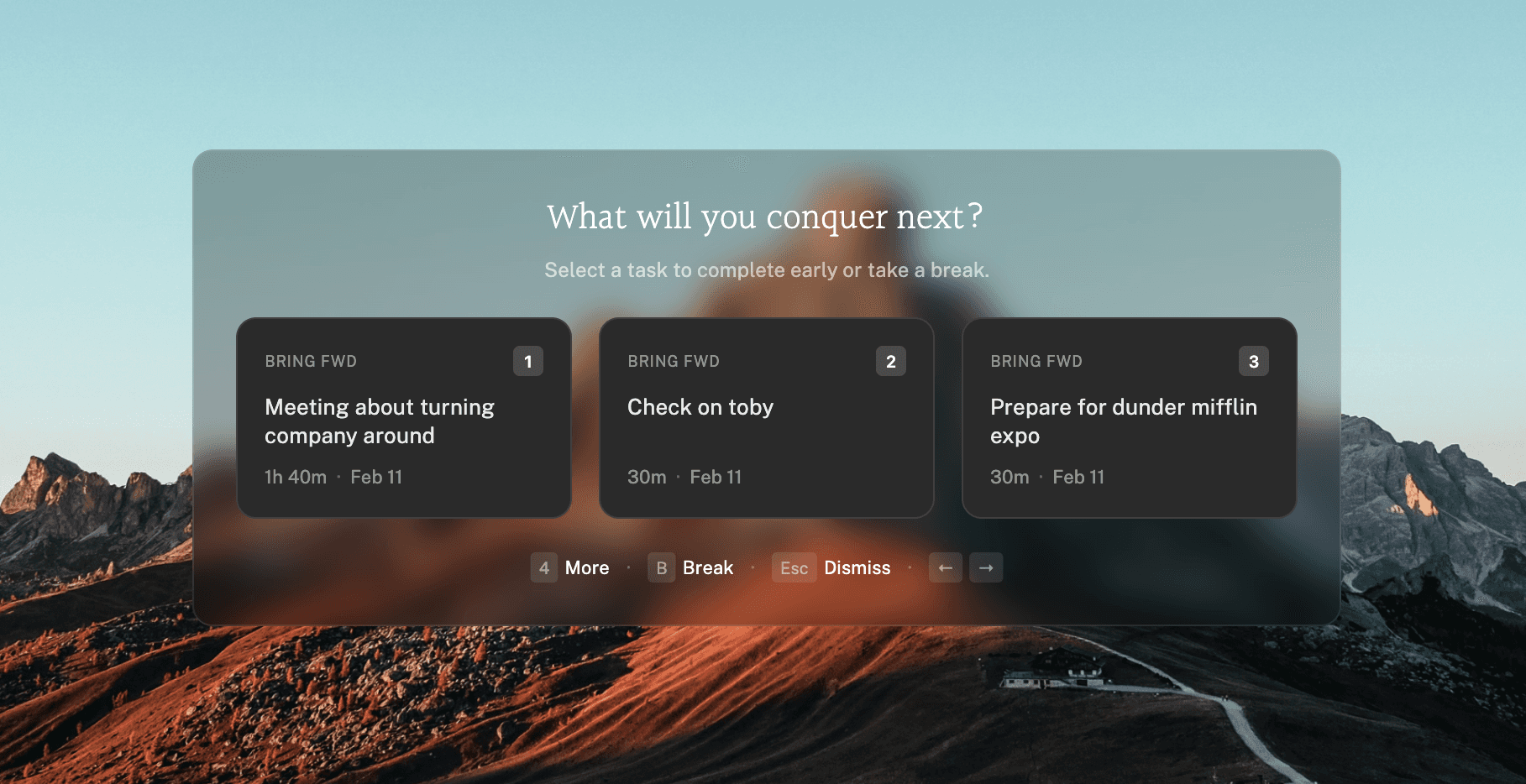
Aftertone addresses the solopreneur's accountability gap directly. There's no manager checking whether your deep work is protected. There's no co-founder to notice that you've been in shallow reactive work for three weeks. The AI weekly and daily reports read your calendar history and surface what that data reveals: whether your time allocation matches your business priorities, whether your deep work capacity is being protected or eroding, and whether this week's structure resembles the weeks where you've historically been most productive. Smart Capture converts pasted text or a screenshot into structured tasks instantly. The Focus Screen narrows the interface to the current task during work sessions. Smart Zoning moves tasks onto the calendar with keyboard shortcuts alone.
Pros:
AI weekly and daily reports provide the feedback loop a solopreneur has no manager to supply
Calendar and task management in one native Mac app — no separate systems to reconcile
Focus Screen for single-task execution during deep work sessions
No team features — designed for individual use without enterprise complexity
Cons:
Mac only — no Windows, no iOS yet
$30/month — the most expensive tool on this list
Google Calendar sync only (no iCloud or Outlook)
Pricing: $30/month. 7-day free trial, no card required.
2. Things 3 — best task management for Apple-ecosystem solopreneurs
Best for: Solopreneurs who want the best personal task manager on Apple with one-time pricing and no ongoing subscription overhead.
Things 3 is the natural task management choice for solopreneurs whose work spans multiple client projects and personal commitments. The Area-Project-Task hierarchy maps cleanly to client work, business development, and admin without requiring a system design degree. Quick Entry captures ideas and commitments instantly from anywhere. Cultured Code has maintained and updated Things 3 for over a decade — it's not going anywhere.
The one-time purchase model ($49.99 for Mac, $9.99 for iPhone) is particularly appealing for solopreneurs already managing multiple SaaS subscriptions. No ongoing cost, no feature degradation over time.
Pros:
One-time purchase — no subscription
Area-Project-Task hierarchy handles client work + business admin naturally
Best-in-class design for Apple platforms — calm, fast, keyboard-driven
Natural language date and time entry
Cons:
Apple only — no Android, Windows, or web
No calendar integration
No AI features
Pricing: $49.99 Mac (one-time). $9.99 iPhone (one-time).
Cross-platform alternative: Todoist (free / $4/month) — works on every platform, natural language input, 80+ integrations. The right choice for solopreneurs not exclusively on Apple.
3. Cal.com — best scheduling links (free Calendly replacement)
Best for: Every solopreneur who currently pays for Calendly or sends back-and-forth availability emails.
Cal.com is the open-source Calendly alternative that covers every feature most solopreneurs actually use — routing pages, multiple meeting types, calendar integration, video conferencing links — at zero cost. Cal.com's free tier is genuinely comprehensive, not a stripped-down trial. The enterprise tier adds routing forms, team scheduling, and Salesforce integration for the cases where the free tier isn't enough.
Every solopreneur who schedules external meetings should have a scheduling link. The back-and-forth email alternative wastes fifteen minutes per meeting and signals a lack of professional infrastructure. Cal.com solves this at no cost.
Pros:
Free for all core scheduling features — unlimited meeting types, routing pages
Open-source — no vendor lock-in, data under your control
Integrates with Google Calendar, Outlook, Zoom, Google Meet, and more
Custom domains on paid plans — professional booking page at your URL
Cons:
Less polished than Calendly — setup requires more configuration
Smaller ecosystem than Calendly for enterprise CRM integrations
Pricing: Free. Enterprise from $15/month.
Alternative: Calendly (free tier / $10/month) — more polished, larger ecosystem, costs money for advanced features Cal.com provides free.
4. Notion — best flexible knowledge base for solopreneurs
Best for: Solopreneurs who want one workspace for client notes, project management, second brain, and business documentation — without paying for a separate CRM, wiki, and project tool.
Notion is where many solopreneurs eventually consolidate: client CRM, project tracker, meeting notes, knowledge base, invoicing tracker, and business documentation in a single flexible workspace. The AI features add drafting and summarisation. The template ecosystem reduces setup time considerably.
The risk Notion always carries: the flexibility that makes it powerful for a well-maintained system makes it a liability for a neglected one. Solopreneurs who don't maintain a weekly review of their Notion workspace often find it slowly filling with unread documents and orphaned pages. The tool rewards discipline it doesn't enforce.
Pros:
One workspace for tasks, notes, docs, CRM, and knowledge — reduces tool count
Free tier is genuinely useful for individuals
AI features for drafting, summarising, and searching across your workspace
Notion Calendar (free) integrates events alongside tasks
Cons:
Flexible system that rewards discipline it doesn't enforce — can become a mess
No native calendar intelligence or AI scheduling
Performance degrades with large databases
Pricing: Free tier. Plus $10/month annual.
5. Toggl Track — best time tracking for solopreneurs who bill by the hour
Best for: Solopreneurs with billable hour requirements who need accurate time tracking across client projects, or those who want empirical data on where their time actually goes.
Toggl Track is the most-used time tracker among freelancers for a straightforward reason: one-click timers, project tagging, and client reporting that converts tracked time into invoiceable data with minimal friction. The free tier covers most solopreneur needs. The integration with billing tools and calendar apps makes it part of a functional time-to-invoice workflow.
Even for solopreneurs who don't bill by the hour, Toggl's weekly reports surface the reality of time allocation — often revealing that the ratio of client delivery to business development to admin is significantly different from what the solopreneur believed. Most people who start tracking are surprised by the data.
Pros:
One-click timer start — minimum friction for consistent tracking
Client and project tagging for invoiceable reporting
Free tier covers most solopreneur use cases
Available on all platforms
Cons:
Manual timers — requires the discipline to start and stop tracking
No automatic activity tracking (Timing for Mac does this automatically)
Pricing: Free tier. Starter $9/user/month.
Mac automatic alternative: Timing ($8/month) — tracks all activity in the background without manual timers. Better for solopreneurs who know they won't remember to start and stop Toggl consistently.
6. Wave — best free invoicing and accounting for solopreneurs
Best for: Solopreneurs who need professional invoicing, expense tracking, and basic accounting without paying for QuickBooks or hiring a bookkeeper.
Wave is free invoicing, accounting, and receipt scanning software built specifically for small businesses and solopreneurs. Send unlimited invoices, track expenses, and connect bank accounts for automatic reconciliation — all at zero cost. Payments processing is available for a transaction fee (2.9% + 60¢ per card payment). For solopreneurs billing clients monthly and tracking basic business expenses, Wave covers everything without a subscription.
Pros:
Invoicing, accounting, and expense tracking completely free
Professional invoice templates with automatic payment reminders
Bank connection for automatic expense categorisation
No subscription — just payment processing fees when clients pay online
Cons:
US and Canada primary focus — limited support for international tax requirements
Less sophisticated than QuickBooks for complex accounting needs
Payment processing fees are higher than some alternatives
Pricing: Free. Payments: 2.9% + 60¢ per transaction.
Alternative for UK/EU solopreneurs: FreeAgent or Xero — better international tax support, both paid.
7. Zapier — best no-code automation for solopreneurs
Best for: Solopreneurs who find themselves doing the same manual transfer of information between tools more than three times a week — and want to eliminate it without writing code.
Zapier connects your tools and automates repetitive transfers: a new Calendly booking creates a Notion client record and sends a welcome email; a completed Toggl timer entry populates a Google Sheet invoice tracker; a new form submission creates a Todoist task and sends a Slack DM. The free tier covers 100 tasks per month — enough for basic automation. The Starter plan ($20/month) covers most solopreneur automation needs.
The ROI calculation for automation is straightforward: if a Zap saves ten minutes of manual work per day, it saves 40+ hours per year. At $20/month, that's $240/year to recover 40 hours of work time. For most solopreneurs, the math works out clearly in favour of at least one automation layer.
Pros:
Connects 6,000+ apps — covers virtually every tool in a solopreneur stack
No-code — no technical knowledge required
Free tier covers basic automation (100 tasks/month)
Multi-step Zaps chain several actions from one trigger
Cons:
Free tier is limited — 100 tasks/month runs out quickly for active users
Paid tiers add up — Starter $20/month, Professional $49/month
More complex automations require time to set up correctly
Pricing: Free (100 tasks/month). Starter $20/month (750 tasks).
Alternative: Make (formerly Integromat) — more powerful for complex multi-step automations, steeper learning curve, lower price per task.
The solopreneur's invisible accountability gap
Employees have managers. Startup founders have boards. Solopreneurs have clients — but clients hold them accountable for outputs, not for the internal choices that produce those outputs: whether the time allocation is right, whether the scheduling patterns are sustainable, whether the system is working or slowly degrading.
That accountability is hardest to maintain without data. Most solopreneurs have a vague sense of whether a week felt productive. Very few have a systematic read on whether their calendar is reflecting their actual business priorities, whether their deep work capacity is trending up or down, or whether the ratio of client delivery to business development is where it needs to be.
Aftertone's weekly reports provide that data systematically — the accountability loop a manager, co-founder, or board would otherwise supply. The tools above handle the execution. The weekly report handles the evaluation. Together they close the feedback loop that every solopreneur's system needs and most are missing.
The minimum viable solopreneur stack
If budget is the primary constraint, the minimum viable stack that covers all seven layers at the lowest cost:
Calendar: Google Calendar (free)
Tasks: Todoist free tier
Scheduling: Cal.com free tier
Knowledge: Notion free tier
Time tracking: Toggl Track free tier
Invoicing: Wave (free)
Automation: Zapier free tier (100 tasks/month)
Total ongoing monthly cost: zero. This stack is more complete than most solopreneurs' current setups, covers every essential layer, and scales to paid tiers in each category as the business grows and the ROI becomes clear.
Frequently asked questions
What are the best productivity apps for solopreneurs in 2026?
The most effective solopreneur stack covers seven layers: calendar and focus protection (Aftertone for Mac, or Google Calendar free), task management (Things 3 one-time purchase for Apple, or Todoist free cross-platform), scheduling links (Cal.com, free), knowledge management (Notion, free tier), time tracking (Toggl Track, free tier), invoicing (Wave, free), and automation (Zapier free tier). The full stack can cost nothing if budget is the constraint — every recommended tool has a free tier.
What is the difference between solopreneur and freelancer productivity needs?
Freelancers typically work within a client's systems and processes, with the client providing structure and accountability. Solopreneurs run an entire business — including client acquisition, delivery, invoicing, and business development — with no external structure. The productivity gap for solopreneurs is wider because they're responsible for every layer of the system, not just execution. Tools that create internal accountability (Aftertone's weekly reports), professional infrastructure (Cal.com scheduling, Wave invoicing), and system automation (Zapier) matter more for solopreneurs than for freelancers who operate within a client's existing systems.
Is Notion good for solopreneurs?
Yes, as a knowledge management and documentation hub — not as a task manager or calendar. Notion handles the growing business knowledge base that doesn't fit neatly elsewhere: client CRM, meeting notes, project specs, business documentation. The free tier serves most solopreneurs; Plus at $10/month adds collaboration features and extended version history. The risk is that Notion's flexibility is only valuable if it's actively maintained — neglected Notion workspaces become unusable faster than neglected simpler tools.
Do solopreneurs need invoicing software?
Yes. Manual invoice creation in Word or Google Docs looks unprofessional and creates tracking overhead. Wave is free invoicing, accounting, and expense tracking software that eliminates this overhead at zero subscription cost. Payment processing fees apply when clients pay online (2.9% + 60¢), but the invoicing and accounting functionality is free. For UK/EU solopreneurs, FreeAgent or Xero handle international tax requirements better.
What is the best free productivity stack for solopreneurs?
Google Calendar (free) + Todoist free tier + Cal.com free tier + Notion free tier + Toggl Track free tier + Wave free + Zapier free tier. This covers all seven layers — calendar, tasks, scheduling, knowledge, time tracking, invoicing, and automation — at zero monthly cost. Each tool has paid tiers that become worth evaluating as the business grows and the value of upgrading becomes clear.
Should solopreneurs use an AI scheduling tool like Motion?
Motion is worth evaluating for solopreneurs with complex, volatile task loads — particularly during busy periods like product launches or client delivery sprints when the overhead of manual scheduling is high. At $19/month, it replaces both a calendar tool and a task manager through AI automation. The alternative for Mac solopreneurs is Aftertone — manual time blocking with AI analysis of the results rather than AI doing the scheduling autonomously. Motion optimises your schedule. Aftertone tells you whether your schedule is working.