The Principle
The workday ends but the work doesn't. You're at dinner thinking about the email you haven't sent. You're in bed running through tomorrow's agenda. You're technically off the clock but cognitively still at your desk - monitoring, processing, planning. It doesn't feel like a problem because you're not doing anything. But your nervous system doesn't make that distinction.
Psychological detachment - genuinely not thinking about work during off-hours - is the single strongest predictor of reduced fatigue identified in occupational health research. A meta-analysis by Bennett, Bakker and Field across more than 26,000 participants found it outperformed every other recovery experience in its relationship to fatigue outcomes. The mechanism is straightforward: sustained cognitive engagement with work, even passive rumination, maintains the same stress response that active work does. Recovery requires genuinely switching off, not just physically leaving.

Definition
Recovery isn't just about not working - it's about mentally letting go of work. Psychological detachment means not thinking about work tasks, not checking work email, and not ruminating about work problems during your off-hours. It's the single most powerful recovery experience researchers have identified.
What The Research Shows
Bennett, Bakker & Field (2018) meta-analyzed 299 effect sizes (N = 26,592) and found psychological detachment had the strongest negative relationship with fatigue of all recovery experiences, explaining up to 62% more variance in outcomes beyond work characteristics alone.
Sonnentag & Fritz (2007) identified four key recovery experiences: psychological detachment, relaxation, mastery, and control. Steed et al. (2021) meta-analyzed 198 samples confirming positive relationships between recovery and well-being, resources, and performance. Karabinski et al. (2021) showed detachment interventions are effective, especially for those with existing health impairments.

What This Means
Psychologically detaching from work during off-hours is the single strongest predictor of reduced fatigue across all recovery experiences studied. Genuinely not thinking about work is categorically different from simply not doing it.
What Most People Get Wrong
The common framing is that rest means not working.
The research on recovery distinguishes between physical absence from work and psychological detachment from it. Checking email from the sofa, ruminating about the next day while trying to sleep, or mentally rehearsing difficult conversations while nominally off duty does not provide recovery. The brain needs to genuinely disengage, not just change location.
When it Fails…
High-demand roles may not permit full detachment. Startups, caregiving situations, and on-call work create genuine structural barriers to psychological disconnection.
Detachment alone does not fix overwork. Forced disconnection without addressing the underlying workload or autonomy issues does not produce sustainable recovery.
The relationship is primarily correlational. Poor detachment may partly be a symptom of overwork rather than its cause.
What This Means For You…
The modern work culture that treats availability as professionalism makes genuine detachment increasingly rare - and increasingly necessary. If you finish every day slightly more depleted than you started, and wake up most mornings without feeling restored, the problem is almost certainly insufficient psychological detachment during your off-hours. The solution is not just stopping work earlier. It's creating a deliberate transition - a ritual that signals to your brain that the workday is closed - and then protecting that boundary. Sleep is the most fundamental recovery mechanism you have. Psychological detachment is what makes sleep actually restorative.
How Aftertone Implements It.
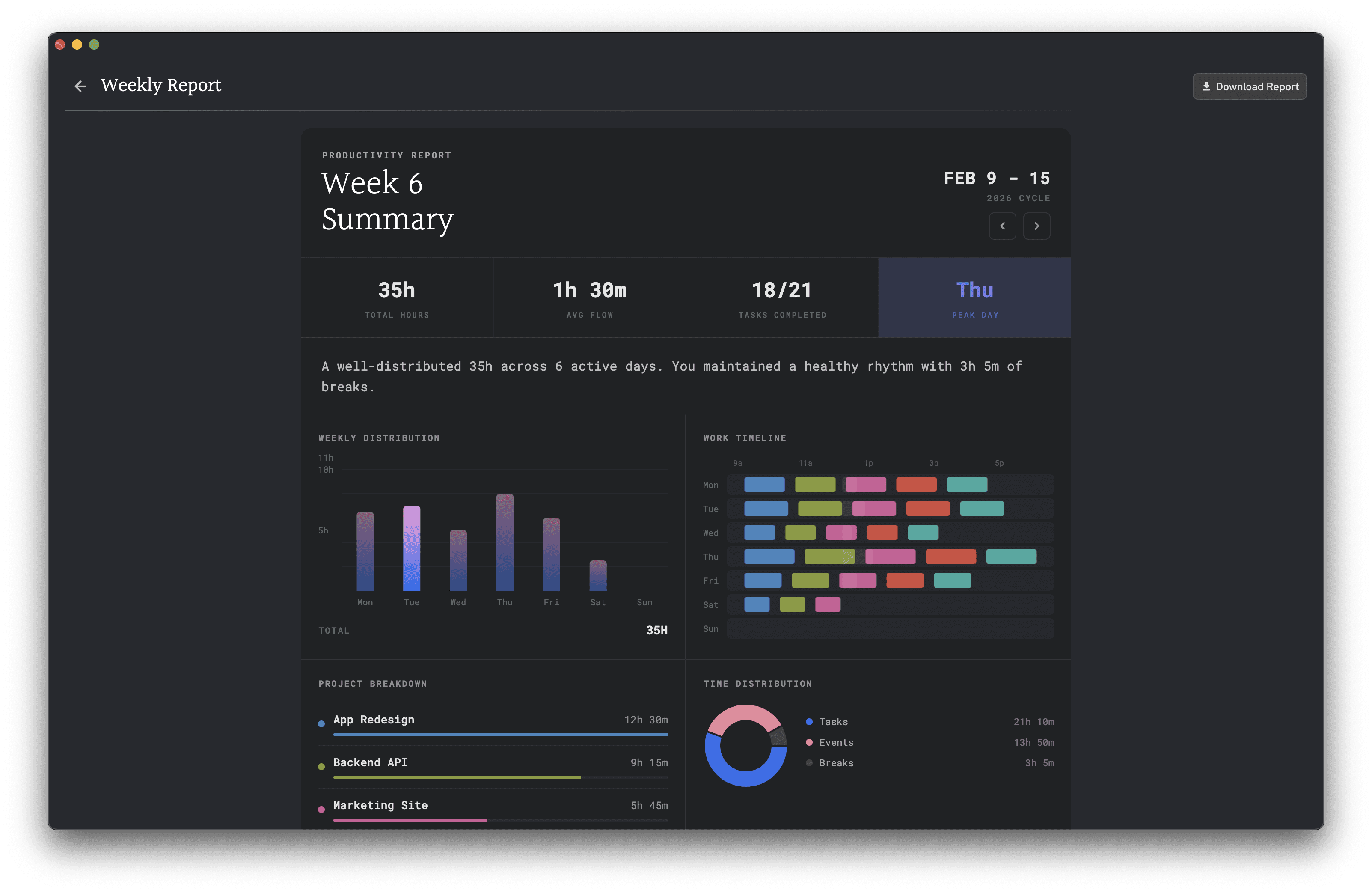
The weekly planning ritual ends with the calendar blocked and the inbox clear. Quick Capture (Option+Space) means that if something occurs to you in the evening, you can capture it to the inbox in seconds and return to what you were doing - the loop is closed without requiring you to open the full app or start planning.
How To Start Tomorrow
Design a five-minute end-of-day ritual that you perform consistently before closing your laptop: write down the three most important things for tomorrow, note one thing that went well today, then physically close your computer and say - out loud if it helps - "work is done." The ritual creates a cognitive boundary. Do it for two weeks and notice whether your evenings feel different when the transition is deliberate rather than gradual.
Related Principles
Micro-Breaks - micro-breaks are within-day recovery; detachment is between-day recovery
Sleep Deprivation - poor detachment impairs sleep, which impairs next-day cognition
Bedtime To-Do Lists and Sleep - an evening planning ritual supports psychological closure and detachment
Autonomy and Intrinsic Motivation - autonomy over recovery timing is essential
Related Reading
Best Deep Work Apps — Tools that make it easier to finish cleanly and actually stop — not just pause.
Best AI Tools to Protect Deep Work Time — AI tools that protect your recovery time with the same logic they use to protect your focus time.
Best Productivity Apps for Solopreneurs — Solopreneurs struggle most with stopping — these apps help draw the line.
Frequently Asked Questions
What does psychological detachment from work mean?
Psychological detachment is the mental state of not engaging with work-related thoughts during off-work time. It is distinct from physical absence from work — you can be at home and still psychologically present at the office if your mind is running through tomorrow's tasks, replaying difficult conversations, or monitoring email. True detachment means the mind has disengaged from work content, not just the workplace.
Why does switching off improve next-day performance?
Sonnentag's research found that psychological detachment during evenings and weekends predicts better next-day vigour, engagement, and performance. The mechanism is genuine cognitive and emotional restoration: resources depleted during work — attention, self-regulation, emotional resilience — are replenished during true recovery periods. Incomplete detachment leaves the restoration process incomplete, compounding fatigue across the week.
What activities promote genuine recovery?
Research identifies four recovery experiences that matter: psychological detachment, relaxation, mastery experiences (learning something new outside work), and control over leisure time. Not all rest is equally restorative. Watching television passively produces some relaxation but limited recovery. Physical exercise, social connection, and absorbing hobbies tend to produce stronger recovery effects — particularly when they involve genuine disengagement from work-related concerns.
Does working from home make detachment harder?
Consistently yes. When the physical boundary between work and home disappears, psychological detachment requires more deliberate effort. Research shows remote workers report more difficulty disengaging and more work-related rumination during off-hours. Structural cues that signal end-of-work — a shutdown ritual, a dedicated workspace that is physically closed, changing clothes — help recreate the psychological boundary that physical commuting once provided automatically.
Further Reading
Bennett, A. A., Bakker, A. B., & Field, J. G. (2018). Recovery from work-related effort: A meta-analysis. Journal of Organizational Behavior, 39(3), 262-275. DOI: 10.1002/job.2217
Sonnentag, S., & Fritz, C. (2007). The Recovery Experience Questionnaire: Development and validation. Journal of Occupational Health Psychology, 12(3), 204-221. DOI: 10.1037/1076-8998.12.3.204