The Principle
The advice is everywhere: work in 90-minute blocks, aligned to your body's natural ultradian rhythms. It sounds scientific. It has a biological mechanism attached to it. It's been repeated so often in productivity writing that it feels established. There's just one problem: the research doesn't support it.
The foundational citation most often used to support the 90-minute cognitive cycle was, on examination, a study that found no significant 90-minute periodicity in cognitive performance - the opposite of the claimed finding. No robust peer-reviewed study has demonstrated a reliable 90-minute cognitive performance cycle. The practical advice to take breaks every 60 to 120 minutes is reasonable - but that range is based on general fatigue research, not a specific biological rhythm. The 90-minute figure is precise in a way the evidence simply doesn't support.

Definition
Many productivity systems claim your body runs on 90-minute ultradian cycles, and that you should work in 90-minute bursts with breaks in between. The actual evidence for a specific 90-minute cognitive rhythm is weak to nonexistent. Most people do well with flexible blocks of 60-120 minutes.
What The Research Shows
Neubauer & Freudenthaler (1995) specifically tested for 90-minute periodicity in cognitive performance and found no significant cycle - directly contradicting the claim most often made in productivity writing. No subsequent peer-reviewed study has demonstrated a reliable 90-minute cognitive performance rhythm.
Ericsson, Krampe & Tesch-Romer (1993) are sometimes cited as the source of the 90-minute claim, but that research concerns optimal session lengths for skill acquisition during deliberate practice - not biological ultradian cycles. The practical recommendation to take breaks every 60 to 120 minutes is supported by fatigue research, but the specific 90-minute figure is not tied to any identified biological mechanism.

What This Means
No peer-reviewed study has demonstrated a reliable 90-minute cognitive performance cycle. The most commonly cited source for this claim found no significant 90-minute periodicity when examined directly - the specific figure has no scientific basis.
What Most People Get Wrong
The 90-minute work cycle is presented as established science in much productivity writing.
The source most often cited for this claim directly contradicts it on examination. No study has found a reliable 90-minute periodicity in cognitive performance. The recommendation to take breaks every 60 to 120 minutes is sensible, but the specific 90-minute figure implies a precision that the evidence does not support.
When it Fails…
The principle itself is not well supported. People who have built routines around 90-minute blocks may find them effective through habit and expectation, not biology.
Rigid cycles are especially problematic for ADHD. Fixed-duration blocks assume consistent time perception that ADHD disrupts.
Any fixed cycle can become its own perfectionism. Treating a personally discovered rhythm as a rule creates the same rigidity the 90-minute myth did.
What This Means For You…
The honest version of this principle is: find your own rhythm. Some people do their best focused work in 45-minute sessions. Others can sustain 2 hours before needing a break. The right block length for you depends on the type of work, your energy at that time of day, and how practiced you are at sustained focus - not on a universal biological cycle. Experiment with different block lengths and pay attention to when your thinking actually starts to decline, rather than when a fixed timer tells you to stop.
How Aftertone Implements It.
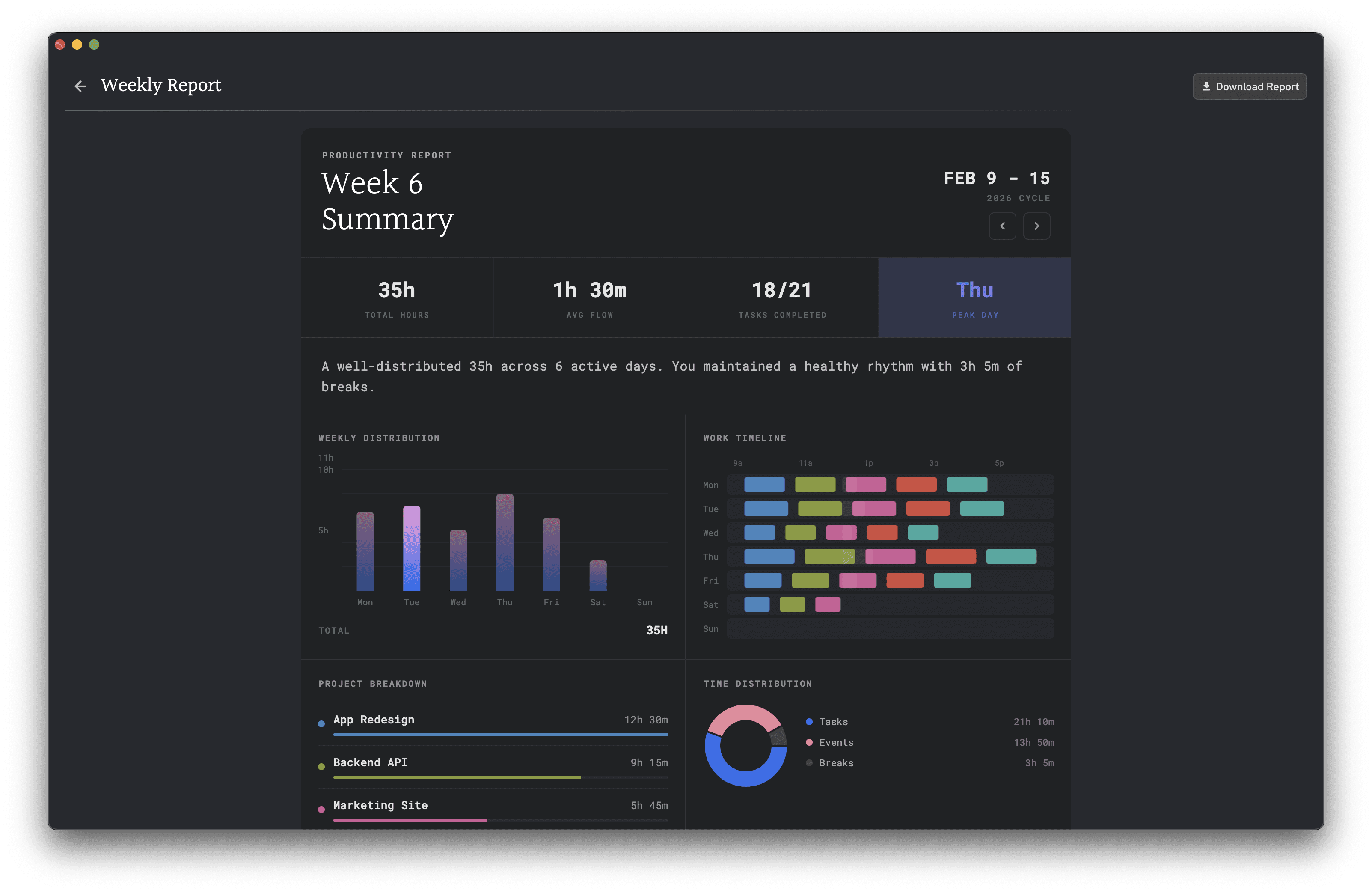
Aftertone does not prescribe a block duration. When you drag a task onto the calendar or create a time block, you set the duration yourself. The work timeline in the weekly report shows your actual focus patterns across the week - the length of real completed sessions - which is more informative than any prescribed cycle.
How To Start Tomorrow
For the next week, don't use a fixed block timer. Instead, work until you notice your focus genuinely fading - not until a timer goes off - then take a break. At the end of each session, note how long it lasted. After five sessions, look at the pattern. That range is your actual focus rhythm, not a prescribed one.
Related Principles
Micro-Breaks - the question of when to take breaks is related but the 90-minute answer is unsupported
Deep Work / Protected Focus Blocks - optimal focus duration varies by individual, not by a fixed cycle
Recovery and Detachment - within-day recovery timing should be flexible
ADHD and Rigid Scheduling - fixed cycles are especially problematic for ADHD users
Related Reading
Best Deep Work Apps — Apps built around 90-minute focus architecture — the practical application of this research.
Best Deep Work Scheduling Apps — Tools that let you structure your day around energy cycles rather than arbitrary slots.
Best Mac Calendar Apps for Deep Work — Mac calendar apps that make 90-minute deep work blocks the default unit of scheduling.
Frequently Asked Questions
What are ultradian rhythms?
Ultradian rhythms are biological cycles shorter than 24 hours that recur multiple times throughout the day. They include cycles of alertness and rest, hormone fluctuations, and sleep stage patterns. The claim that cognitive performance follows a reliable 90-minute work-rest cycle — popularised in productivity writing — draws on ultradian rhythm research, but the application to daytime work performance is more contested than widely presented.
Is the 90-minute work cycle actually supported by research?
Weakly. The 90-minute figure comes primarily from Kleitman's basic rest-activity cycle (BRAC), which was documented in sleep research and extrapolated to waking performance. Direct evidence that cognitive performance reliably peaks and troughs in 90-minute cycles during daytime work is limited and inconsistent. The cycle exists in sleep but has not been robustly demonstrated to govern waking cognition in the way productivity advice suggests.
Should you structure your work in 90-minute blocks?
Working in sustained blocks with intentional breaks is well-supported by research — the specific 90-minute figure is not the critical variable. The evidence supports focused work periods followed by genuine rest, but the optimal duration varies significantly between people and task types. Treating 90 minutes as a rough starting point for experimentation is reasonable; treating it as a scientifically established biological mandate is not.
How can you find your own optimal work rhythm?
Track your own performance patterns across several weeks — when you produce your best work, how long sessions feel sustainable before quality drops, and how different break lengths affect subsequent performance. This individual calibration produces more accurate and actionable guidance than applying a population-level average that may not match your own physiological and cognitive profile.
Further Reading
Neubauer, A. C., & Freudenthaler, H. H. (1995). Ultradian rhythms in cognitive performance: No evidence for a 1.5-h rhythm. Biological Psychology, 40(3), 281-298. PMID: 7669837. Note: this study found no significant 90-minute periodicity, directly contradicting the popular claim.