The Principle
You lie down and your brain immediately starts running through tomorrow. The email you need to send. The meeting you're not prepared for. The thing you almost forgot. It's not anxiety exactly - it's your brain doing its job, trying to keep track of unfinished business at midnight, when you need it to stop.
Writing a specific to-do list before bed gives your brain permission to let go. Research by Scullin and colleagues found that writing tomorrow's tasks - not journaling about today, not general reflection, but a concrete forward-facing list - helped people fall asleep significantly faster. The more specific the list, the stronger the effect. The mechanism is the same as cognitive offloading: a written plan closes the mental loop, and the loop stops running.

Definition
Your brain treats tomorrow's unfinished business like an open browser tab - it keeps running in the background. Writing a specific to-do list before bed offloads those tasks, letting your mind release them so you can fall asleep faster. The more detailed the list, the better it works.
What The Research Shows
Scullin et al. (2018) ran a polysomnography RCT with 57 healthy young adults: those who spent 5 minutes writing tomorrow's to-do list fell asleep ~9 minutes faster (mean SOL ~16 vs. ~25 min) than those who journaled about completed activities. Greater specificity in the to-do list correlated with faster sleep onset (r = -0.42). The effect size is comparable to some pharmaceutical sleep interventions.
Syrek et al. (2017) showed unfinished tasks impair weekend sleep via affective rumination across 357 observations over 12 weeks. Limitations: single-night design, young healthy adults only, small sample.

What This Means
People who wrote a specific to-do list for tomorrow before bed fell asleep around nine minutes faster than those who journaled about their day. The more specific the list, the faster they fell asleep.
What Most People Get Wrong
Most people assume that thinking about work before bed is what causes poor sleep.
The research distinguishes between types of pre-bed thinking. Vague rumination and worry do interfere with sleep. But writing a specific, concrete plan for tomorrow actually accelerates sleep onset. The act of planning closes the mental loops that would otherwise keep running. Journaling about what you have already done does not produce the same effect.
When it Fails…
Limited sample. The study tested only young healthy adults aged 18-30 for a single night - effects in older adults or chronic poor sleepers are untested.
Clinical insomnia may not respond. People with anxiety disorders or clinical insomnia may find task-listing before bed activating rather than calming.
Past-focused journaling doesn't work. Writing about what you have already done that day did not produce the same sleep benefit - the list must be forward-facing.
What This Means For You…
If you regularly lie awake running through tomorrow, the problem probably isn't anxiety - it's unfinished planning. Your brain hasn't been given a clear signal that the day is accounted for, so it keeps checking. A five-minute to-do list before bed is less about productivity and more about giving your mind the closure it needs to switch off. Specificity matters: "work on the project" keeps the loop open. "Write the intro at 9am" closes it. This is one of the few productivity interventions tested in a sleep lab with objective measures - it's not anecdotal.
How Aftertone Implements It.
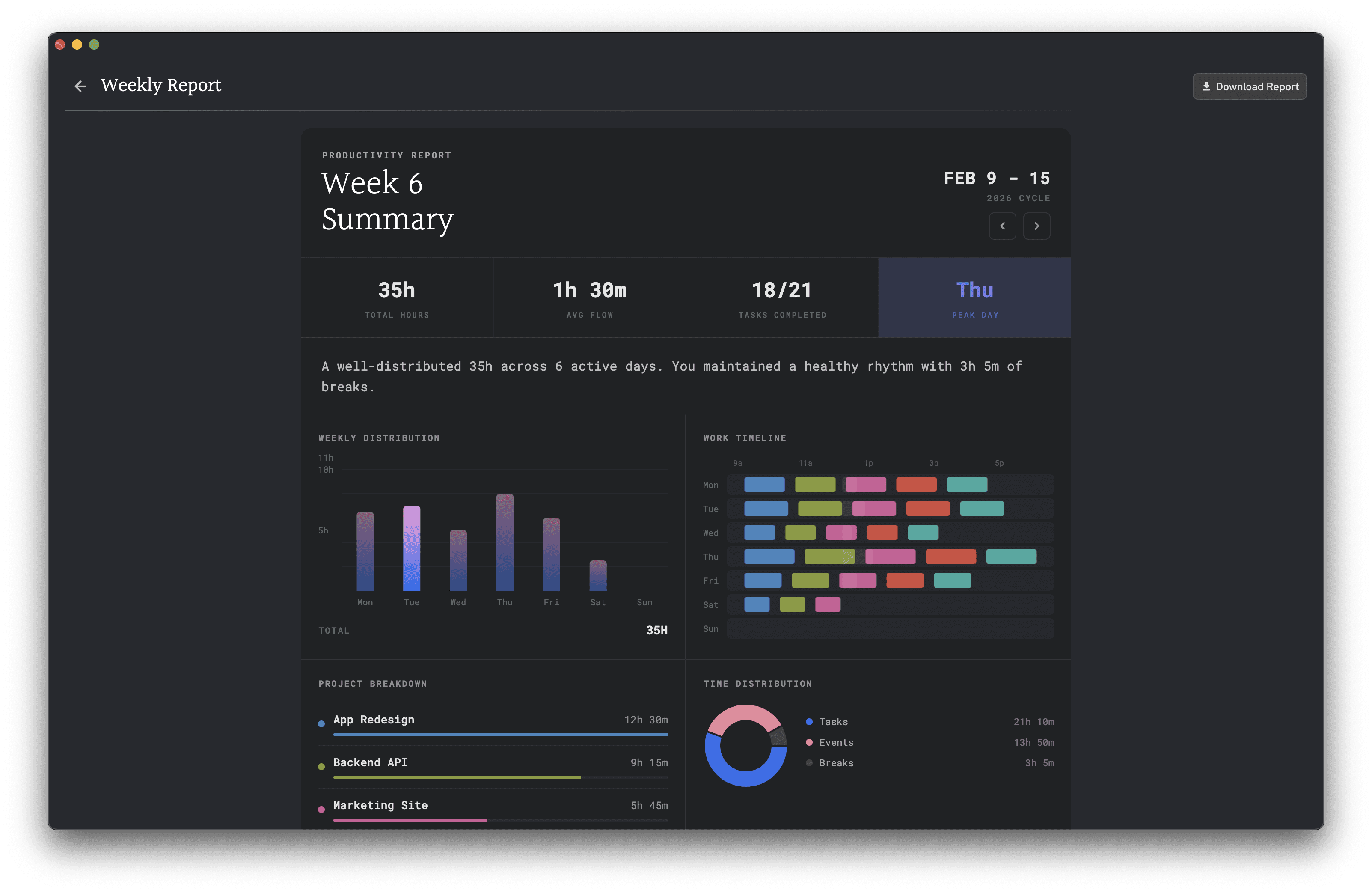
The weekly planning ritual in Aftertone is designed to be done Sunday evening or Monday morning. Working through your inbox with Shift+P, assigning every task a specific date, and blocking time for your top three priorities creates the same forward-facing specificity the research identifies as the active ingredient in pre-sleep to-do lists. The goal is to end each week with zero unplanned tasks - nothing left running as an open loop.
How To Start Tomorrow
Tonight, five minutes before bed, write tomorrow's to-do list on paper - specifically what you'll do, with enough detail that you don't need to think about it again. Then put it down. Track how long it takes you to fall asleep compared to nights you skip it.
Related Principles
Cognitive Offloading - bedtime lists are cognitive offloading applied to sleep
Cognitive Offloading - the bedtime list works because it closes the same mental loops that cognitive offloading addresses during the day
Implementation Intentions - the more specific the list, the better it works, mirroring if-then planning
Related Reading
Best AI Daily Planning Tools — Tools that make it easy to plan tomorrow before you finish today.
Best Weekly Review Apps — Weekly review apps that help you close open loops at the end of the week, not just the day.
Best Productivity Apps for Solopreneurs — For solopreneurs, the line between work and rest is blurry — these apps help draw it.
Frequently Asked Questions
Does writing a to-do list before bed actually help you sleep faster?
Yes. A polysomnography RCT by Scullin et al. (2018) found that participants who spent 5 minutes writing tomorrow's to-do list fell asleep around 9 minutes faster than those who journaled about completed activities. The effect was measurable in a sleep lab using objective recording equipment, not self-report.
Why does a forward-looking list help more than journaling about today?
The mechanism is cognitive offloading: your brain keeps circling back to unresolved future tasks. Writing a specific forward-facing plan signals to your brain that these tasks are accounted for, reducing the intrusive thoughts that delay sleep. Journaling about past completed activities does not produce the same effect because it does not close open loops.
How specific does the bedtime to-do list need to be?
More specific is better. Scullin's study found that specificity in the list correlated with faster sleep onset (r = -0.42). A list of concrete tasks with enough detail that you would not need to think about them again is more effective than vague intentions. "Email Sarah about the Q3 report" works better than "sort out work stuff."
Will this work if I have clinical insomnia or anxiety?
The research was conducted on healthy young adults aged 18–30 and has not been tested in clinical populations. People with anxiety disorders or chronic insomnia may find that engaging with task lists before bed is activating rather than calming. If sleep difficulty is a clinical concern, speaking with a specialist is more appropriate than applying this technique alone.
Further Reading
Scullin, M. K., et al. (2018). The effects of bedtime writing on difficulty falling asleep. Journal of Experimental Psychology: General, 147(1), 139-146. DOI: 10.1037/xge0000374