The Principle
You're in a meeting, but part of your mind is still on the email you need to send. You're writing, but a corner of your attention keeps circling back to the thing you promised and haven't planned yet. Unfinished tasks don't sit quietly - they keep interrupting, demanding attention until they're resolved or accounted for.
Cognitive offloading is the practice of moving that mental burden outward - onto paper, a system, a trusted list - so your working memory can let go. The research shows that what quiets the mental loop isn't finishing the task. It's making a concrete plan for when and how you'll handle it. The brain treats a specific plan almost like completion. The intrusive thoughts stop. The focus returns.

Definition
When you have an unfulfilled goal rattling around in your head, your brain keeps returning to it involuntarily - a phenomenon related to the Zeigarnik effect. Research shows that simply making a concrete plan for when and how you'll address the task shuts down these intrusive thoughts, freeing your mind for the work in front of you.
What The Research Shows
Masicampo & Baumeister (2011) conducted five lab experiments showing that making specific plans for unfulfilled goals eliminated their cognitive interference - intrusive thought frequency dropped from ~3.0 to ~1.8 on a 7-point scale. Scullin et al. (2018) extended this to sleep: participants who wrote specific to-do lists before bed fell asleep 9 minutes faster than those who journaled about completed activities, verified by polysomnography. Syrek et al. (2017) showed unfinished Friday tasks impair weekend sleep via affective rumination across 357 observations over 12 weeks. Key limitation: Masicampo studies were lab-based with short time horizons.

What This Means
Writing a task down with a specific plan stops your brain from intruding on that task while you try to focus on something else. The relief does not require finishing the task - only making a credible plan for it.
What Most People Get Wrong
The common belief is that to-do lists create anxiety.
This is sometimes true, but the culprit is vague lists without plans, not capture itself. A list of tasks with no times and no next actions keeps all those loops open in your head. A list of tasks with specific times and first actions closes them. The difference between an anxiety-inducing list and a clarifying one is specificity.
When it Fails…
Vague captures don't close the loop. Writing "figure out the project" does not quieten intrusive thoughts - the plan needs a specific time and first action to work.
Capturing without processing backfires. People who add tasks but never schedule them can end up with a list that generates its own anxiety rather than reducing it.
What This Means For You…
Your brain is not a reliable storage system for open tasks - it's an execution engine that keeps getting hijacked by everything you've promised yourself but haven't planned. Every unscheduled commitment, every vague intention, every "I must remember to" is running a background process that consumes attention you need elsewhere. The fix isn't doing everything immediately. It's capturing it specifically enough that your brain trusts it won't be forgotten. A vague list doesn't achieve this - "sort out the project" still leaves the loop open. A specific plan with a time and a first action closes it.
How Aftertone Implements It.
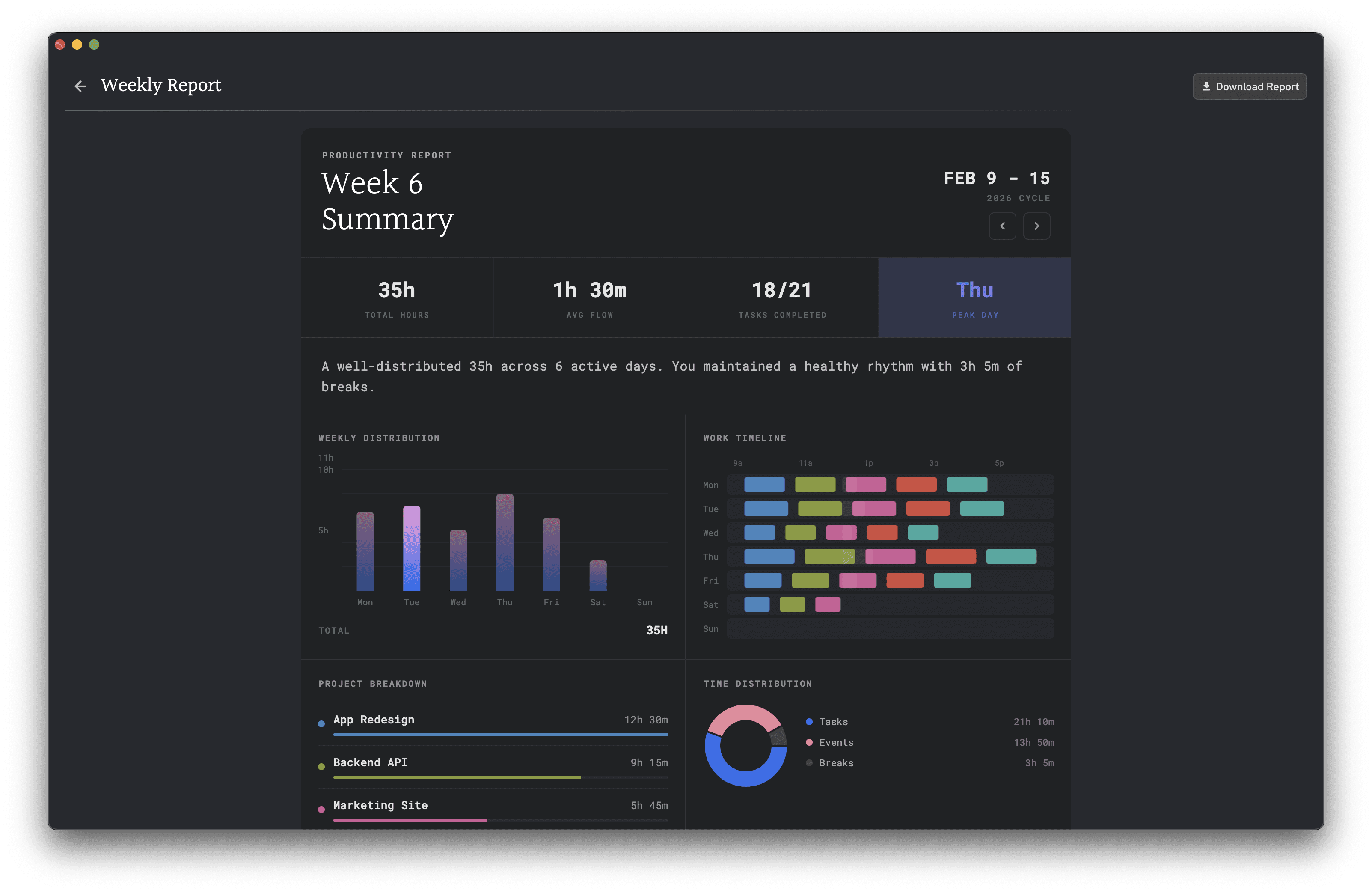
Quick Capture (Option+Space) lets you capture a task from anywhere on your Mac in under three seconds without breaking focus. It goes directly to your inbox. The Planning View (Shift+P) is then where you process those captures - using P to assign each one a date, which converts a vague open loop into a specific committed plan. An inbox with tasks and dates attached is categorically different from one with tasks and no plan.
How To Start Tomorrow
Take five minutes at the end of today and write down everything currently occupying space in your head - every open task, unresolved commitment, nagging "I should." Next to each one, write the specific next action and when you'll do it. Notice how much quieter your mind feels once it's all out and planned. That's cognitive offloading.
Related Principles
Implementation Intentions - cognitive offloading is the capture step; implementation intentions are the planning step
Bedtime To-Do Lists and Sleep - writing tomorrow's tasks is cognitive offloading applied to sleep
Attention Residue - offloading reduces residue from unfinished tasks
Bedtime To-Do Lists and Sleep - writing tomorrow's tasks before bed applies the same offloading mechanism to improve sleep onset
Related Reading
Best AI Task Managers for Mac — Task managers are the practical application of cognitive offloading — your brain hands off the remembering.
Best Time Blocking Apps — Getting tasks out of your head and onto the calendar is where the science becomes practice.
Best AI Daily Planning Tools — AI tools that capture and organise tasks so you don't have to hold them in mind.
Frequently Asked Questions
What is cognitive offloading?
Cognitive offloading is the practice of moving mental burden outward — onto paper, a system, or a trusted list — so your working memory can release it. The key finding is that you do not need to finish a task to stop ruminating on it. A specific plan for when you will handle it is enough.
Why does writing tasks down reduce mental noise?
Masicampo and Baumeister's research showed that the brain keeps returning to unfulfilled goals involuntarily — a phenomenon related to the Zeigarnik effect. Making a concrete plan for when and how you will handle a task shuts down these intrusive thoughts, because the brain treats a specific plan almost like completion.
Does writing a vague to-do list help?
No — a vague list without times or next actions keeps the mental loops open. "Sort out the project" does not close the loop. "Write the intro at 9am Tuesday" does. The specificity of the plan is what triggers the cognitive offloading effect, not the act of capture alone.
Can cognitive offloading improve sleep?
Yes. Scullin et al. (2018) found that writing a specific to-do list for the next day before bed helped people fall asleep around 9 minutes faster than those who journaled about completed activities. The more specific the list, the stronger the effect — consistent with the offloading mechanism.
Further Reading
Masicampo, E. J., & Baumeister, R. F. (2011). Consider it done! Plan making can eliminate the cognitive effects of unfulfilled goals. Journal of Personality and Social Psychology, 101(4), 667-683. DOI: 10.1037/a0024192
Scullin, M. K., et al. (2018). The effects of bedtime writing on difficulty falling asleep. Journal of Experimental Psychology: General, 147(1), 139-146. DOI: 10.1037/xge0000374
Syrek, C. J., et al. (2017). Zeigarnik's sleepless nights: How unfinished tasks at the end of the week impair employee sleep through rumination. Journal of Occupational Health Psychology, 22(2), 225-238. DOI: 10.1037/ocp0000031