The Principle
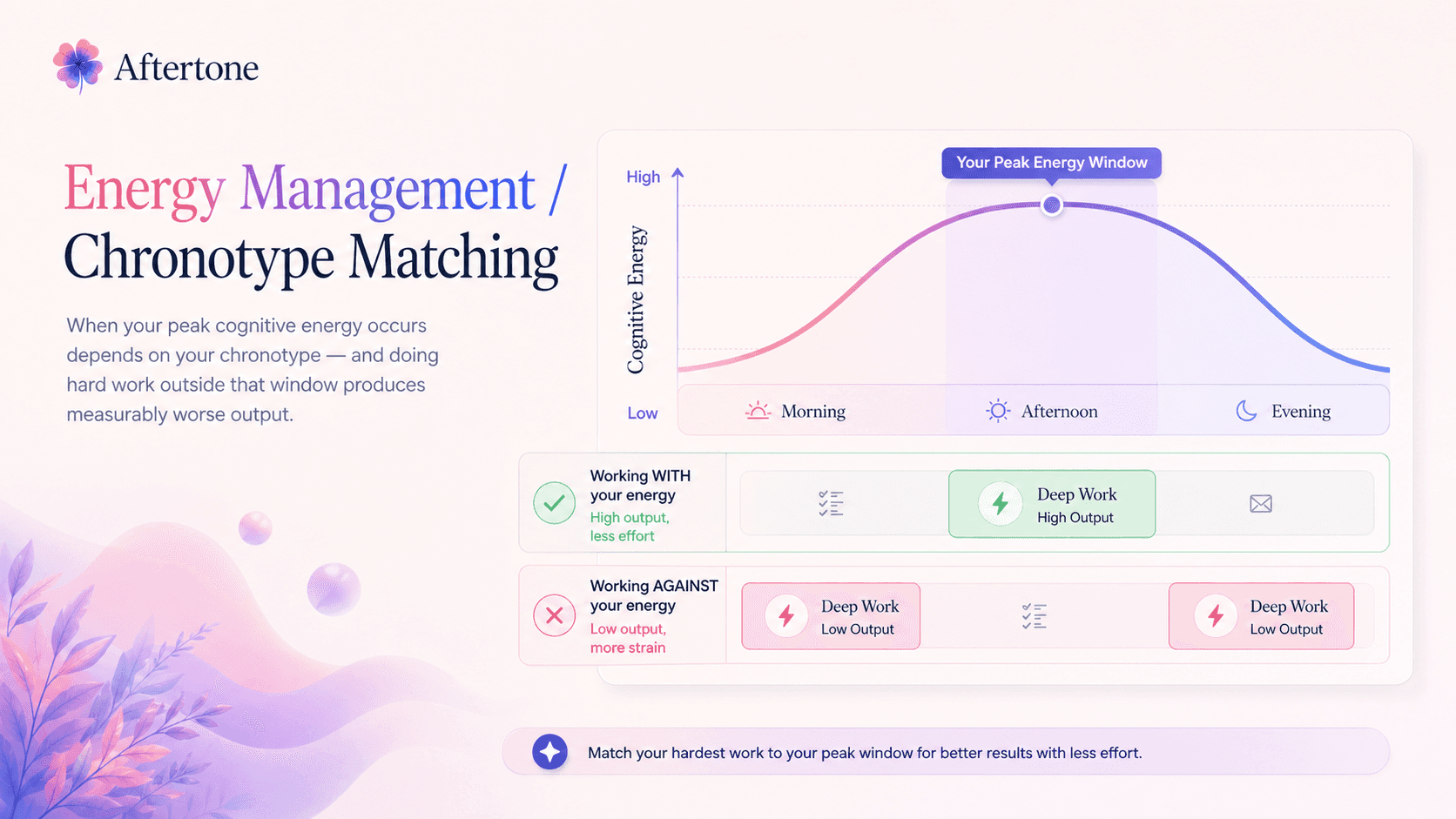
You've heard that you should do your most important work first thing in the morning. So you try - and find that before 10am your thinking feels slow, your writing is flat, and your best ideas don't arrive until early afternoon. You assume this is a discipline problem. It's not. It's a chronotype mismatch.
Chronotype is your biological tendency toward morningness or eveningness - when your cognitive performance naturally peaks across the day. Research by Wieth and Zacks found that analytical and logical tasks are significantly better performed during your chronotype's peak window, while creative insight and lateral thinking can sometimes benefit from off-peak times when the brain's inhibitory processes are looser. "Do your hardest work in the morning" is advice calibrated for morning chronotypes. For evening types, it's actively counterproductive.

Definition
Cognitive performance is not flat across the day. It rises and falls based on your chronotype - your biological tendency toward morningness or eveningness. Analytical and logical tasks are significantly better performed during your peak window, while creative insight can sometimes benefit from off-peak times when the brain's inhibitory processes are more relaxed. The right time to do your most demanding work is not culturally prescribed. It is biologically individual.
What The Research Shows
Wieth and Zacks (2011) found in a study of 428 participants that analytical problem-solving performance peaked at participants' chronotype-optimal times of day, while creative insight problems were solved more successfully during off-peak hours.
Matchock and Mordkoff (2009) demonstrated chronotype-by-time-of-day interaction effects on sustained attention tasks. Roenneberg and colleagues (2004) established that chronotypes are biologically distributed across the population, with meaningful differences between individuals in their natural sleep-wake timing. Limitation: most studies use self-report chronotype measures; direct field tests of schedule-matching interventions are limited.

What This Means
Analytical performance peaks during your chronotype's optimal time of day and declines meaningfully outside it. Doing your hardest work in the morning is advice calibrated for morning types only - for evening types, it produces systematically worse work.
What Most People Get Wrong
The advice to do the hardest work first thing in the morning is common enough to feel like a universal truth.
It is calibrated specifically for morning chronotypes. Evening types who follow this advice are scheduling their most demanding cognitive work during their lowest-performing hours. The correct principle is to match demanding work to your personal peak, not to a culturally prescribed time of day.
When it Fails…
Many people cannot control their meeting schedule. Social and organisational obligations frequently override the ability to match task type to energy state.
Rigid matching creates its own perfectionism. Treating your energy window as a rule means missing it feels like a failure rather than just a different kind of day.
Self-reported chronotype is not perfectly accurate. Observed completion patterns often differ meaningfully from stated preferences.
What This Means For You…
Matching your most demanding cognitive work to your natural peak energy window - not the culturally prescribed morning slot - is one of the highest-leverage schedule adjustments you can make. The same task done at the wrong time of day can take twice as long and produce half the quality of the same task done at the right time. The practical work is identifying your actual peak - through honest observation, not aspiration - and then defending that window for the work that requires your best thinking, rather than filling it with email and meetings because that's when other people are active.
How Aftertone Implements It.
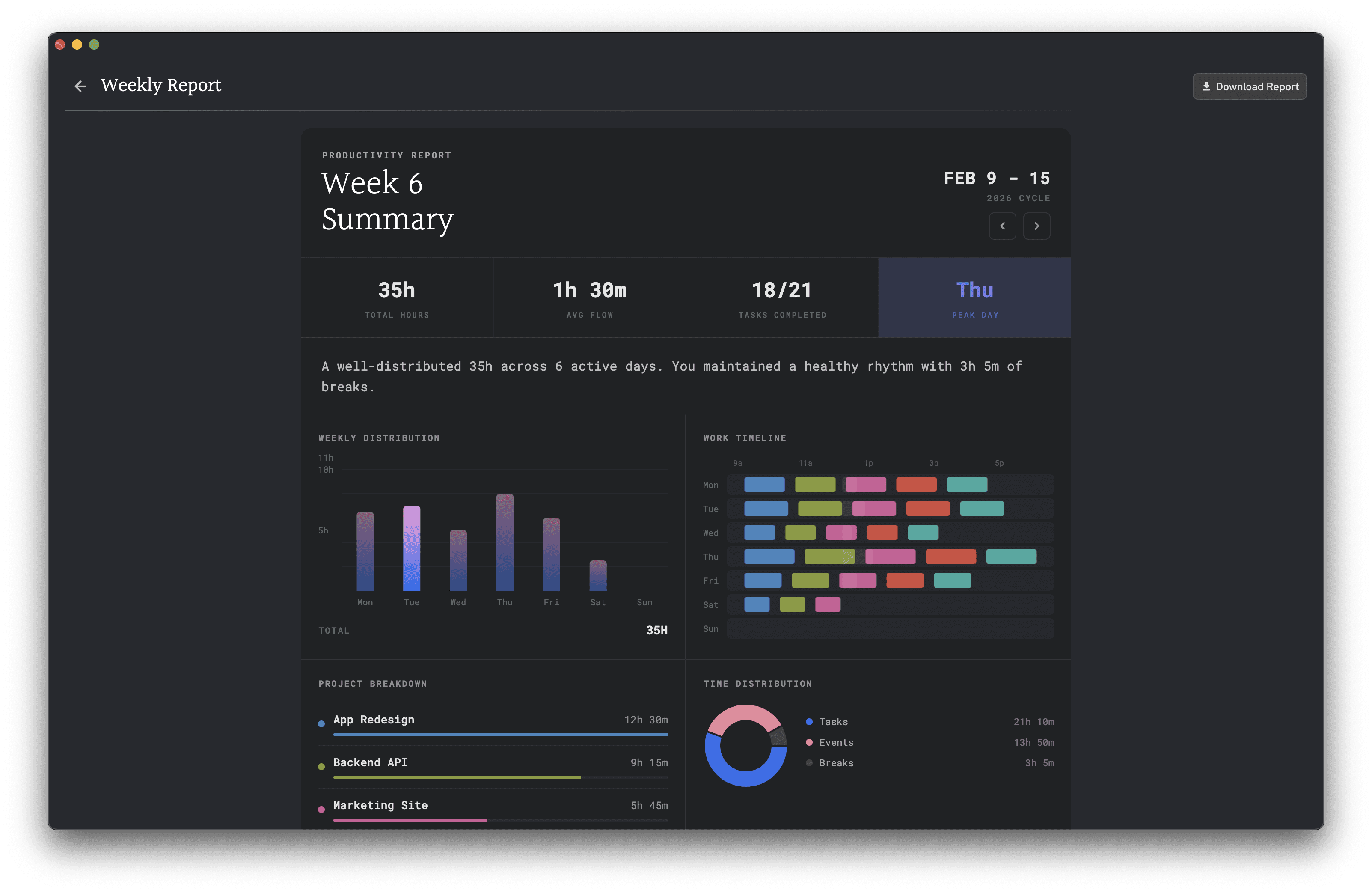
The week view (Cmd+7) and Calendar view in Aftertone let you place your highest-priority tasks in specific time slots before the week starts. The weekly report's peak day metric shows which day of the week tends to produce the most flow sessions over time - that pattern, once visible, is the signal for where to concentrate your most demanding work.
How To Start Tomorrow
For the next week, note the time of day when you produce your best thinking - when writing flows, problems feel clearer, and work feels less effortful. Don't assume: observe. At the end of the week, look at how that window is currently being used in your calendar. If it's filled with meetings or reactive work, you've found the highest-value schedule change available to you.
Related Principles
Deep Work - most effective during peak energy
ADHD - energy-based may be more ADHD-friendly
Ultradian Rhythms - within-day fluctuation
Recovery - includes knowing when to stop
Related Reading
Best Deep Work Scheduling Apps — Tools that let you schedule demanding work during your actual peak, not just a free slot.
Best Mac Calendar Apps for Deep Work — Mac calendar apps that make peak-hour protection a visible part of your week.
Best AI Daily Planning Tools — AI planners that surface your peak windows and route your hardest tasks there.
Frequently Asked Questions
What is a chronotype?
A chronotype is your biological tendency toward morningness or eveningness — when your body naturally wants to sleep, wake, and reach peak cognitive performance. It is primarily determined by genetics and shifts across the lifespan: most adolescents are naturally evening-typed, shifting progressively toward morningness through adulthood. Chronotype is not a preference or a habit — it is a biological characteristic.
Does your chronotype affect cognitive performance throughout the day?
Yes, significantly. Research by Anderson et al. and Christensen et al. shows that performance on attention and memory tasks peaks at chronotype-appropriate times — morning types peak earlier, evening types peak later. Working against your chronotype consistently — doing cognitively demanding work at your biological low point — produces measurably worse outcomes than scheduling the same work at your natural peak.
Why is energy management more effective than time management for some people?
Time management treats all hours as equivalent. They are not — the same hour of work produces different outputs depending on where it falls in your cognitive rhythm. Matching cognitively demanding work to peak energy hours and administrative or routine work to low energy periods extracts more value from the same total hours than simply maximising total hours worked.
How do you identify your own chronotype?
The Munich Chronotype Questionnaire (MCTQ) is the validated research instrument. A practical proxy is tracking your natural wake time without an alarm over several days of rest, and noting when you feel most alert during the day. Horne and Östberg's Morningness-Eveningness Questionnaire (MEQ) is another validated self-report measure available freely online.
Further Reading
Wieth, M. B., & Zacks, R. T. (2011). Time of day effects on problem solving: When the non-optimal is optimal. Thinking and Reasoning, 17(4), 387-401. DOI: 10.1080/13546783.2011.625663
Roenneberg, T., et al. (2004). A marker for the end of adolescence. Current Biology, 14(24), R1038-R1039. DOI: 10.1016/j.cub.2004.11.039
Matchock, R. L., & Mordkoff, J. T. (2009). Chronotype and time-of-day influences on the alerting, orienting, and executive components of attention. Experimental Brain Research, 192(2), 189-198. DOI: 10.1007/s00221-008-1567-6