The Principle
Your phone lights up. You don't pick it up. You glance at the notification, see it's not urgent, and return to what you were doing. Thirty seconds, start to finish. What you don't notice is that your performance on the task you returned to is now measurably worse - not because of the time lost, but because the interruption forced a context switch your brain is still recovering from.
Interruption recovery cost is the time and cognitive effort required to fully return to a task after being pulled away. Gloria Mark's field research tracking real workers across real days found that workers in interrupted conditions complete tasks faster but at significantly higher stress and effort, even without losing time. The interruption doesn't just cost the seconds you were away. It costs the quality of what comes after.

Definition
When you're interrupted during focused work, getting back to where you were isn't instant - it takes real time and mental energy, and the stress lingers even after you've nominally returned to the task. About half of all interruptions are self-initiated, meaning this is partly within your control.
What The Research Shows
Mark, Gudith & Klocke (2008) found workers switch tasks every ~3 minutes on average. Interrupted workers completed tasks slightly faster but at significantly higher stress, frustration, and effort. The widely cited '23 minutes and 15 seconds' recovery figure comes from Mark's follow-up analyses and interviews rather than the 2005 paper itself. The 2005 study (Mark, Gonzalez & Harris) reported workers switch spheres every ~10.5 minutes and that 57% of working spheres are interrupted. Importantly, ~50% of interruptions are self-initiated. Limitation: observational field studies in specific industries; exact recovery time varies by task type.

What This Means
Interrupted workers complete tasks faster but at substantially higher stress and effort, even when total time spent is the same. The interruption does not just cost the seconds you were away - it costs the quality of everything that follows.
What Most People Get Wrong
The common assumption is that interruptions are costly only when they are frequent or lengthy.
Research on knowledge workers found that even brief interruptions impose a recovery cost on subsequent performance. Workers adapt by speeding up, but this comes at a measurable cost in stress and effort. The interruption does not need to be significant to be costly.
When it Fails…
Not all interruptions are equal. Some are genuinely urgent and must be taken - the cost is real but unavoidable in certain roles.
Collaborative roles require availability. Managers and support staff may need to remain interruptible as a core part of their function.
Total notification blocking creates its own anxiety. For many people, going fully offline creates a different stress that outweighs the focus benefit.
What This Means For You…
The idea that you can absorb interruptions and bounce back instantly is not how attention works. Every interruption - whether you respond to it or just notice it - imposes a recovery cost on the work you return to. In a day filled with notifications, messages, and context switches, those costs accumulate invisibly until you reach the end of the day having worked hard but produced less than you should have. Protecting focus is not productivity maximalism - it's basic cognitive respect for how long it actually takes your brain to get back into complex work after being pulled out of it.
How Aftertone Implements It.
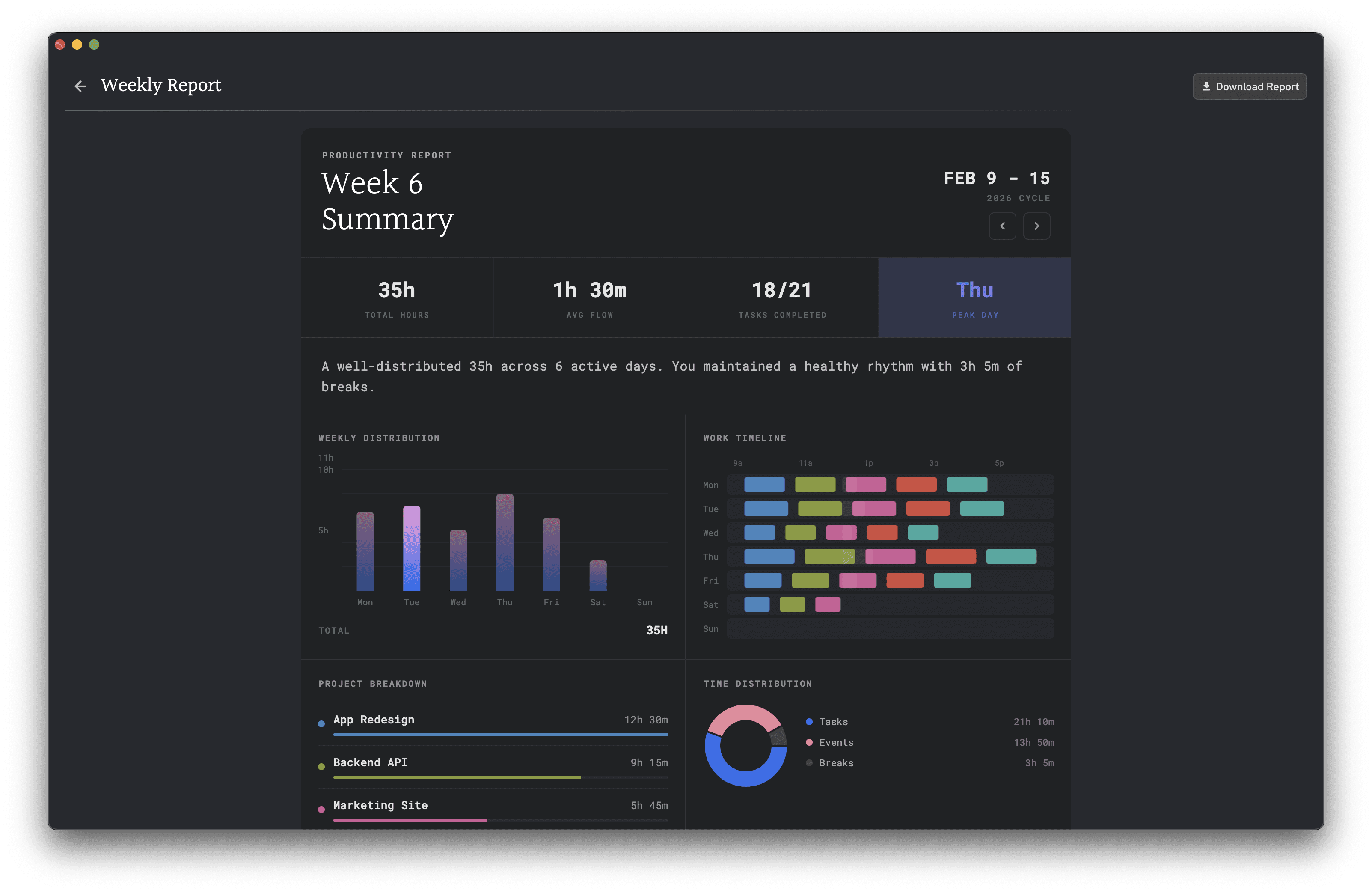
When something comes in during a focus session, pressing Option+Space captures it to your inbox in under three seconds without leaving Focus Mode. If it genuinely cannot wait, press Escape to go to the Calendar view, handle it, then Tab back in. The university guidance is explicit: never leave a task floating after an interruption - use P to reschedule it immediately so it does not become an open loop.
How To Start Tomorrow
For one hour today, close every communication channel - email, Slack, phone face-down in another room - and work on one thing. When the hour ends, compare the quality and quantity of output to a typical interrupted hour. The difference is your personal interruption recovery cost made visible.
Related Principles
Attention Residue - interruptions create residue that explains the recovery cost
Task Switching Costs - each interruption forces a task switch
Notification Distraction - even passive notifications trigger the interruption cycle
Deep Work / Protected Focus Blocks - focus blocks are the solution to interruption costs
Related Reading
Best Deep Work Apps — The apps best equipped to eliminate the interruptions this research quantifies.
Best AI Tools to Protect Deep Work Time — Tools that block interruptions before they happen rather than recovering from them after.
Best Mac Calendar Apps for Deep Work — Mac calendar apps that create visible protected windows so the cost of interrupting is obvious.
Frequently Asked Questions
How long does it take to refocus after an interruption?
Gloria Mark's research at UC Irvine found that after an interruption, the average time to fully return to a task is around 23 minutes. This is not how long the interruption takes — it is the recovery time needed to restore the depth of focus that existed before the interruption. Even brief interruptions carry this cost.
Does it matter what kind of interruption it is?
Yes — the nature and timing of the interruption affects recovery time. Interruptions that arrive during complex cognitive work cause more residue than those during simpler tasks. Interruptions that require a meaningful response (a conversation, a decision) tend to produce more residue than passive ones (a notification you glance at). Voluntary task switches also incur a version of this cost.
Why does recovery take so long if the interruption is short?
Focus in cognitively demanding work is not a binary on-off state — it involves holding multiple threads, context, and partial progress in working memory simultaneously. An interruption disrupts this working memory state, which takes time to reconstruct. The interruption itself may last 30 seconds; rebuilding the mental context required to continue effectively takes much longer.
What's the most effective way to protect against interruption recovery costs?
The most effective protection is structural: create uninterrupted focus blocks with communications closed during that period, so interruptions physically cannot arrive. Secondary strategies include batching responses, using visual do-not-disturb signals in shared spaces, and building transition time between high-focus work and communication-heavy work.
Further Reading
Mark, G., Gudith, D., & Klocke, U. (2008). The cost of interrupted work: More speed and stress. Proceedings of CHI 2008, 107-110. DOI: 10.1145/1357054.1357072
Mark, G., Gonzalez, V., & Harris, J. (2005). No task left behind? Examining the nature of fragmented work. Proceedings of CHI 2005, 321-330. DOI: 10.1145/1054972.1055017
