The Principle
Every time you switch between different types of cognitive work, your brain must deactivate one set of task rules and load another — a two-stage process (goal shifting and rule activation) with a measurable performance cost. Rubinstein, Meyer and Evans's experiments found this overhead can consume up to 40% of productive time under high-complexity switching conditions. The 40% figure applies to the worst-case scenario in lab conditions; real-world costs depend on task similarity and switch frequency, but the direction of the effect is robust across decades of research.
You feel productive. You've been responding to messages, reviewing a document, jumping on a quick call, checking the project board, drafting a reply. You've been doing things constantly. But the one piece of work that actually mattered - the thing that required real thinking - hasn't moved. You were busy the whole time. You just weren't working on that.
Task switching costs are the measurable productivity losses that occur every time you shift between different types of cognitive work. Rubinstein, Meyer and Evans showed this involves two distinct brain processes - goal shifting and rule activation - each taking time and effort. The cost increases with task complexity. In demanding cognitive work, the total overhead from constant switching can consume up to 40% of productive time. You don't experience this as wasted time. You experience it as a day where the important things somehow didn't happen.
The real-world scale is striking: Gloria Mark's research at UC Irvine found that knowledge workers switch between tasks and applications an average of 1,200 times per day during core work hours — 275 interruptions, most of them context switches. At even a fraction of Rubinstein's lab-measured cost per switch, the cumulative drain on cognitive capacity is substantial. The most effective intervention is the same in both lab and field: batch similar work together and separate dissimilar task types into distinct blocks.

Definition
Your brain doesn't switch tasks instantly - it needs to deactivate the old set of rules and activate the new ones. This two-stage process (goal shifting + rule activation) takes measurable time and effort, and the cost increases with the complexity of the tasks involved.
What The Research Shows
Rubinstein, Meyer & Evans (2001) conducted four lab experiments (~108 total participants) demonstrating that task-switching involves two distinct executive control stages: goal shifting ('I need to do this now') and rule activation ('these are the rules for this task'). Switching costs increased substantially with task complexity — up to 40% of productive time in the highest-complexity conditions. The American Psychological Association widely cited this finding as evidence of task-switching costs in workplace contexts. Limitation: lab tasks were abstract and dissimilar; the 40% figure represents the high-complexity ceiling, not an average across all switching; real-world effects vary with task similarity and expertise.
Monsell (2003) reviewed the broader task-switching literature and confirmed the switch cost phenomenon is robust across paradigms. He identified that costs are higher when: tasks are more cognitively demanding, the switch is externally imposed (interruption) rather than self-initiated, and the new task context has not been recently activated. This pattern explains why reactive work environments produce disproportionately high costs relative to self-directed batching.

What This Means
Every shift between different types of cognitive work requires your brain to deactivate one rule set and activate another - and in complex work this overhead can consume up to 40% of productive time. The cost accumulates invisibly across a day of frequent switching.
What Most People Get Wrong
Most people believe they are good at multitasking, or that rapid switching is an acceptable substitute for sustained focus.
Research consistently finds that virtually no one multitasks effectively on complex cognitive work. What feels like multitasking is rapid switching, and each switch carries a cost that increases with the complexity of the tasks involved.
When it Fails…
Costs are lowest for simple or similar tasks. The switching penalty is highest for complex, dissimilar tasks and much smaller when tasks are routine or closely related.
Some creative work benefits from switching. The incubation effect means stepping away from a creative problem and switching briefly can actually improve insight.
Constant-switching roles may not be able to batch. For people whose job requires real-time context switching, batching is structurally impractical.
What This Means For You…
The standard knowledge worker day - a continuous mix of email, meetings, reactive tasks, and occasional deep work - is almost optimally designed to incur maximum switching costs. Each transition between task types burns time and attention you don't notice losing. The antidote is batching: grouping similar types of work into dedicated blocks so the switching cost is paid once per block rather than once per task. Email in a batch costs one switch. Email woven through the day costs dozens. The principle applies across all task types - same type together, different types separated.
How Aftertone Implements It.
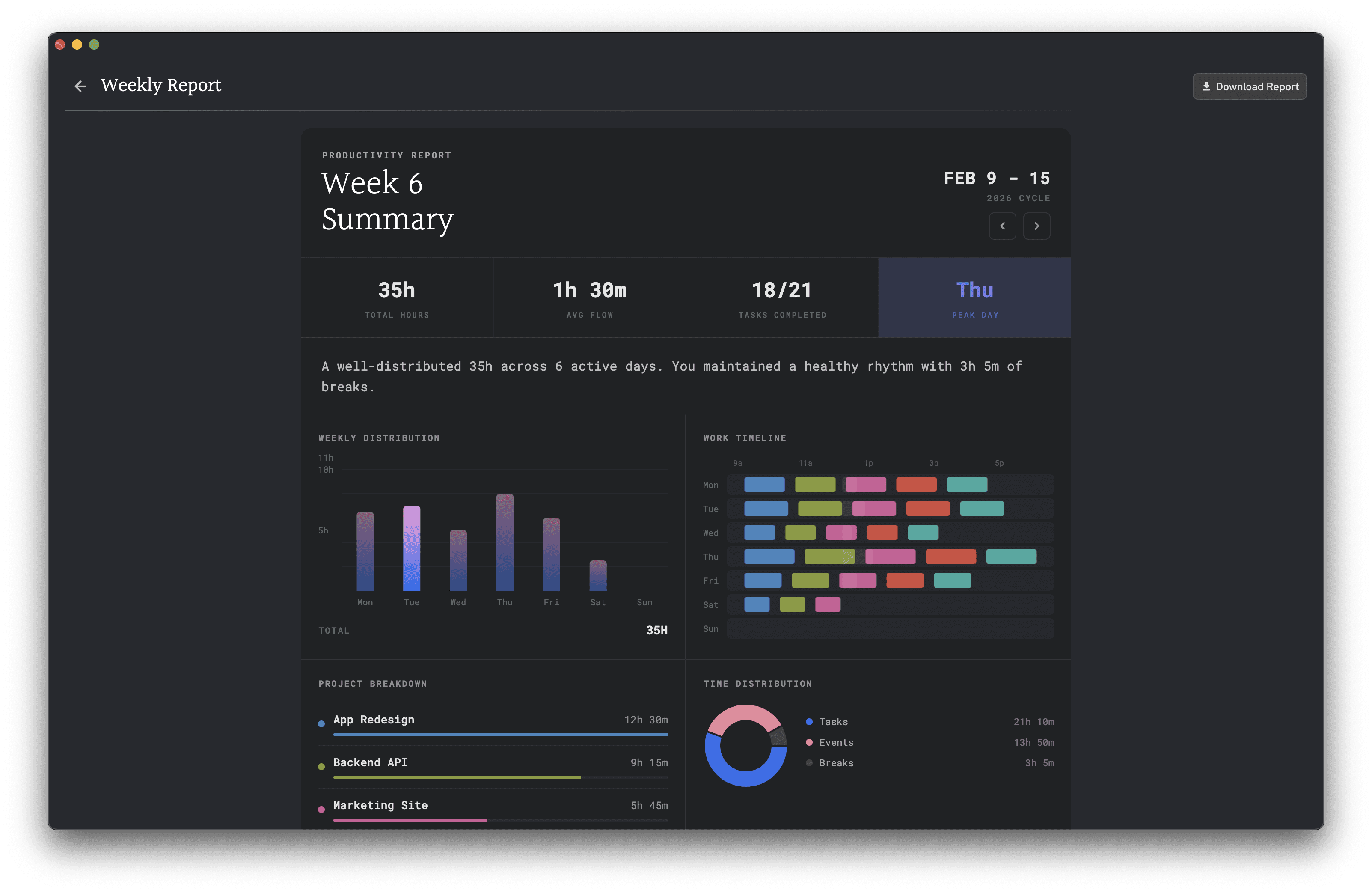
The Calendar view in Aftertone makes task sequencing visible before the day begins. You can see adjacent blocks and deliberately group similar work - deep work in one run, communication tasks in another - rather than letting them interleave. The Planning View (Shift+P) and week view (Cmd+7) give you the full picture to arrange blocks by type before the day starts.
How To Start Tomorrow
Tomorrow, pick one category of reactive work - email, Slack, or admin - and handle all of it in one or two dedicated windows instead of spreading it through the day. Keep everything else closed. At the end of the day, compare how much deep work you produced versus a typical day. That difference is what task switching was costing you.
Related Principles
Attention Residue - each switch creates residue that compounds the cost
Interruption Recovery - external interruptions force unplanned switches
Email Batching - email batching is task-switching reduction applied to communication
Deep Work / Protected Focus Blocks - long uninterrupted blocks minimize switching
Related Reading
Best Deep Work Apps — Apps that remove the conditions that make switching so costly.
Best Time Blocking Apps — Time blocking batches similar work together — the most direct structural fix for switching costs.
Best AI Tools to Protect Deep Work Time — AI tools that keep you in one context longer by defending your schedule.
Context Switching: The Hidden Cost — The practical guide to managing task switching costs across a real workday.
Task Batching Guide — The structural intervention that reduces switching costs by grouping similar work.
Frequently Asked Questions
What are task switching costs?
Task switching costs are the performance penalties incurred when moving between different types of cognitive work. Rubinstein, Meyer and Evans's experiments found that switching costs can reach up to 40% of productive time — this figure applies to the highest-complexity switching conditions in lab experiments. Real-world costs vary with task similarity and switch frequency, but the direction of the effect is consistent: switching between dissimilar, demanding tasks is measurably costly in time and cognitive quality, even when each switch takes only seconds.
Why does switching between tasks reduce productivity?
Each task switch requires the brain to disengage from one mental context, retrieve the relevant context for the new task, and restart the working memory load that was interrupted. This reorientation process takes time and effort. When switches happen frequently, the cumulative overhead becomes substantial — leaving less net cognitive capacity for the work itself.
What's the difference between task switching costs and attention residue?
They are related but distinct. Task switching costs refer to the overhead of context-switching itself — the time and effort to reorient. Attention residue refers specifically to the lingering partial attention on the previous task that impairs the new one. Both occur with task switching, but they are separate mechanisms that compound each other.
Is multitasking real or a myth?
For complex cognitive work, multitasking is a myth — the brain cannot genuinely process two demanding tasks simultaneously. What feels like multitasking is rapid sequential switching, and each switch carries a cost in both time and output quality. The APA's review of task-switching research states this clearly: what people call multitasking is task switching, and task switching reduces the quality of work on both tasks involved. The exception is simple or automatic tasks (walking while listening) where one task runs on a well-established routine and the other requires attention. For knowledge work — writing, analysis, coding, strategy — genuine multitasking is not possible.
How does batching reduce task switching costs?
Batching groups similar tasks into a single time block so the relevant mental context only needs to be loaded once. Processing all emails in one window, completing all review work in one session, and scheduling all calls in one afternoon each eliminates the repeated context-switching overhead that would occur if those tasks were distributed throughout the day.
Further Reading
Rubinstein, J. S., Meyer, D. E., & Evans, J. E. (2001). Executive control of cognitive processes in task switching. Journal of Experimental Psychology: Human Perception and Performance, 27(4), 763-797. DOI: 10.1037/0096-1523.27.4.763
Monsell, S. (2003). Task switching. Trends in Cognitive Sciences, 7(3), 134-140. DOI: 10.1016/S1364-6613(03)00028-7