The Principle
You've been time-blocking for three months. Your estimates are still as optimistic as they were on day one. You keep planning Tuesdays as deep work days despite the fact that Tuesdays reliably fill with reactive work. You keep underestimating how long the client work takes. The system is running, but it's not learning - because you're never looking at what the system is telling you.
After-action reviews are structured reflection sessions that close the learning loop: what happened, what was expected, why the gap exists, and what to do differently. Military research found that reviews of this kind produced performance improvements of 20-25% over additional practice alone. The mechanism is simple - experience without reflection reinforces whatever patterns exist, including the bad ones. Experience with structured reflection converts those patterns into information that improves future decisions.

Definition
An after-action review is a structured reflection on what happened, what was expected to happen, and what accounts for the gap between the two. Originally developed by the US Army, the format has been studied in workplace and educational contexts and consistently produces performance improvements over additional practice alone. The mechanism is that practice without reflection reinforces whatever patterns exist - including unhelpful ones - while structured reflection converts experience into information that can change future decisions.
What The Research Shows
Ellis and Davidi (2005) conducted a field experiment with 83 Israeli Defence Force officers and found that structured after-event reviews improved performance by 20-25% compared to additional practice alone. Anseel and colleagues (2009) meta-analyzed the broader reflection literature and found structured reflection improves performance at d = 0.39. Di Stefano and colleagues (2016) found that reflection strengthens self-efficacy, which mediates the performance improvement - people do not just learn what to do differently, they become more confident in their ability to execute. Limitation: most research is in structured organisational or military contexts; evidence specific to individual productivity planning is limited.

What This Means
Structured reviews of what happened versus what was expected improved subsequent performance by 20 to 25% compared to additional practice alone. Practice without reflection reinforces existing patterns - including the unhelpful ones.
What Most People Get Wrong
Practice is commonly assumed to be the primary driver of improvement.
Research on structured reflection finds that practice without review reinforces existing patterns, including the unhelpful ones. The same planning mistakes repeat indefinitely if no feedback loop closes. A brief review of what happened versus what was expected does more to improve future performance than additional repetition of the same approach.
When it Fails…
Self-critical users can spiral into rumination. For people with perfectionist tendencies, reviewing what went wrong can amplify self-blame rather than produce useful learning.
Routine work generates diminishing return from review. When the patterns are already understood and the decisions are not meaningfully variable, structured reflection adds little.
Framing determines the outcome. A review framed as learning produces different results than one framed as performance audit - the same questions can help or hurt depending on tone.
What This Means For You…
The value of tracking your work - time estimates, completed blocks, planned versus actual - is entirely realised through reflection. Data without review is just noise. A brief weekly review of what went well, what didn't, and what you'd do differently is how the system improves over time. Without it, you repeat the same planning mistakes indefinitely because the feedback loop never closes. Five minutes at the end of the week reviewing your actual data is worth more than any amount of intention at the beginning of it.
How Aftertone Implements It.
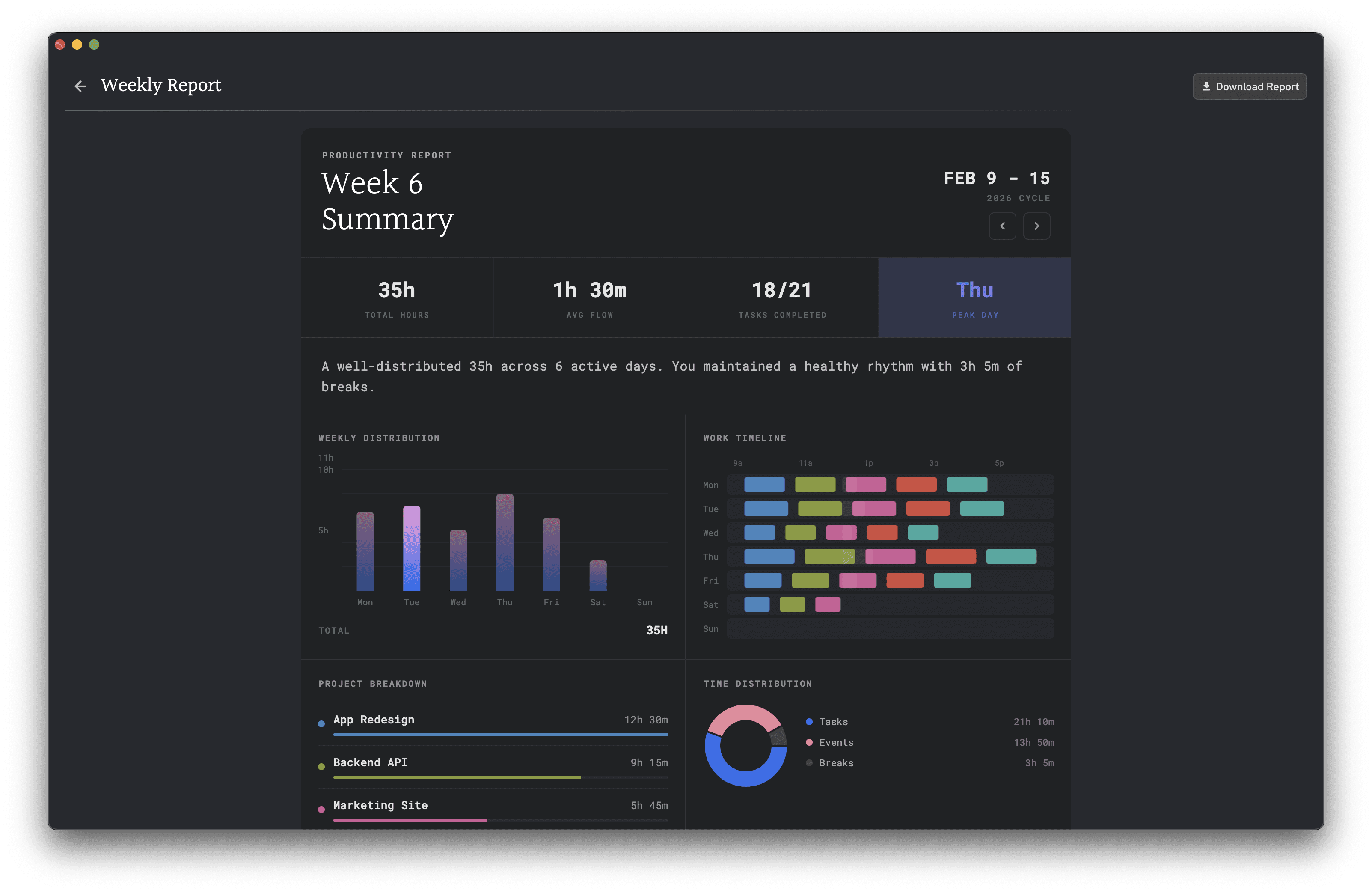
The Weekly Report and Review is the evaluate layer of Aftertone's structure. The report shows flow sessions, peak day, streak, tasks completed by project, and the full work timeline. The recommended review asks three questions: what was the most important thing completed this week, what did not get done that should have, and what will you do differently next week. The Planning View session that follows converts those answers into next week's structure.
How To Start Tomorrow
This Friday, spend five minutes reviewing your week: what did you plan to do that you actually did, what did you plan that didn't happen, and what happened that you didn't plan for? Write one sentence on what you'd do differently next week based on what you observed. Do this every Friday for a month. Notice how your planning accuracy improves as the pattern becomes visible.
Related Principles
Self-Monitoring - review interprets tracking data
Planning Fallacy - review corrects estimation errors
Perfectionism - must be framed as learning
Weekly Review - structured reflection format
Related Reading
Best Weekly Review Apps — Weekly review apps that structure reflection as a process, not just a habit.
Best Mac Calendar Apps for Weekly Reviews — Mac calendar apps with built-in review workflows.
Best AI Time Audit Tools — AI tools that generate the raw data for an honest after-action review automatically.
Frequently Asked Questions
What is an after-action review?
An after-action review (AAR) is a structured reflection process conducted after completing a project, task, or significant period of work. Originating in the US military, it typically answers four questions: what was supposed to happen, what actually happened, why was there a difference, and what should be done differently next time. Research finds that AARs improve future performance by 20–25% compared to experience without structured reflection.
Why does structured reflection improve performance more than experience alone?
Experience without reflection produces pattern recognition but not necessarily accurate pattern recognition. Without deliberate analysis, people tend to attribute success to skill and failure to circumstance — the self-serving bias — which prevents accurate learning. Structured reflection forces explicit comparison between intention and outcome, surfaces the actual causal factors, and creates concrete changes rather than vague resolutions.
How often should you do an after-action review?
The cadence should match the rhythm of your work. Weekly reviews serve as lightweight AARs for the week's planned versus actual outcomes. Project AARs are most valuable immediately after completion, when details are fresh. The research on memory reconsolidation suggests that reviewing recent experience within hours or days — while it is still labile — is more effective than reviewing it weeks later when the memory has fully consolidated in whatever form it first took.
What makes an after-action review effective rather than just a post-mortem?
Psychological safety, specificity, and forward orientation. AARs that focus on blame rather than learning produce defensiveness rather than insight. Effective reviews are specific — naming exactly what worked and what did not, rather than general impressions — and forward-facing, producing concrete changes rather than attributing outcomes to unchangeable factors. The question is always what will be different next time, not who is responsible for last time.
Further Reading
Ellis, S., & Davidi, I. (2005). After-event reviews: Drawing lessons from successful and failed experience. Journal of Applied Psychology, 90(5), 857-871. DOI: 10.1037/0021-9010.90.5.857
Di Stefano, G., et al. (2016). Making experience count: The role of reflection in individual learning. Harvard Business School Working Paper 14-093. DOI: 10.2139/ssrn.2414478