The Principle
You've had a day of meetings, email, and reactive work. Nothing on your project moved. At the end of the day you feel vaguely deflated - not exhausted exactly, just flat. You were busy, technically productive in a dozen small ways, but you can't point to anything that feels like real progress. That feeling is significant. It's not just mood - it's information about what drives motivation and engagement at work.
Teresa Amabile and Steven Kramer analysed 12,000 diary entries from 238 workers across seven companies and found that making meaningful progress was present on 76% of people's best workdays - more powerful than recognition, incentives, or management support. Even small progress counted. What mattered was that something moved forward on work the person found meaningful. The inverse was equally true: days without visible progress on meaningful work were reliably the worst days, regardless of how much activity occurred.

Definition
Of all the factors that affect how people feel and perform on any given workday, making meaningful progress on work they care about is the most powerful. This finding comes from a study of 12,000 diary entries from 238 knowledge workers across seven companies, analysed by Amabile and Kramer. The effect held even for small, incremental progress - what mattered was that something moved forward on work the person found meaningful. Recognition, incentives, and management support all played a smaller role than progress.
What The Research Shows
Amabile and Kramer (2011) analysed 12,000 diary entries from 238 workers across seven companies, covering nearly 700 individual workdays. They found that making meaningful progress on work was the strongest predictor of positive inner work life - more powerful than recognition, incentives, or collegial support - and was present on 76% of participants' best-mood days. Even small progress counted. The inverse held equally: lack of progress was the primary feature of the worst workdays. Limitation: the methodology is correlational diary research, which cannot establish causation - it is possible that positive mood produces perceived progress rather than the reverse, though the authors argue the data pattern supports progress as the primary driver.

What This Means
Making meaningful progress on work you care about was present on 76% of people's best workdays across 12,000 diary entries - more powerful than recognition, incentives, or management support. Activity without progress does not produce the same effect.
What Most People Get Wrong
The common assumption is that motivation is driven by recognition, incentives, or large milestones.
Analysis of tens of thousands of working days found that day-to-day motivation correlates most strongly with making meaningful progress on work the person cares about. Recognition and incentives matter, but less than progress. Days filled with activity but no movement on meaningful work are reliably reported as among the worst, regardless of how much was technically done.
When it Fails…
Long-horizon projects with no milestones leave the mechanism dormant. When meaningful progress is invisible for extended periods, the motivational effect cannot activate.
Maintenance work does not feel like progress. Keeping systems running or managing ongoing relationships does not generate a felt sense of forward movement even when done well.
The work must feel meaningful. Progress on tasks the person does not care about does not produce the same motivational effect - the research is specific about meaningful work.
What This Means For You…
The implication is that what you work on matters as much as how much you work. A day of high-volume reactive work - emails sent, meetings attended, small tasks dispatched - can feel empty in a way that a single hour of genuine progress on meaningful work doesn't. Building your day around at least one piece of work that advances something you care about is not indulgence - it's the condition for sustained motivation. The daily planning habit is most valuable not as a scheduling tool but as a mechanism for ensuring meaningful work gets protected time every day before the reactive work consumes it.
How Aftertone Implements It.
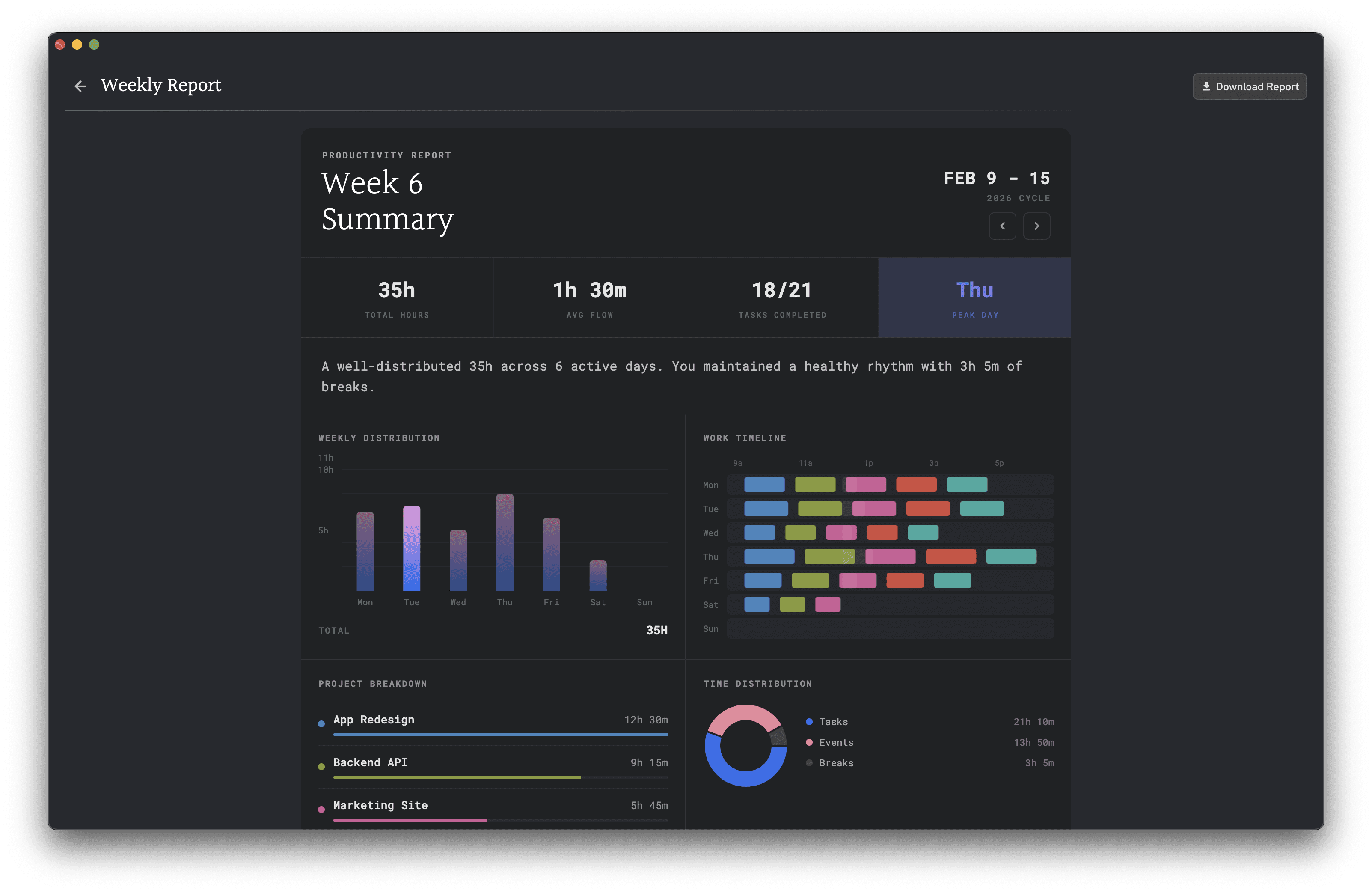
The work timeline in the weekly report shows every completed task as a green block against the calendar. Flow sessions count uninterrupted sequences of completed tasks. These are the records of real progress - not plans, not intentions, but completed work made visible. The weekly report is the place where the week's actual output becomes concrete rather than something you have to reconstruct from memory.
How To Start Tomorrow
At the end of each day this week, write down one thing that moved forward - however small - on work you find meaningful. Not tasks completed, not emails sent, but something that made progress on something that matters. At the end of the week, read back through the five entries. Notice how much of your week's real motivational value came from those moments versus the volume of everything else.
Related Principles
Self-Monitoring - progress principle explains why tracking motivates
Moral Licensing - small-win celebration shouldn't substitute for finishing
Gamification Risks - progress visibility can tip into unhealthy gamification
Specificity - specific tasks make progress visible
Related Reading
Best Habit Tracking Apps — Habit trackers that make small wins visible and record them — exactly what this research supports.
Best Weekly Review Apps — Weekly review apps that surface completions before gaps — the framing that drives motivation.
Best Productivity Systems for High Performers — Systems that measure forward movement, not just time spent.
Frequently Asked Questions
What is the progress principle?
The progress principle, identified by Teresa Amabile and Steven Kramer through diary studies of knowledge workers, is the finding that the single biggest day-to-day motivator is making meaningful progress in work that matters. Not recognition, not incentives, not a good manager — the perception of moving forward on something that has value is more consistently associated with positive inner work life than any other factor studied.
Do small wins actually matter, or is progress only motivating when it is significant?
Small wins matter considerably. Amabile and Kramer's research found that even minor, incremental progress — a problem partially solved, a single section completed, one obstacle removed — produced meaningful positive effects on motivation and mood. The key condition is that the work itself is perceived as meaningful. Small progress on meaningless work does not produce the same effect.
Why does making progress feel motivating?
Perceived progress activates positive affect and a sense of competence — both of which feed back into motivation and engagement. It also partially closes the Zeigarnik loop on open tasks, reducing mental noise. There is also a momentum effect: progress makes continued effort feel more tractable because the gap to completion has visibly narrowed, whereas starting from zero requires more activation energy.
How can you make the progress principle work for you?
Make progress visible — track completion explicitly rather than relying on memory. Break large projects into milestones where progress can be registered at meaningful intervals rather than only at project completion. End each day with a brief review of what moved forward, however small. This is both a peak-end intervention (ending on a completion) and a direct application of the progress principle — making the progress real in your own awareness rather than leaving it invisible.
Further Reading
Amabile, T. M., & Kramer, S. J. (2011). The Progress Principle: Using Small Wins to Ignite Joy, Engagement, and Creativity at Work. Harvard Business Review Press. ISBN: 978-1422198575
Amabile, T. M., & Kramer, S. J. (2011). The power of small wins. Harvard Business Review, 89(5), 70-80.