The Principle
The calendar shows back-to-back blocks from 9am to 6pm. It looks efficient - every hour accounted for, nothing wasted. By 11am the first block has run over, which has pushed the second, which has made the third tight. By early afternoon the whole structure has compressed and you're behind on everything, spending the rest of the day catching up rather than working. The schedule that looked productive made the day structurally impossible.
Buffer time and transition periods are the gaps between blocks that allow for the realities of work: tasks run longer than planned (the planning fallacy), transitions between different types of work take cognitive time (attention residue), and unexpected things happen. A schedule without buffer is a schedule built on the assumption that everything will go exactly as planned. That assumption is wrong every day, and the consequences cascade through everything that follows the first overrun.

Definition
Every transition between activities takes time and cognitive effort. Moving from one meeting to the next, switching from a phone call to focused writing, or returning to a task after an interruption all require a period of adjustment that scheduled blocks rarely account for. Without buffer time built into the schedule, the first task that runs slightly long creates a cascade that leaves the rest of the day running behind before midday.
What The Research Shows
The planning fallacy research by Buehler, Griffin and Ross (1994) established that tasks are consistently underestimated by 25-50%, which means schedules without buffer are structurally flawed before the day begins.
Leroy (2009) demonstrated that switching between tasks requires cognitive transition time - attention residue persists from incomplete tasks and degrades performance on what follows. Research on ADHD scheduling by Fabio and Capri (2017) specifically highlighted the importance of buffer zones for users with impaired time perception. No study has directly tested optimal buffer duration as an independent variable - the recommendation is inferred from the convergent evidence on time estimation and cognitive transition costs.

What This Means
Tasks consistently take 25 to 50% longer than estimated - and without buffer time, the first overrun cascades through everything that follows. A schedule without gaps is a schedule built on the assumption that everything goes exactly as planned, which is wrong every day.
What Most People Get Wrong
Fully scheduled days look efficient and feel organised.
In practice they are fragile. Because tasks consistently take longer than estimated, the first block to run over cascades through everything that follows. A day with no slack has no capacity to absorb the ordinary variance of work. Building in buffer is not wasted time. It is what keeps the rest of the schedule on track when the inevitable overrun occurs.
When it Fails…
Back-to-back scheduling norms create friction. In organisations where wall-to-wall calendars are cultural, adding buffer creates tension with colleagues' expectations.
People with very limited time resist buffers as luxuries. Even when the evidence is clear, the feeling of wasting time during buffer is real and hard to override.
Optimal buffer duration varies too much to prescribe. The right gap depends on task type, individual transition speed, and energy state - a fixed 10 minutes suits some and not others.
What This Means For You…
Building buffer time into your schedule is not inefficiency - it's realism. A calendar with 10-15 minute gaps between significant blocks is more likely to stay on track through an entire day than one that is fully packed. The buffer absorbs overruns, provides transition time for your attention to shift between task types, and gives you a moment to capture anything that came up in the previous block before it becomes an open loop. The goal is a schedule that survives contact with the actual day, not one that looks perfect in theory.
How Aftertone Implements It.
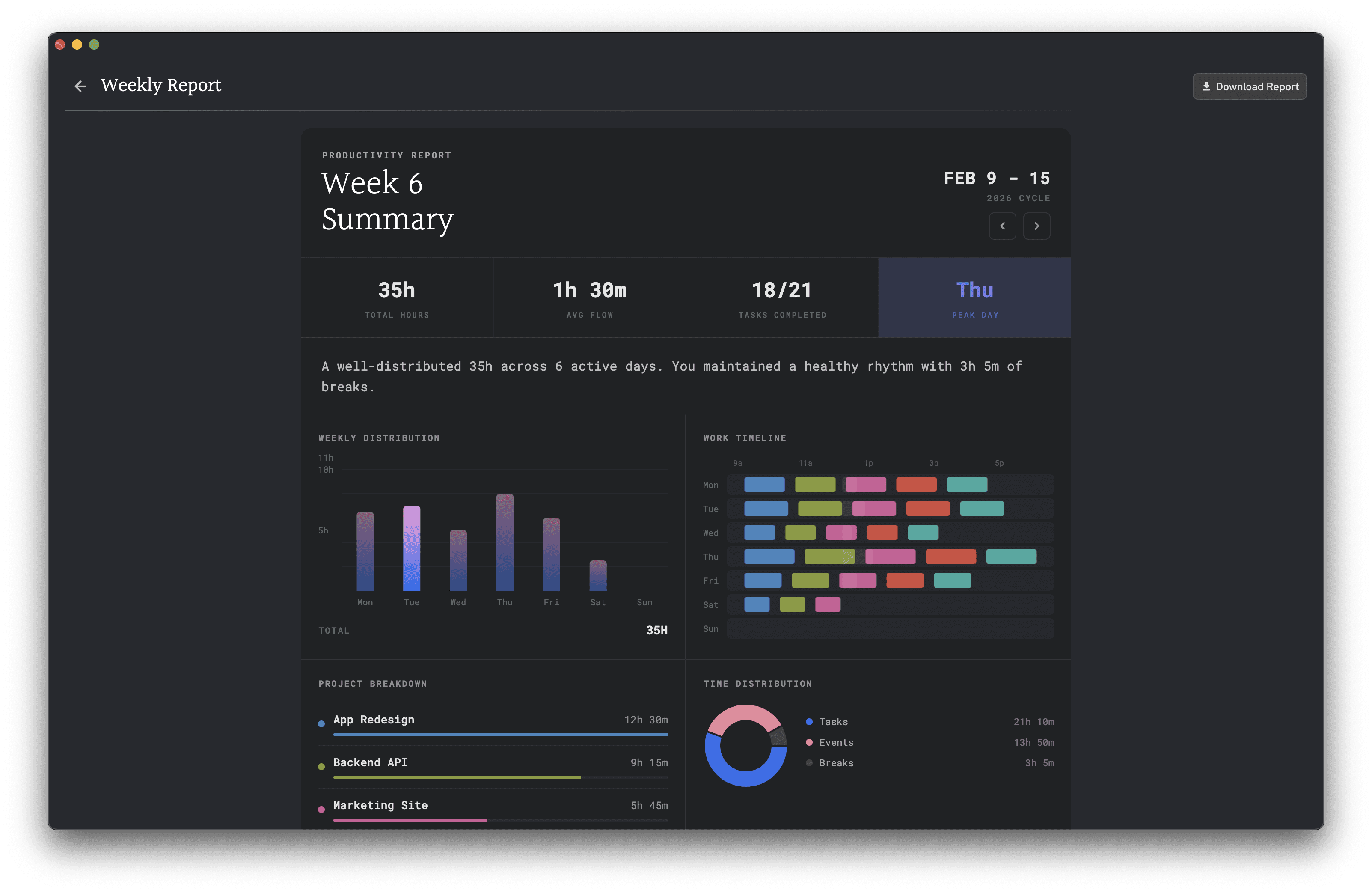
When a task runs past its scheduled block in Focus Mode, Aftertone shows an overdue tag and lets you choose to extend, complete, or add time - from the focus screen without navigating away. The week view (Cmd+7) makes schedule density visible before the day starts, so you can see where you have blocked wall-to-wall and where you have left room.
How To Start Tomorrow
Take tomorrow's calendar and add 10-minute gaps between every significant block. If that means removing something, remove it. At the end of the day, track how many blocks ran to time versus overran. Compare with a typical packed day. The buffer isn't wasted time - it's what keeps the rest of the day on track.
Related Principles
Planning Fallacy - buffers compensate for underestimation
Attention Residue - buffers let residue dissipate
ADHD - buffers essential for ADHD scheduling
Overplanning - structure without buffers creates fragility
Related Reading
Best Time Blocking Apps — Time blocking tools that make it easy to build in transition time as a default, not an afterthought.
Best Mac Calendar Apps for Time Blocking — Mac calendar apps that support buffer-aware scheduling between blocks.
Best Apps to Reduce Meeting Overload — If your buffers keep getting eaten by meetings, these apps help protect the gaps.
Frequently Asked Questions
What is buffer time and why does it matter?
Buffer time is deliberately unscheduled time between tasks or meetings — not free time, but time reserved to absorb overruns, handle transition costs, and allow cognitive resetting between contexts. It matters because back-to-back scheduling ignores the reality that tasks rarely end exactly on time and that switching mental contexts carries a cost that needs somewhere to go.
Why does back-to-back scheduling consistently fail?
Back-to-back scheduling treats time as perfectly divisible and tasks as perfectly predictable. Neither is true. When a meeting runs five minutes over, the next one starts late, which runs over, compressing the next — the cascade compounds throughout the day. Research on time estimation bias confirms that tasks routinely run over initial estimates. Without buffer, overruns have nowhere to go except into the next commitment.
How much buffer time should you build between tasks?
Research does not specify a universal figure, as it depends on task complexity and transition cost. A useful starting heuristic is 10–15 minutes between meetings and 20–30 minutes between cognitively demanding work sessions. Back-to-back meetings can work with a 5-minute break; switching from a deep work block to a completely different context benefits from a longer transition period to allow attentional resetting.
Is buffer time just wasted time?
No — it is the time that makes the rest of the schedule reliable. A calendar with buffer is one where commitments can actually be honoured. A calendar without buffer runs on the fiction that nothing will overrun, and it fails every day that reality differs from the plan. Buffer time also serves as the space for the brief transitions, note-taking, and mental closure that improve performance on what follows.
Further Reading
Buehler, R., Griffin, D., & Ross, M. (1994). Exploring the planning fallacy: Why people underestimate their task completion times. Journal of Personality and Social Psychology, 67(3), 366-381. DOI: 10.1037/0022-3514.67.3.366
Leroy, S. (2009). Why is it so hard to do my work? The challenge of attention residue when switching between work tasks. Organizational Behavior and Human Decision Processes, 109(2), 168-181. DOI: 10.1016/j.obhdp.2009.04.002