The Principle
You reach the end of a busy day having responded to dozens of messages, attended three meetings, handled several small requests, and crossed off numerous items. The task that actually mattered most - the one that required real thought and would have moved something important - is still untouched. You were productive all day in every sense except the one that counts.
Prioritisation frameworks exist to solve this exact problem: the tendency to default to urgent, visible, easy work at the expense of important, demanding, high-value work. The Eisenhower Matrix separates tasks by urgency and importance, directing attention to the quadrant that generates the most meaningful outcomes. "Eat the frog" - doing your most important or difficult task first - is a simpler heuristic with the same intent. Neither is a perfect system, but both correct for the systematic bias toward busyness over impact that characterises most unplanned workdays.

Definition
Most people default to whatever feels most urgent, most visible, or easiest when deciding what to work on next. Prioritisation frameworks exist to interrupt that default and replace it with a deliberate decision about what actually matters. The Eisenhower Matrix separates tasks by urgency and importance, directing attention to work that is important but not urgent before it becomes a crisis. Eat the Frog is a simpler heuristic: do your most important or difficult task before anything else.
What The Research Shows
Aeon, Faber and Panaccio (2021) meta-analyzed 158 studies involving over 53,000 participants and found that prioritisation behaviour specifically correlates with job performance at r = 0.26 and with life satisfaction at r = 0.43. Claessens and colleagues (2007) reviewed 32 studies on time management and found prioritisation was a consistent feature of effective time management behaviours. Neither the Eisenhower Matrix nor the Eat the Frog heuristic have been tested directly in controlled trials - the evidence base supports the practice of prioritisation, not any specific framework for doing it.

What This Means
Prioritisation behaviour correlates with job performance and more strongly with life satisfaction - but the specific framework matters less than the habit of deciding what matters before the day begins. Any system that forces that decision in advance is doing the essential work.
What Most People Get Wrong
Busyness is routinely mistaken for productivity.
Completing many tasks feels productive regardless of whether those tasks actually mattered. Prioritisation frameworks exist to counteract this: they force a decision about what is important before the day starts, rather than leaving that decision to the moment when urgent and visible work competes loudest for attention. The specific framework matters less than the habit of making the decision in advance.
When it Fails…
Reactive roles cannot defer urgency. Support, crisis management, and clinical work require responding to whatever arrives regardless of its quadrant.
Eat the Frog is poorly matched to evening chronotypes. Doing your hardest task first thing assumes morning peak performance - for evening types this is their worst time.
When everything feels important, the framework creates paralysis. The prioritisation decision itself becomes the obstacle when the list does not differentiate clearly.
What This Means For You…
The difference between a busy day and a productive day is not the number of tasks completed. It's whether the tasks that actually mattered got done. Most people can articulate their top priority clearly when asked. The problem is that the day's structure doesn't protect it - meetings, messages, and easier tasks colonise the time that was nominally available for the important work. Prioritisation frameworks are most useful not as complex systems but as a simple daily forcing function: before anything else, decide what the one or two most important things are today, and ensure they have protected time before the reactive work begins.
How Aftertone Implements It.
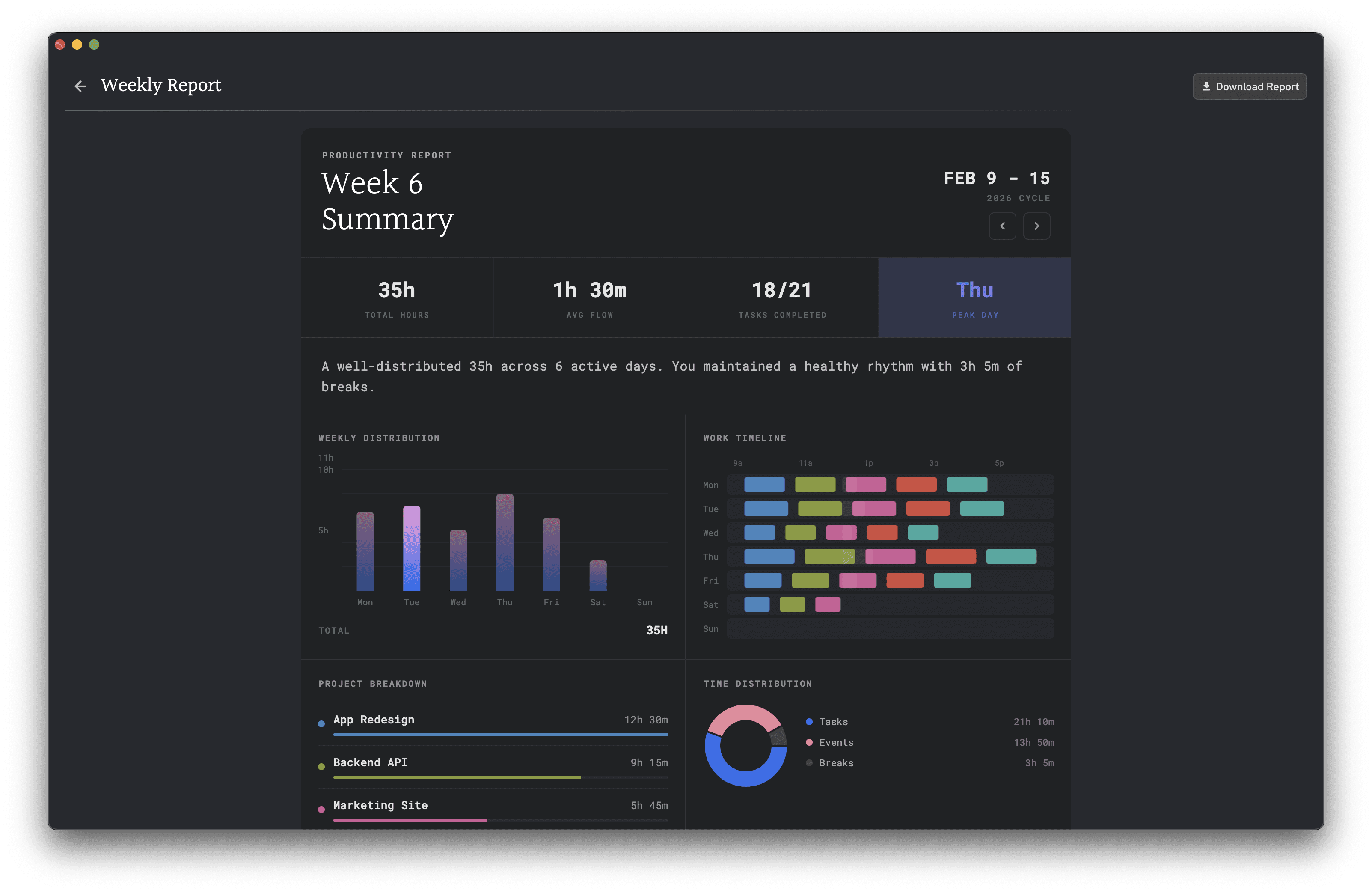
The weekly planning ritual recommends identifying three priorities for the week before scheduling anything else - dragging them to the top of the inbox so they are the first tasks visible during daily planning. The Calendar week view (Cmd+7) is then used to block time for those three priorities first, in your best working hours, before filling in the rest of the week around them.
How To Start Tomorrow
Each morning this week, before opening your inbox or calendar, write down the single most important thing you could do today - the one task that would make the day genuinely successful if it were the only thing you completed. Then block time for it before anything else. At the end of the week, count how many days that task actually got done. That number tells you how well your current system is protecting your priorities.
Related Principles
Energy Management - priorities align with peaks
Decision Fatigue - prioritising early reduces later load
Implementation Intentions - scheduling priorities is if-then planning
Time Blocking - priorities need protected blocks
Related Reading
Best AI Daily Planning Tools — AI planners that surface your most important task and route it to your best hours automatically.
Best Productivity Systems for High Performers — Systems that build prioritisation into the daily workflow rather than leaving it to intuition.
Best Time Blocking Apps — Time blocking forces a prioritisation decision before the day starts — these tools make that easy.
Frequently Asked Questions
What is the Eisenhower Matrix?
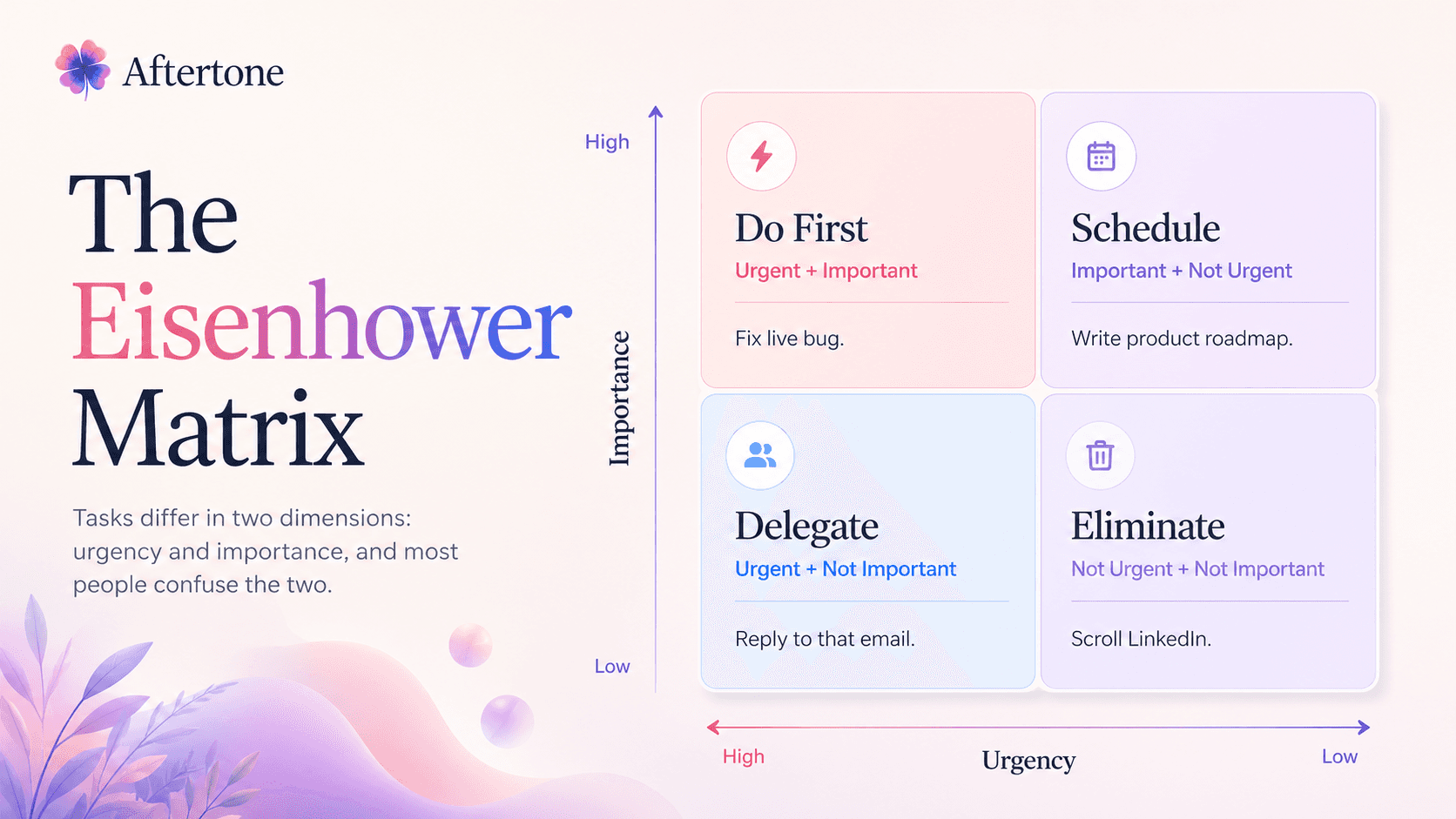
The Eisenhower Matrix is a prioritisation framework that categorises tasks on two axes — urgent vs non-urgent, and important vs non-important — creating four quadrants. The core insight, attributed to Dwight Eisenhower, is that the most important work is rarely urgent, and most urgent work is rarely important. The framework prescribes doing important-urgent tasks immediately, scheduling important-non-urgent tasks, delegating urgent-non-important tasks, and eliminating non-urgent, non-important tasks.
What is Eat the Frog?
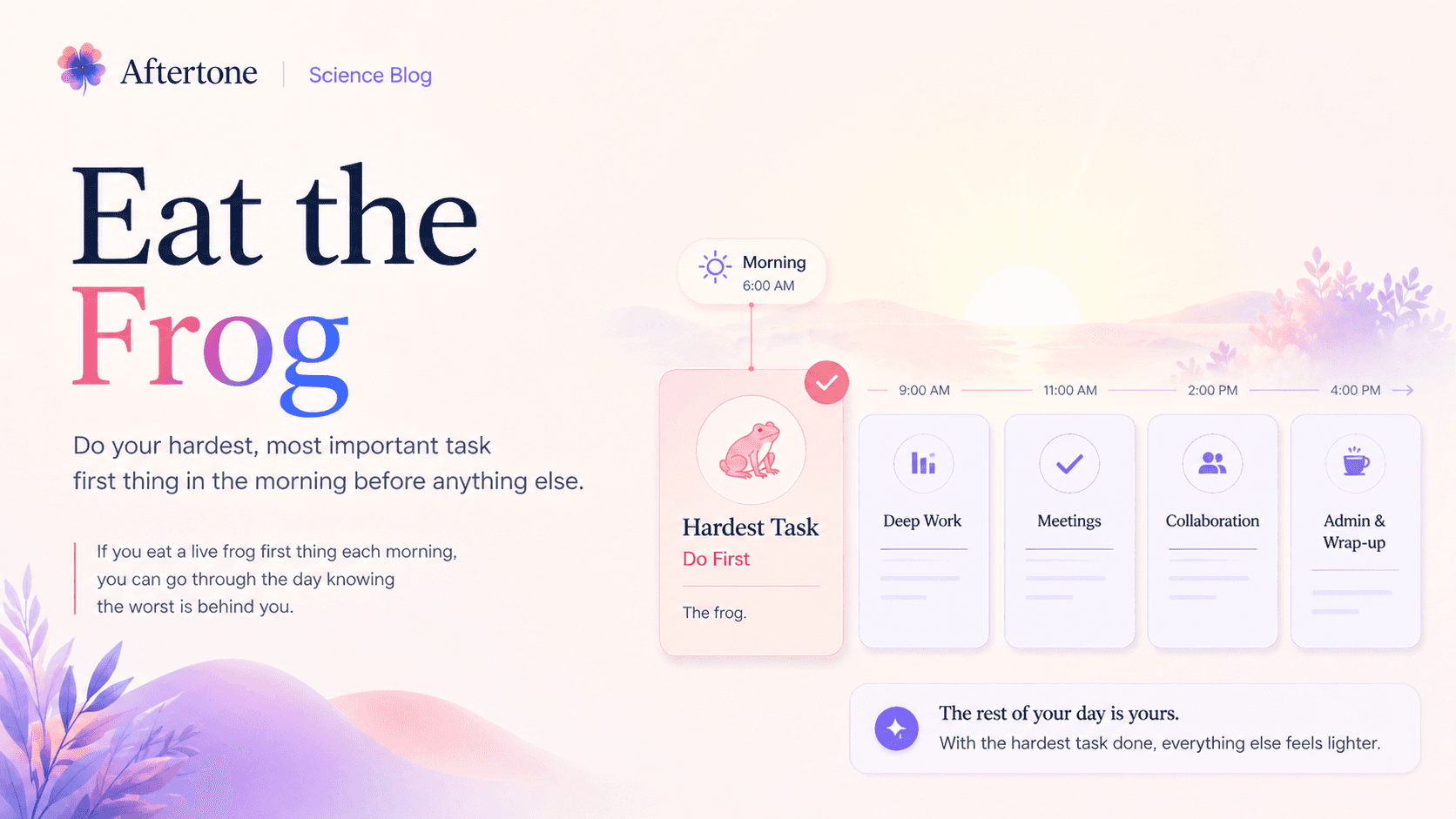
Eat the Frog is a prioritisation heuristic attributed to Mark Twain's advice to begin the day by doing the most difficult or most important task — the "frog" — before anything else. By tackling the highest-priority task first, when cognitive resources and willpower are freshest, you ensure that the day's most important work gets done regardless of what else arrives. The approach is particularly effective for tasks that are prone to avoidance.
Which prioritisation framework works best?
There is no universally superior framework — the most effective one is the one you will actually use consistently. The Eisenhower Matrix is more powerful for managing a large, varied task set and clarifying what deserves attention at all. Eat the Frog is more actionable as a daily discipline for ensuring the most important task gets protected time. Many people combine them: use the matrix to identify the high-leverage work, then protect it with the Eat the Frog discipline.
Why do people struggle to prioritise important-but-not-urgent work?
The mere urgency effect explains this directly: urgency is a stronger attentional signal than importance. Tasks with deadlines or notifications create a pull that non-urgent tasks cannot compete with in real time. Important work that is not urgent — strategic thinking, relationship building, skill development — gets perpetually deferred because it never creates the urgency signal that forces action. This is why structural time protection for important work is necessary, not optional.
Further Reading
Aeon, B., Faber, A., & Panaccio, A. (2021). Does time management work? A meta-analysis. PLOS ONE, 16(1), e0245066. DOI: 10.1371/journal.pone.0245066
Locke, E. A., & Latham, G. P. (2019). The development of goal setting theory: A half century retrospective. Motivation Science, 5(2), 93-105. DOI: 10.1037/mot0000127