The Principle
You keep your phone on your desk because you might need it. You keep Slack open because a message might come in. You keep your email tab visible because something might be urgent. None of these things are usually urgent. But their presence in your environment means you're making a decision about them - whether to check, whether to respond, whether this is the moment - dozens of times per hour without consciously choosing to.
Research on environment design and behaviour shows consistently that the path of least resistance determines what most people do most of the time - not intentions, not willpower, not discipline. Ward and colleagues found that having a smartphone nearby, even switched off, reduced available cognitive capacity simply through its presence. Thaler and Sunstein's work on defaults showed that what's easiest and most visible shapes behaviour far more powerfully than what people say they want to do. Design your environment for the behaviour you want, and you reduce the decision-making load to near zero.

Definition
The environment you work in shapes your behaviour more reliably than your intentions do. Default options, physical arrangements, and what is visible and accessible determine what most people do most of the time - not willpower or motivation. Making the desired behaviour the path of least resistance is more effective than relying on discipline to overcome an environment designed for distraction.
What The Research Shows
Thaler and Sunstein (2008) established the framework of nudge theory - that default options and environmental architecture shape behaviour far more powerfully than conscious choice.
Johnson and Goldstein (2003) demonstrated the effect dramatically: organ donation rates differed from 4.25% to 99.98% between opt-in and opt-out systems, with no change in stated preferences. Ward and colleagues (2017) found that smartphone proximity reduced available cognitive capacity even when the phone was switched off and face-down, across two studies totalling nearly 800 participants. Neal and colleagues (2012) showed that environmental context cues, not goals or intentions, are the primary triggers for established habits.

What This Means
Having a smartphone nearby - even switched off and face-down - reduces available cognitive capacity. Default options and environmental cues shape behaviour more reliably than intentions and willpower.
What Most People Get Wrong
The dominant productivity narrative frames discipline and willpower as the primary tools for behaviour change.
Research on how environments shape behaviour consistently finds that context cues and default options are more powerful predictors of what people do than their stated intentions. Productive people have often designed their environment to make productive behaviour easy, not trained themselves to resist a distracting one.
When it Fails…
Shared environments limit individual control. Open-plan offices, shared homes, and team workspaces constrain what environmental changes a person can actually make.
Organisational requirements often override personal design. Mandatory communication tools, IT policies, and management expectations set defaults that individuals cannot change.
What This Means For You…
The most reliable way to change your behaviour is not to try harder - it's to change what's easy. If distraction is easy and focus is effortful, distraction wins most of the time regardless of intent. If you engineer your environment so that focused work is the path of least resistance - device in another room, communication tools closed, task list visible, everything else out of sight - you stop fighting your defaults and start using them. Environment design is not a hack. It's what actually drives behaviour for the vast majority of people in the vast majority of moments.
How Aftertone Implements It.
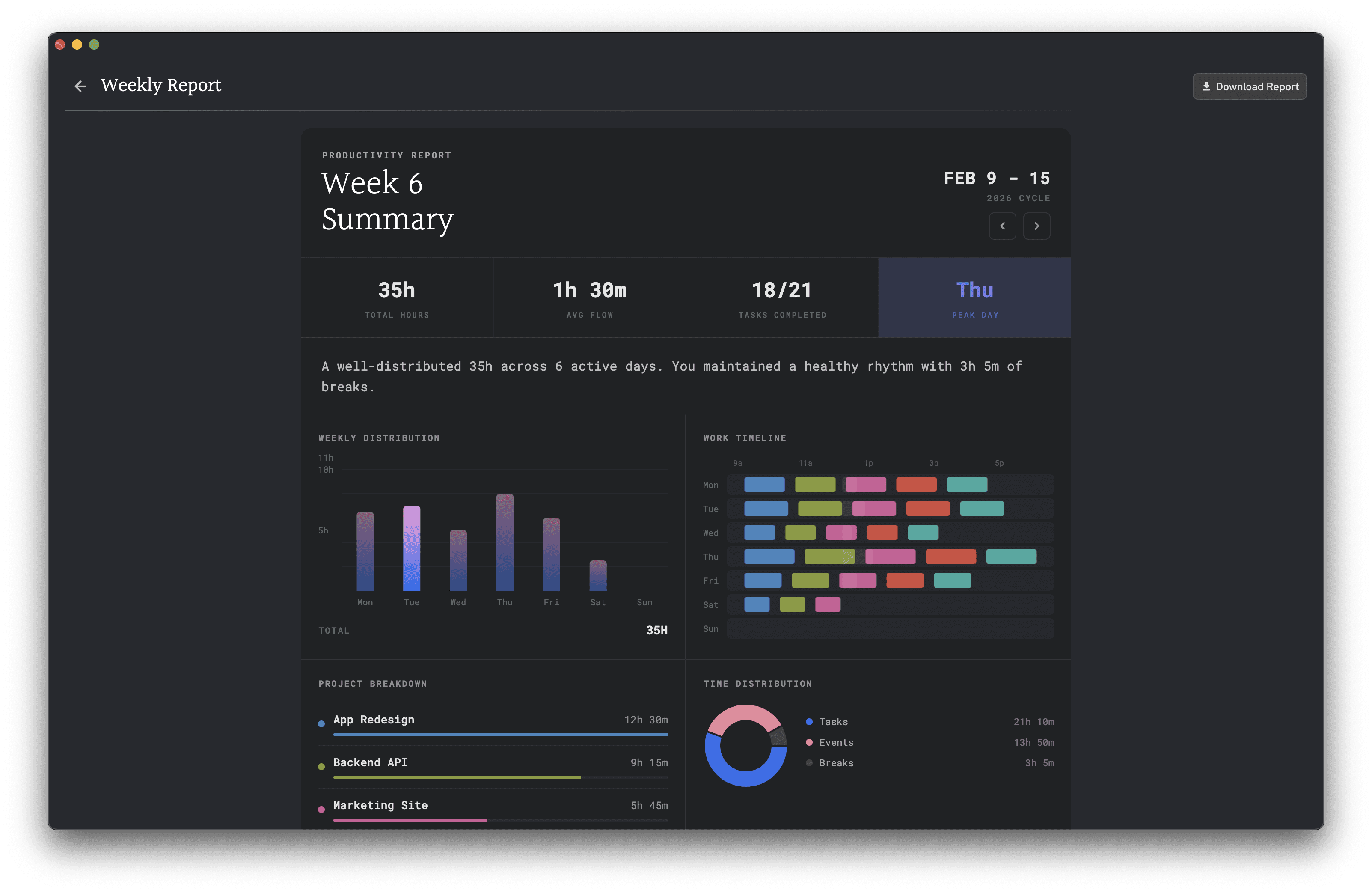
The Calendar view in Aftertone opens on today by default - not a backlog of everything overdue. The keyboard-first design means the most common actions (capture, plan, complete, break) are single keystrokes from the keyboard rather than navigation through menus. Quick Capture (Option+Space) works from anywhere on the Mac without opening the app, making capturing a task easier than ignoring it.
How To Start Tomorrow
Before your next work session, spend three minutes redesigning your environment for focus: phone in another room, browser tabs closed except what you need, task list open and visible, anything visually distracting removed from your desk. Do nothing else differently - same task, same duration, just a different environment. Compare the session to your default setup and notice what changed.
Related Principles
Notification Distraction - removing notifications is environment design
Deep Work - focus blocks are designed environments
Habit Stacking - environmental cues trigger habits
Autonomy - environment design preserves autonomy better than rules
Related Reading
Best Deep Work Apps — These tools are environment design applied to software — removing friction for focus, adding it for distraction.
Best AI Tools to Protect Deep Work Time — AI tools that redesign your digital environment to make focus the path of least resistance.
Best Habit Tracking Apps — Habit trackers that work with your environment rather than relying purely on motivation.
Frequently Asked Questions
What is environment design for behaviour?
Environment design is the deliberate structuring of your physical or digital surroundings to make desired behaviours easier and undesired ones harder — without relying on willpower in the moment. It draws on research showing that context cues, default options, and friction levels have a powerful and automatic influence on behaviour that operates below conscious decision-making.
Why is environment design more effective than willpower?
Willpower is a depleting resource that must be actively applied in the moment of temptation. Environment design eliminates the temptation encounter entirely — the phone is in another room so there is no moment requiring resistance. Research consistently finds that people who appear to have high self-control are often people who have arranged their environments to minimise the need for self-control rather than people who exercise more of it.
What are practical examples of environment design for productivity?
Closing email tabs during focus work eliminates the cue that triggers checking. Moving the phone to another room removes the attentional cost of its presence. Leaving tomorrow's first task open on screen provides a positive cue that reduces starting friction. Designing your workspace so the path of least resistance leads to the desired behaviour — rather than requiring effort to initiate it — is the core application.
Can digital environments be designed the same way as physical ones?
Yes — digital environment design is increasingly important given that most knowledge work happens in digital contexts. Notification settings, app arrangements, browser defaults, and interface design all function as environmental cues that shape behaviour automatically. Placing productive tools prominently and communication tools out of immediate reach applies exactly the same friction-reduction logic to digital contexts as moving a phone out of a room applies to physical ones.
Further Reading
Ward, A. F., et al. (2017). Brain drain: The mere presence of one's own smartphone reduces available cognitive capacity. Journal of the Association for Consumer Research, 2(2), 140-154. DOI: 10.1086/691462
Thaler, R. H., & Sunstein, C. R. (2008). Nudge: Improving Decisions About Health, Wealth, and Happiness. Yale University Press. ISBN: 978-0300122237