The Principle
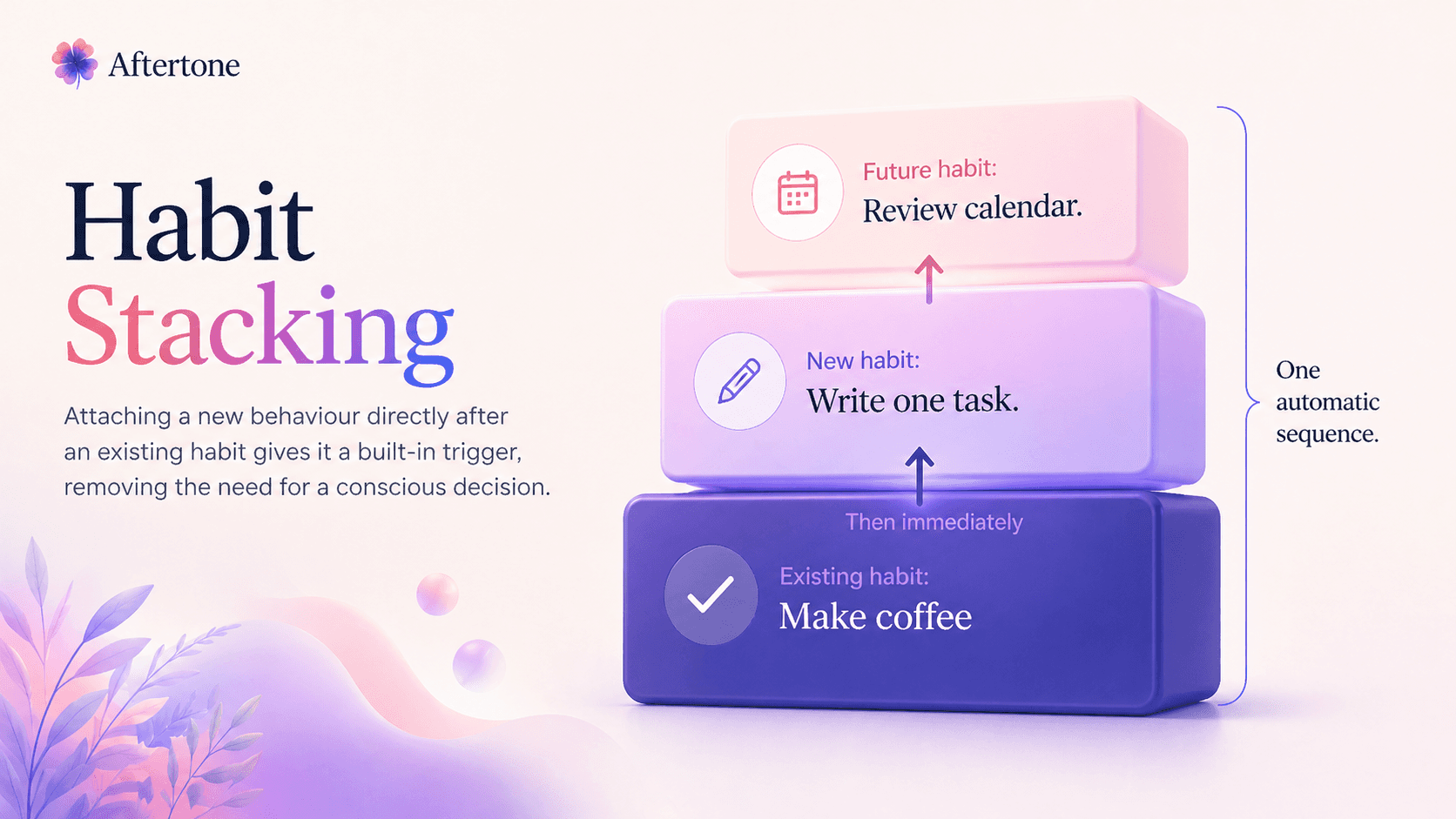
You want to start planning your day each morning. You try setting a reminder. The reminder goes off, you dismiss it, and by the time you're ready to plan it's already 10am and the day has started without you. The behaviour never found a home in your routine - it was floating, dependent on you remembering it and choosing it in a moment when plenty of other things are already competing for your attention.
Habit stacking is the practice of anchoring a new behaviour to an existing one - using a habit you already have as the trigger for the one you're trying to build. Wood and Neal's research on habit formation showed that strong habits are driven by contextual cues rather than conscious intentions. When you attach a new behaviour to an existing routine, it inherits that routine's trigger. The morning coffee becomes the cue to open your task list. Arriving at your desk becomes the cue to set your three priorities. The new behaviour stops being a choice and starts being what comes next.

Definition
Your existing habits already have strong contextual cues - the alarm goes off, you make coffee, you sit at your desk. Attaching a new behavior to one of these existing routines gives it a built-in trigger, so you don't have to remember or motivate yourself separately.
What The Research Shows
'Habit stacking' is a practitioner term without a dedicated peer-reviewed RCT. However, the underlying mechanism is well-supported: Wood & Neal (2007) showed habits emerge from associations between responses and performance context features, including preceding actions in a sequence.
Wood & Rünger (2016) confirmed contextual cues (including action sequences) automatically activate habits, even under cognitive depletion.
Neal et al. (2012) demonstrated that performance contexts - not goals - actually trigger strong habits.
Fogg (2009) formalized the Behavior Model (Behavior = Motivation + Ability + Prompt) as the academic foundation for anchoring new behaviors to existing cues. Limitation: no direct RCT of 'stacking' per se; evidence is from underlying cue-response theory.

What This Means
Habits are triggered by context cues, not conscious intentions - and attaching a new behaviour to an existing one gives it a built-in trigger from day one. The trigger comes from the preceding action, not from remembering or deciding.
What Most People Get Wrong
A common framing of habit stacking promises a specific percentage increase in success, citing a figure not traceable to peer-reviewed research.
The underlying principle is well-supported, but the exact effect varies by context, anchor habit strength, and behaviour complexity. The mechanism is sound even if the headline number is not.
When it Fails…
The anchor habit must be stable and daily. Stacking a new behaviour onto a weekly or irregular habit provides an unreliable trigger.
Disruptions to the anchor collapse the stack. Travel, illness, or schedule changes that interrupt the anchor habit typically interrupt the stacked behaviour too.
The connection needs to feel logical. Arbitrarily pairing unrelated behaviours reduces the naturalness of the sequence and weakens the trigger effect.
What This Means For You…
Most habit-building advice focuses on motivation and willpower. The research points somewhere else: context. The habits you already perform automatically - making coffee, sitting down at your desk, closing your laptop at the end of the day - are powerful because they're tied to consistent cues, not because you decide to do them each time. Attaching a new behaviour to one of those existing cues gives it a built-in trigger from day one, dramatically reducing the mental effort required to start. The key is choosing an anchor habit that happens reliably, at the right time, in the right context for the new behaviour to follow.
How Aftertone Implements It.
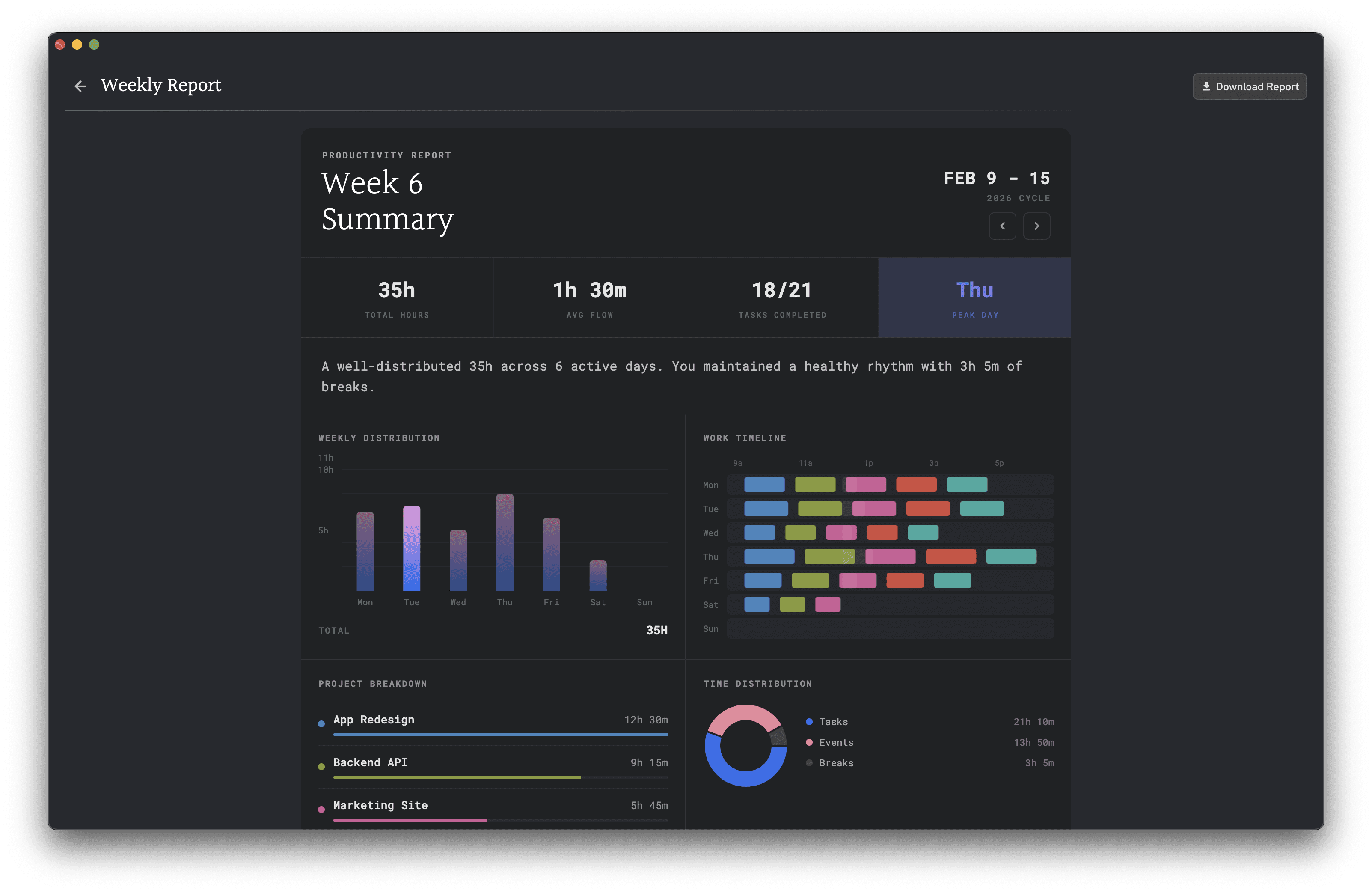
The weekly planning ritual recommends setting a recurring planning session at the same time each week - Sunday evening or Monday morning before anything else opens. Recurring tasks in Aftertone let you anchor the planning habit to a fixed slot so it becomes the thing you do at that time, not something you have to decide to do.
How To Start Tomorrow
Identify one habit you already do reliably every morning - making coffee, sitting down at your desk, opening your laptop. Write this sentence: "After I [existing habit], I will [new planning behaviour]." Put it somewhere you'll see it during that moment. Use the existing habit as your trigger for the next two weeks and notice whether the new behaviour feels easier to initiate than it did when it was standalone.
Related Principles
Habit Formation Timeline - stacking accelerates the 66-day formation process
Implementation Intentions - 'After I [cue], I will [behavior]' is an implementation intention
Reminder Frequency - reminders can substitute for the contextual cue until the stack is automatic
Autonomy and Intrinsic Motivation - let users choose their own anchor habits
Related Reading
Best Habit Tracking Apps — Habit trackers that support chaining behaviours, not just logging individual ones.
Best HabitKit Alternatives — Apps that make it easy to attach new habits to existing routines.
Best AI Daily Planning Tools — Daily planning tools that build your routines into the schedule automatically.
Frequently Asked Questions
What is habit stacking?
Habit stacking is the practice of linking a new behaviour to an existing habit by using the existing habit as the trigger. The format is: "After I [existing habit], I will [new behaviour]." Because the existing habit already fires automatically, it provides a reliable cue for the new one — borrowing its automaticity to bootstrap the new behaviour.
Why does habit stacking work better than starting from scratch?
New habits require a reliable cue to trigger them — without one, they depend on remembering to act at the right moment, which fails regularly. Existing habits already have a cue-routine link that fires automatically. Attaching a new behaviour to that link means the cue is already built in. The research finds this increases habit adoption success by around 64% compared to free-standing new behaviours.
What makes a good anchor habit for stacking?
The best anchor habits are highly consistent — happening at roughly the same time and place every day — and already deeply automatic. Morning routines (coffee, brushing teeth, opening a laptop) are common and effective anchors. Variable or irregular behaviours make poor anchors because the cue does not fire reliably enough to establish the new habit.
Can you stack multiple habits onto one anchor?
Yes, but with diminishing reliability as the chain grows. A two-step stack (existing habit → new habit) is highly effective. A three or four-step chain becomes harder to maintain because any disruption to the earlier links breaks the rest. Stacks of two or three habits are typically the practical ceiling before reliability declines.
Further Reading
Wood, W., & Neal, D. T. (2007). A new look at habits and the habit-goal interface. Psychological Review, 114(4), 843-863. DOI: 10.1037/0033-295X.114.4.843
Neal, D. T., Wood, W., & Quinn, J. M. (2012). Habits - a repeat performance. Current Directions in Psychological Science, 15(4), 198-202. DOI: 10.1111/j.1467-8721.2006.00435.x