The Principle
You made a good plan. You had the right priorities. You knew what mattered. And then mid-afternoon arrived and you spent forty minutes on something that didn't matter, snapped at someone who didn't deserve it, and couldn't get back into the thing you were supposed to be doing. The plan didn't fail because it was a bad plan. It failed because the person executing it was hungry, hadn't slept properly, and had been in back-to-back meetings for four hours without a break.
HALT is an acronym originating in addiction recovery — Hungry, Angry, Lonely, Tired — used to identify physiological and emotional states that predictably trigger relapse or poor decisions. Its clinical origins are well-established; its application to knowledge work and productivity is newer but mechanistically grounded. Each of the four states independently degrades the prefrontal cortex function needed for self-regulation, prioritisation, and sustained effort. They don't just make work feel harder. The research shows they make it objectively worse.

Definition
HALT identifies four physiological and emotional states — Hungry, Angry, Lonely, Tired — that each independently impair self-regulation and decision quality. Originally a clinical tool in addiction recovery, the framework maps onto robust research showing that glucose depletion, emotional arousal, social isolation, and sleep deprivation each compromise the prefrontal function required for sustained, goal-directed behaviour.
What The Research Shows
Hungry: Gailliot et al. (2007) found that self-control tasks deplete blood glucose and that consuming glucose restored self-control performance, though this glucose model has since been contested by meta-analyses (Hagger et al., 2010). The depletion effect on decision quality is more robustly supported than the specific glucose mechanism. Angry / emotionally aroused: Lerner & Tiedens (2006) showed that anger increases risk-seeking and reduces careful deliberation, with effects persisting beyond the triggering event. Lonely: Cacioppo & Hawkley (2003) demonstrated that loneliness impairs executive function, sleep quality, and self-regulation through chronically elevated stress responses. Tired: Van Dongen et al. (2003) showed that even moderate sleep restriction (6 hours/night for two weeks) produces cognitive deficits equivalent to 48 hours of total sleep deprivation — and crucially, subjects did not perceive their own impairment. Limitations: HALT as an integrated framework lacks direct experimental validation; the evidence is assembled from four separate research streams.

What This Means
Your ability to execute a good plan depends as much on your physiological state when you sit down to work as on the quality of the plan itself. A well-structured day that begins when you are rested, fed, and emotionally regulated will produce different outcomes than the same plan executed while you are tired, hungry, and carrying unresolved frustration — even if the calendar looks identical.
What Most People Get Wrong
The assumption is that motivation and discipline are the primary variables in execution.
HALT suggests this is backwards for a significant portion of productivity failures. When someone consistently abandons their plan in the afternoons, repeatedly makes poor decisions under pressure, or finds that their best intentions collapse by Thursday, the diagnosis is rarely "needs more discipline." More often it is a physiological state problem: chronic sleep debt, irregular meals, social isolation, or unprocessed emotional load. These are not character failings. They are inputs to the system that the system has not accounted for. A plan that ignores the state of the person executing it is an incomplete plan.
When it Fails…
HALT is a diagnostic tool, not a solution. Identifying that you are tired does not produce the rest needed to fix it. The framework is more useful for explaining past failures and designing preventive systems than for in-the-moment recovery.
Chronic states are structural. Someone working in a role that produces chronic sleep restriction, social isolation, or sustained emotional stress will not resolve HALT states through productivity techniques alone. The conditions creating them need to change.
Self-perception of HALT states is unreliable. The Van Dongen sleep research found that people consistently underestimate their own impairment — meaning that asking yourself "am I too tired to work well?" is not a reliable check.
What This Means For You…
The most overlooked input to your productivity system is your own physiological state at the time of execution. No task management method, time blocking approach, or planning ritual will consistently outperform the baseline created by whether you slept, ate, have some sense of social connection, and are not carrying acute emotional activation into your work. Practically: build your schedule around when your HALT states are most managed, not just when calendar slots are available. Protect the early morning if it's when you're least depleted. Build eating into your schedule deliberately, not as an afterthought. Treat a 15-minute social interaction as a legitimate input to afternoon performance. Acknowledge that Thursdays and Fridays carry a different cognitive budget than Mondays.
How Aftertone Implements It.
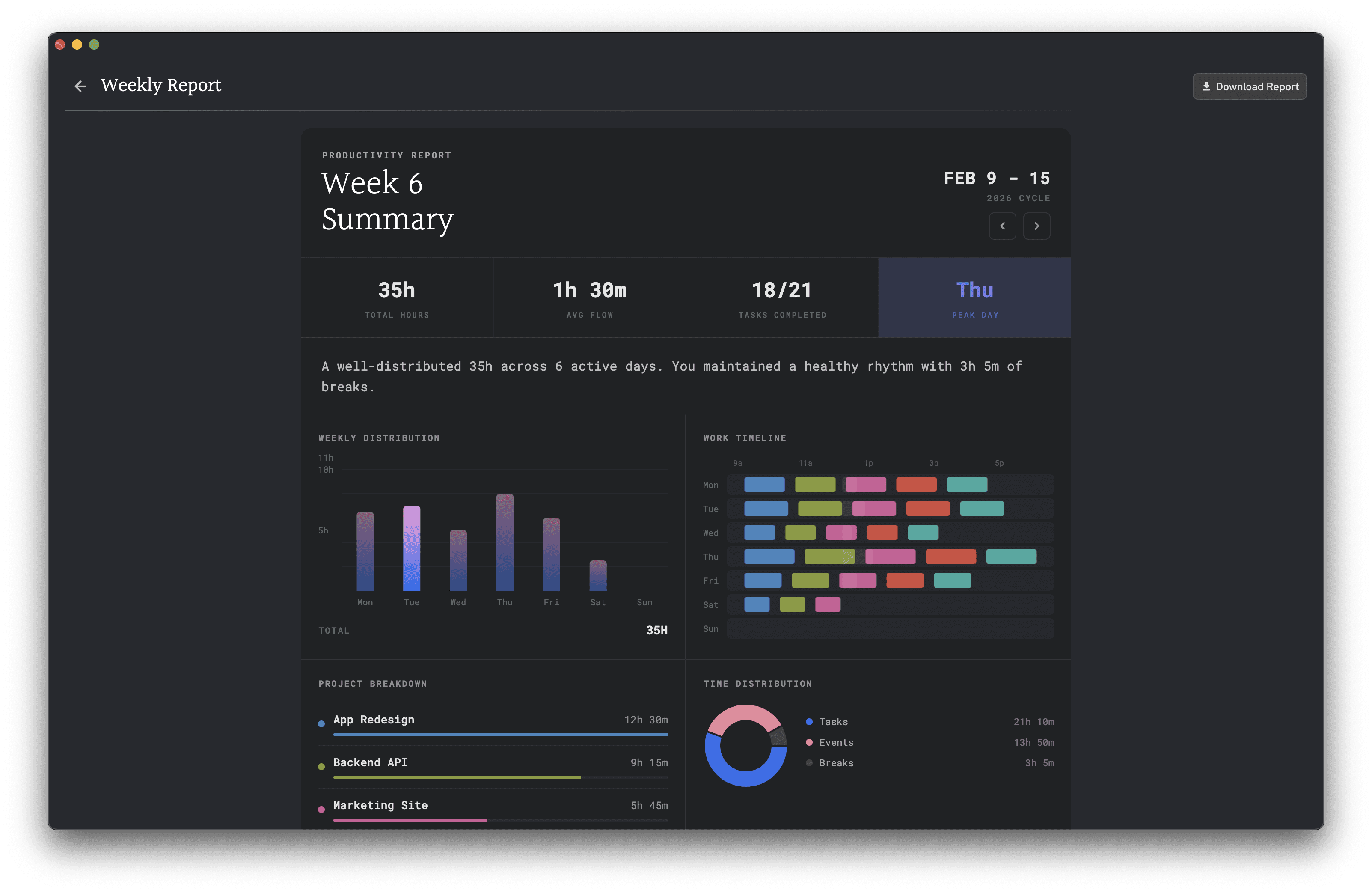
Aftertone's AI weekly report surfaces the relationship between your schedule patterns and your output patterns — making HALT-state effects visible in your own data. When the report shows that focus blocks scheduled after 3pm consistently underperform those scheduled in the morning, or that weeks with heavy meetings produce fewer completed deep work tasks, it is often a HALT pattern made visible. The goal is not to diagnose which state is responsible but to make the pattern clear enough that the schedule can adapt around it.
How To Start Tomorrow
For the next two weeks, note your HALT state at the start of each work session — a quick score on whether you are currently hungry, emotionally activated, socially isolated, or tired. At the end of the two weeks, compare those scores against which sessions produced your best and worst work. Most people find a clear pattern that no amount of motivation would have overridden. Use it to redesign when you schedule your hardest work, not just what you schedule.
Related Principles
Sleep Deprivation — the T in HALT; the research on sleep and cognitive performance is the most robustly evidenced of the four states
Energy Management — HALT states interact with chronotype; the worst HALT combinations occur at your chronotypic low points
Decision Fatigue — tiredness and emotional depletion compound decision fatigue; the states are not independent
Recovery and Detachment — recovery from HALT states, particularly anger and tiredness, requires genuine detachment rather than passive rest
Related Reading
Best AI Daily Planning Tools — Planning tools that build in natural breakpoints where self-checks become part of the workflow.
Best Productivity Systems for High Performers — Systems that treat self-regulation as a resource to manage, not a character trait to rely on.
Best Deep Work Apps — Focus apps that track session quality, not just session length — the data that HALT is pointing at.
Frequently Asked Questions
What does HALT stand for?
HALT stands for Hungry, Angry, Lonely, Tired — four physiological and emotional states that each independently impair self-regulation and decision quality. The acronym originated in addiction recovery as a diagnostic checklist for high-risk states. Its application to knowledge work is newer but grounded in robust individual research streams: each of the four states has documented effects on prefrontal function and cognitive performance.
How does being hungry affect cognitive performance?
Gailliot et al.'s research found that self-control tasks deplete blood glucose and that replenishing glucose restored performance. The specific glucose model has since been contested, but the underlying effect — that metabolic state affects cognitive and self-regulatory performance — remains supported. Irregular meals and long periods without eating create conditions that degrade exactly the executive function required for sustained, goal-directed work.
Why is tiredness the most dangerous HALT state for knowledge workers?
Because the impairment is invisible to the person experiencing it. Van Dongen et al.'s research found that two weeks of six-hours-per-night sleep produced cognitive deficits equivalent to 48 hours of total sleep deprivation — but participants rated their own sleepiness as only slightly elevated. The combination of real impairment and absent self-awareness means tired workers make decisions about their own capacity that are systematically inaccurate.
How do you use the HALT framework practically?
As a pre-work diagnostic rather than an in-moment intervention. Before beginning important cognitive work, briefly check whether any HALT state is present. If you are hungry, eat before the session rather than during it. If emotionally activated, note it and consider whether a brief settling period would serve the work better than starting immediately. The framework is most useful for explaining patterns in retrospect and designing preventive routines — not as a willpower override when you are already impaired.
Further Reading
Van Dongen, H. P. A., et al. (2003). The cumulative cost of additional wakefulness: Dose-response effects on neurobehavioral functions and sleep physiology. Sleep, 26(2), 117-126. DOI: 10.1093/sleep/26.2.117
Lerner, J. S., & Tiedens, L. Z. (2006). Portrait of the angry decision maker. Journal of Behavioral Decision Making, 19(2), 115-137. DOI: 10.1002/bdm.515
Cacioppo, J. T., & Hawkley, L. C. (2003). Loneliness and health: Potential mechanisms. Psychosomatic Medicine, 65(1), 29-34. DOI: 10.1097/01.PSY.0000054526.21458.4e