The Principle
Prospective memory — the ability to remember to act at the right future moment — accounts for approximately half of all everyday forgetting. Every missed appointment, forgotten follow-up, and dropped commitment is a prospective memory failure, not a general memory failure. The distinction matters because the fix is different: prospective memory is not improved by trying harder to remember, but by building external structures that remove the spontaneous retrieval requirement entirely.
You intended to send the email after the meeting. You planned to bring it up when you spoke to them. You were going to start the report on Tuesday. The intention was genuine. The action never happened. This is not forgetfulness in the usual sense — you remembered the task perfectly well when reminded. What failed was the retrieval of the intention at the moment it was needed. That specific failure has a name: prospective memory failure. NASA researcher R. Key Dismukes identified the mechanism precisely: cognitive tunneling — when a problem arises with the current task, attention narrows onto it and the deferred intention drops from active memory, even when the intention was clearly formed and genuinely important.
Prospective memory is the ability to remember to perform an intended action at the right moment in the future, as distinct from retrospective memory (remembering past events or information). It is cognitively distinct, neurologically distinct, and fails in ways that retrospective memory does not. The research on prospective memory explains why to-do lists in isolation fail, why intentions without specific triggers miss, and why the combination of a specific time plus a specific cue is dramatically more effective than either alone.

Definition
Prospective memory is the cognitive capacity to remember to perform a planned action at the appropriate future moment. It operates differently from retrospective memory — it must self-initiate retrieval without an obvious external prompt, making it inherently more fragile. Research distinguishes two types: time-based (remember to do X at 3pm) and event-based (remember to do X when Y happens), with different failure modes and different support strategies for each.
What The Research Shows
Einstein & McDaniel (1990) established the foundational taxonomy of prospective memory, showing it operates through spontaneous retrieval triggered by environmental cues rather than deliberate search. Event-based prospective memory (triggered by an event) is generally more reliable than time-based (triggered by clock monitoring), because the triggering event itself serves as a retrieval cue. Marsh et al. (1998) demonstrated that prospective memory failures increase substantially when the cue-action link is weak or the delay between intention and execution is long. Scullin et al. (2012) showed that implementation intentions (if-then plans) significantly improve prospective memory success by strengthening the association between cue and intended action at encoding. Limitations: most prospective memory research uses laboratory tasks; ecological validity in real-world complex work settings is harder to establish.
Dismukes (2012) reviewed the prospective memory literature from a workplace perspective (NASA Ames Research Center) and found that implementation intentions improve prospective memory performance by two to four times in real-world tasks including medication adherence, exercise, and homework completion. He also documented the "cognitive tunneling" mechanism — when a problem arises with the current task, attention narrows onto it and deferred intentions drop from active memory. Aviation and medicine now rely on checklists specifically as external prospective memory cue systems to defend against this failure mode.

What This Means
When you make a plan without specifying the cue that will trigger retrieval of that plan, you are relying on a cognitively fragile process to deliver an important action at the right moment. A to-do list without a time or trigger is a prospective memory task with no support — the brain must spontaneously retrieve the intention from among competing demands at exactly the right moment. The research predicts this will fail regularly, not because of inattention but because spontaneous retrieval without cues is inherently unreliable.
What Most People Get Wrong
Most task management advice focuses on capture and organisation — getting things onto a list.
Prospective memory research identifies the actual failure point as retrieval: the moment the action was supposed to happen. A perfectly organised task list that is not reviewed at the right moment, attached to the right cue, or embedded in a time-based trigger is a list of prospective memory tasks waiting to fail. The organisational work is not the hard part. The hard part is building the conditions under which the intention surfaces at the moment it needs to.
When it Fails…
Long delays dramatically increase failure rates. Intentions formed hours or days before the required action are much more vulnerable than those formed shortly before execution. The longer the gap, the more critical external support becomes.
High cognitive load suppresses prospective memory. When working memory is heavily occupied, even well-encoded prospective intentions are less likely to surface at the right moment — explaining why busy periods produce more missed intentions, not fewer.
Atypical cue environments fail. Event-based prospective memory depends on encountering the triggering cue. If the environment changes (different location, different routine), the cue may not appear and the intention is lost.
What This Means For You…
Every task you add to a list without a time, trigger, or cue is a prospective memory task you are leaving to chance. The research is consistent: event-based cues (when I open my email, when I finish the standup) and time-based anchors (at 2pm, on Monday morning) reliably outperform intention alone. This is the mechanistic explanation for why implementation intentions work, why time blocking works, and why "I'll do it when I remember" reliably fails. The practical rule: every commitment that matters should have either a specific time block or a specific trigger event — not because of discipline, but because prospective memory without cues is structurally unreliable.
How Aftertone Implements It.
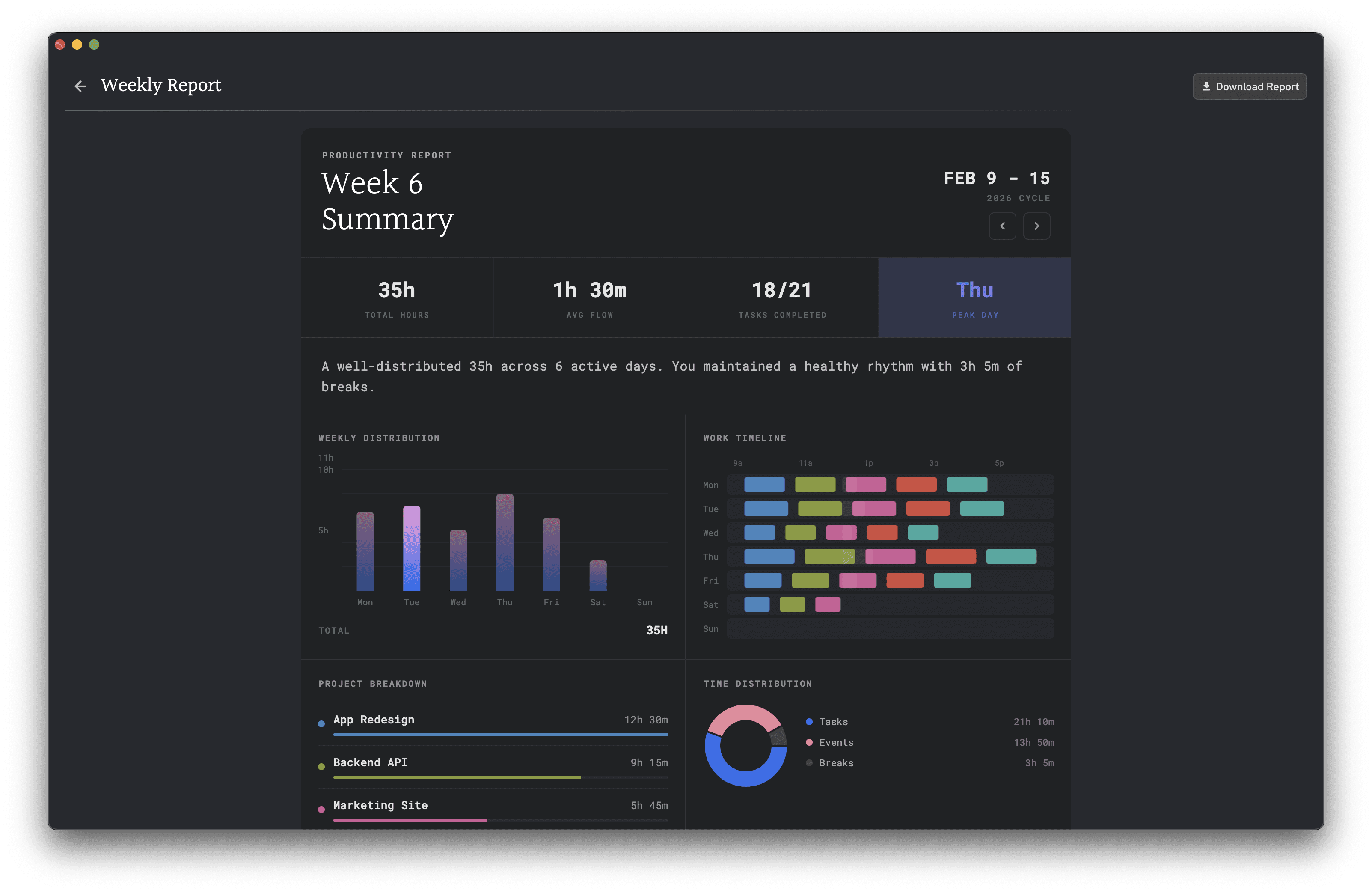
Aftertone's entire design is a prospective memory support system. Dragging a task onto the calendar converts a prospective memory task (remember to do this sometime) into a time-based prospective memory task with an explicit anchor (do this at 2pm Tuesday). The Focus Screen eliminates the need for spontaneous retrieval entirely — it presents the intended actions at the moment they are due, so the person never has to remember to check what they planned. Quick Capture (Option+Space) encodes intentions immediately, reducing the delay between intention formation and cue embedding that the research identifies as the primary failure point.
How To Start Tomorrow
Go through your current task list and identify every item that has no specific time and no specific trigger. Each one is a prospective memory task relying on spontaneous retrieval. For each, add either a time ("I will do this at 9am Thursday") or an event cue ("I will do this immediately after my Monday standup"). Notice over the following week how many of those tasks actually happen compared to tasks without anchors. The difference is prospective memory support in practice.
Related Principles
Implementation Intentions — if-then plans work partly because they strengthen the prospective memory cue-action link at encoding
Time Blocking — time blocks are the practical application of time-based prospective memory support
Cognitive Offloading — externalising tasks reduces the prospective memory demand by placing the retrieval burden on the system rather than the brain
Reminder Frequency — reminders are external prospective memory cues; their timing and frequency determine whether they support or disrupt the retrieval process
Related Reading
Best Time Blocking Apps — Scheduling a task at a specific time removes the prospective memory requirement entirely.
Best Mac Calendar Apps for Time Blocking — Mac calendar apps that surface tasks at the right moment so you don't have to remember them.
Best AI Daily Planning Tools — AI planners that handle the 'remember to do this' problem so you don't have to carry it.
Planned vs Actual: Tracking Intentions — The practice of recording what you intended vs what happened closes the prospective memory feedback loop.
Weekly Review How-To — The weekly review processes open prospective memory loops before they fail silently.
Frequently Asked Questions
What is prospective memory?
Prospective memory is the cognitive capacity to remember to perform a planned action at the right future moment — distinct from retrospective memory, which is remembering past events or information. It is inherently more fragile because it must self-initiate retrieval without an obvious external prompt. Research distinguishes time-based prospective memory (do X at 3pm) from event-based prospective memory (do X when Y happens), each with different failure modes.
Why does prospective memory fail so often?
Prospective memory relies on spontaneous retrieval — the intention must surface from memory at the right moment without a clear external trigger. Unlike looking up a fact (retrospective memory), which is externally prompted, prospective memory must generate its own retrieval cue from within. This process is unreliable under high cognitive load, after long delays between intention formation and required action, and when the environmental cue linked to the action is absent or changed.
What is the difference between time-based and event-based prospective memory?
Time-based prospective memory requires monitoring the clock and acting at a specified time — it is more demanding because it requires ongoing time-monitoring in parallel with other activity. Event-based prospective memory fires when a specific external event occurs (finishing a meeting, seeing a particular person), which provides a natural retrieval cue and is generally more reliable. Implementation intentions exploit event-based memory by specifying the triggering event explicitly.
Why do we forget things we fully intended to do?
Because prospective memory relies on spontaneous retrieval — the intention must surface from within at the right moment, without an obvious external prompt. Unlike remembering a fact (which is triggered by a question), remembering to act at a future moment must generate its own retrieval cue. Under cognitive load or when absorbed in a different task, this retrieval fails even when the intention was clearly formed. NASA researcher R. Key Dismukes called this cognitive tunneling: problem-focus on the current task causes deferred intentions to drop from active memory. The fix is externalising the retrieval cue — a calendar entry, an event-based if-then plan, a physical reminder — so the system does the retrieval work rather than the brain.
What is the most effective way to support prospective memory?
External scaffolding consistently outperforms relying on internal retrieval. Assigning a specific time to a task (time-based support), attaching it to an existing event or routine (event-based support), or placing a physical cue in the environment where the action needs to happen all reduce the failure rate significantly. Implementation intentions — if-then plans that specify both the trigger and the action — strengthen the cue-action link at encoding and have been shown to improve prospective memory performance by two to four times in real-world tasks such as medication adherence and homework completion (Dismukes, 2012). Aviation and medicine use checklists for exactly this reason: the checklist is an external prospective memory system that removes reliance on spontaneous retrieval in high-stakes environments.
Further Reading
Einstein, G. O., & McDaniel, M. A. (1990). Normal aging and prospective memory. Journal of Experimental Psychology: Learning, Memory, and Cognition, 16(4), 717-726. DOI: 10.1037/0278-7393.16.4.717
Scullin, M. K., et al. (2012). Implementation intentions and prospective memory: Psychophysiological evidence. Journal of Experimental Psychology: General, 141(4), 749-762. DOI: 10.1037/a0027516
Dismukes, R. K. (2012). Prospective memory in workplace and everyday situations. Current Directions in Psychological Science, 21(4), 215-220. DOI: 10.1177/0963721412447621