The Principle
You told yourself you'd start on the report this afternoon. This morning you had every intention. But this afternoon arrived and there was a Slack message to reply to, a quick thing to check, a smaller task that felt more completable. The report sits there. The problem is not that you forgot about it or that you don't care about it. The problem is that the pull of the immediate is structurally stronger than the pull of the future — by a measurable, predictable, and frustratingly stable margin.
Hyperbolic discounting describes the pattern by which people value rewards that arrive sooner far more than the same rewards delayed — and do so in a curved (hyperbolic) rather than consistent way. The peculiarity is the reversal: people prefer a smaller sooner reward over a larger later one when both are close in time, but prefer the larger later reward when both are distant. This creates preference reversals — making a plan now to do something later, then abandoning it when later becomes now — that are not the result of weak character but of a predictable feature of how the brain values time.

Definition
Hyperbolic discounting is the tendency to apply steeper discounting to rewards in the near future than to rewards further away, producing preference reversals and present bias. Unlike exponential discounting (which is consistent across time horizons), hyperbolic discounting produces a curve that drops sharply near the present — meaning the gap between "now" and "in five minutes" is psychologically larger than the gap between "in one month" and "in one month and five minutes."
What The Research Shows
Ainslie (1975) demonstrated hyperbolic discounting in pigeons choosing between immediate and delayed food rewards, with the preference reversal pattern — choosing immediate when close, delayed when both are distant — providing the signature of hyperbolic rather than exponential discounting. Thaler (1981) showed the same pattern in humans across monetary rewards, with discount rates for immediate delays (today vs tomorrow) far exceeding those for equivalent delays in the future (next year vs next year plus one day). Laibson (1997) formalised the beta-delta model of quasi-hyperbolic discounting to capture the present-bias phenomenon in economic decision-making. Applied to procrastination: O'Donoghue & Rabin (1999) showed that present bias produces systematic procrastination even in people who are fully aware of their own bias and want to overcome it. Limitations: most foundational studies use monetary or food rewards; generalisation to complex knowledge work tasks involves additional assumptions.

What This Means
The version of you making plans in advance and the version of you executing those plans are operating with different utility functions. Planning-you discounts the future gently and makes sensible commitments. Executing-you faces those same tasks when they are now immediate and discounts them steeply against whatever else is happening right now. This is not failure of motivation or character — it is a predictable consequence of hyperbolic discounting, and it affects virtually everyone.
What Most People Get Wrong
The standard response to procrastination driven by hyperbolic discounting is to try harder or want the future goal more.
This doesn't work because the problem is structural: the discounting function itself creates the preference reversal. The research-consistent responses are different: pre-commitment (making it harder to deviate from the future plan when the time comes), reducing the friction of starting (making the immediate version of the task feel less costly), and reframing tasks to make their value feel more immediate rather than distant. Wanting to do the report more does not change the discounting curve. Writing the first sentence before closing your laptop tonight changes what "starting the report tomorrow" means — because starting is already done.
When it Fails…
Strong intrinsic motivation reduces the effect. When someone genuinely wants to do a task for its own sake right now — not as a means to a future outcome — hyperbolic discounting has less purchase. The problem is most acute for instrumental tasks whose value is primarily future-oriented.
Deadlines partially override discounting. External deadlines shift the temporal structure so that the cost of not acting becomes immediate, partly counteracting the discounting effect. This is why many people work best close to deadlines.
Individual differences are substantial. Some people exhibit much stronger present bias than others, and these differences are relatively stable. One-size-fits-all procrastination advice fails to account for this range.
What This Means For You…
If you consistently make plans you don't execute, the most useful frame is not "why don't I have more discipline?" but "how do I design around the discounting curve?" Concretely: pre-commit by telling someone what you'll do, or by scheduling the task in a calendar that will actively remind you. Reduce present friction by doing the first action now, so tomorrow-you starts from progress rather than zero. Make future value feel more immediate by writing down concretely what completing this task would feel like — not in the abstract but specifically. And use deadlines deliberately, even artificial ones, because they shift the temporal structure in a way that your discounting function responds to.
How Aftertone Implements It.
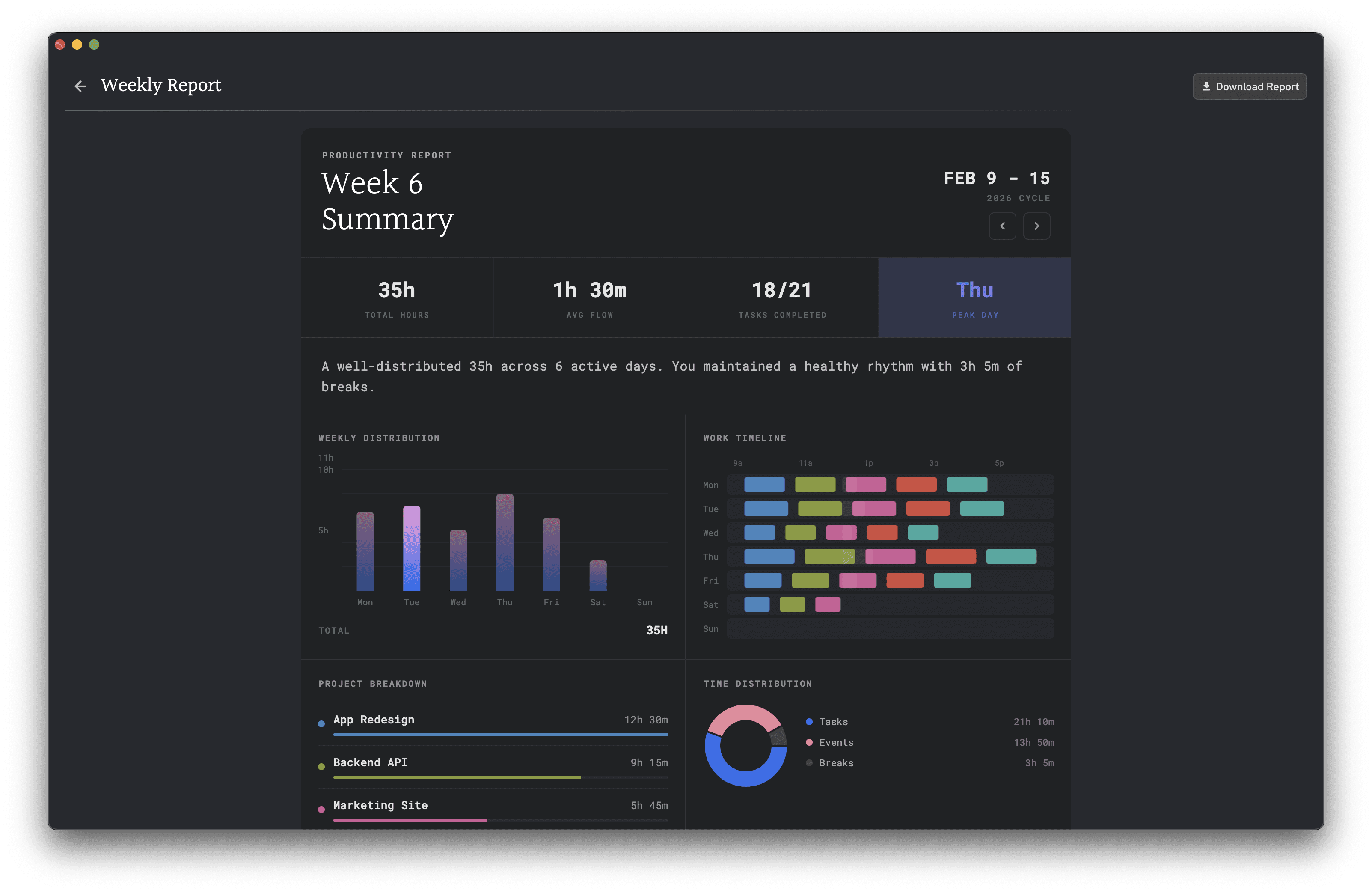
Time blocking in Aftertone is a pre-commitment device that partially counteracts hyperbolic discounting. When you drag a task onto Tuesday's calendar, you are making planning-you's preference binding on executing-you — the block creates a visible commitment that has to be actively overridden rather than passively abandoned. The Focus Screen further reduces present friction by presenting the planned task immediately and making starting it the path of least resistance. The goal is to make the hyperbolic curve work in your favour: by the time the task arrives, you are already oriented toward it.
How To Start Tomorrow
Pick one task you have been putting off. Instead of planning to do it "this week," do two things now: write down the specific first action required to start it, and do that first action today — even if only for five minutes. Then schedule the rest for a specific time. You are pre-committing and reducing starting friction simultaneously. Notice whether the task feels different when it arrives compared to ones you plan but don't start.
Related Principles
Procrastination as Emotion Regulation — hyperbolic discounting is the temporal mechanism; emotion regulation is the emotional mechanism; both contribute to avoidance
Implementation Intentions — if-then plans partially counteract hyperbolic discounting by pre-specifying the conditions of execution
Temptation Bundling — bundling an immediate reward with a future-oriented task makes its value feel more present, directly addressing the discounting curve
Parkinson's Law — artificial deadlines work partly because they shift when the cost of not acting becomes immediate
Related Reading
Best Time Blocking Apps — Committing to a scheduled block makes the future task concrete — the most reliable counter to discounting.
Best AI Daily Planning Tools — AI planners that route long-term priorities into today's schedule before short-term urgency takes over.
Best Productivity Systems for High Performers — Systems that structure the week so important-but-not-urgent work gets time before it becomes urgent.
Frequently Asked Questions
What is hyperbolic discounting?
Hyperbolic discounting is the tendency to apply much steeper discounting to rewards in the near future than to equivalent rewards further away, producing preference reversals. Unlike rational exponential discounting — which applies a consistent rate across all time horizons — hyperbolic discounting drops steeply near the present. This means the gap between 'now' and 'in five minutes' feels larger than the gap between 'in a year' and 'in a year and five minutes', creating systematic present bias.
How does hyperbolic discounting cause procrastination?
The version of you making plans in advance discounts the future gently and commits to sensible goals. The version of you who arrives at the execution moment faces those same tasks when they are now immediate — and discounts them steeply against whatever else is available right now. This creates preference reversals: you preferred to do the report on Tuesday when you planned on Sunday, but on Tuesday the immediate pull of smaller tasks overrides that preference. The plan was genuinely intended; the discounting mechanism undermined it.
What strategies counteract hyperbolic discounting?
Pre-commitment — making it costly to deviate from a future plan — is the most effective structural intervention. Time blocking functions as pre-commitment: the calendar block creates a visible commitment that requires active cancellation rather than passive abandonment. Reducing present friction (doing the first action now so tomorrow-you starts mid-task) and making future value feel more immediate (visualising completion in concrete terms) both address the discounting curve directly rather than relying on motivation to overcome it.
Is hyperbolic discounting the same as laziness or poor willpower?
No — it is a structural feature of how human brains value time, documented across species and cultures. Ainslie demonstrated it in pigeons; Thaler and others documented it in human economic decisions. It is not a character trait but a predictable bias that affects virtually everyone. This reframe matters because it points toward structural solutions (pre-commitment, friction reduction, cue design) rather than motivational ones — willpower is poorly suited to overriding a temporal discounting function.
Further Reading
Ainslie, G. (1975). Specious reward: A behavioral theory of impulsiveness and impulse control. Psychological Bulletin, 82(4), 463-496. DOI: 10.1037/h0076860
O'Donoghue, T., & Rabin, M. (1999). Doing it now or later. American Economic Review, 89(1), 103-124. DOI: 10.1257/aer.89.1.103