The Principle
You had a productive morning. A good deep work session, a problem solved, a piece of writing that came together. Then the afternoon went sideways: a difficult conversation, a meeting that ran long, a task that didn't finish. You ended the day frustrated. Later, when you thought about how the day went, it felt like a bad day — despite the morning being genuinely good. The four good hours were overridden by the difficult last hour.
Daniel Kahneman's peak-end rule describes a robust finding: people evaluate experiences not by integrating all the moments but by averaging two specific points — the most intense moment (the peak) and the final moment (the end). Duration neglect accompanies this: the total length of an experience has surprisingly little effect on how it is remembered and rated. A two-hour experience with a strong peak and a good ending is remembered more positively than a one-hour experience with a weak peak and a poor ending, regardless of which contained more total positive time.

Definition
The peak-end rule is the finding that people's retrospective evaluations of experiences are determined primarily by how they felt at the most intense moment and at the end, with the duration and average of the experience having little independent influence. This creates systematic divergence between experienced utility (how good something was moment to moment) and remembered utility (how good it is judged to have been).
What The Research Shows
Kahneman et al. (1993) demonstrated the peak-end rule in a colonoscopy study where patients who experienced an additional period of reduced (but non-zero) pain rated the overall experience as less unpleasant than those whose procedure ended at peak pain — despite the longer group objectively experiencing more total discomfort. The milder ending overrode the duration. Redelmeier & Kahneman (1996) replicated this in a clinical setting with 682 patients. Fredrickson & Kahneman (1993) showed the same pattern for pleasant experiences — a peak moment and a strong ending determine overall memory quality independent of duration. Limitations: most studies involve bounded, discrete experiences; applicability to extended, open-ended experiences like a working week is inferential.

What This Means
How you end a work session, a day, or a week matters disproportionately to how you will remember and evaluate that period. A strong ending — a small completion, a clear shutdown ritual, a brief note of what was accomplished — overrides a mediocre middle. A weak or frustrating ending contaminates an otherwise good experience in memory. The implication is not to ignore the middle but to design endings deliberately, because the brain weights them far above their proportional contribution.
What Most People Get Wrong
Most people treat the end of the day or week as a residue of what didn't get done — a trailing edge rather than a designed moment.
The peak-end rule suggests this is exactly backwards. The ending is the moment that will most determine how the day or week is remembered and evaluated, which in turn shapes motivation going forward. An abrupt stop at 6pm when the last task didn't finish leaves the peak-end evaluation at its most negative. A two-minute shutdown ritual that acknowledges what was accomplished and closes open loops leaves it at its most positive — and the research predicts that positive memory will influence tomorrow's motivation more than the actual quality of most of the intervening hours.
When it Fails…
Extended, poorly bounded experiences are harder to evaluate by peak-end. A working week without clear start and end points provides a weaker peak-end structure than a discrete session or day.
Very intense peaks can overwhelm endings. In highly emotionally charged experiences, an extreme peak moment can dominate the evaluation regardless of how the experience ends.
The rule applies to remembered evaluation, not real-time experience. If the goal is to maximise moment-to-moment enjoyment rather than retrospective assessment, peak-end design is less directly relevant.
What This Means For You…
Design your endings. The shutdown ritual at the end of each work day is not a productivity technique — it is a peak-end intervention. Closing loops, noting completions, and transitioning deliberately changes what the brain records as the evaluation of that day. Similarly, the weekly review is not just planning — it is an opportunity to give the week a positive ending that memory will weight heavily. Even a single small completion at the end of a difficult day changes the peak-end score. If you cannot control the peak, you can almost always control the end.
How Aftertone Implements It.
The shutdown ritual in Aftertone — reviewing what was completed, clearing the inbox, and setting the next day's top priorities — is a direct peak-end application. It gives each day a designed ending that records positively regardless of how much of the middle was difficult. The weekly review serves the same function at the week level: the act of reviewing completed work, seeing the pattern of what was accomplished, and setting next week's intentions creates a positive ending that the peak-end rule predicts will shape how the week is remembered — and how motivated the following Monday feels.
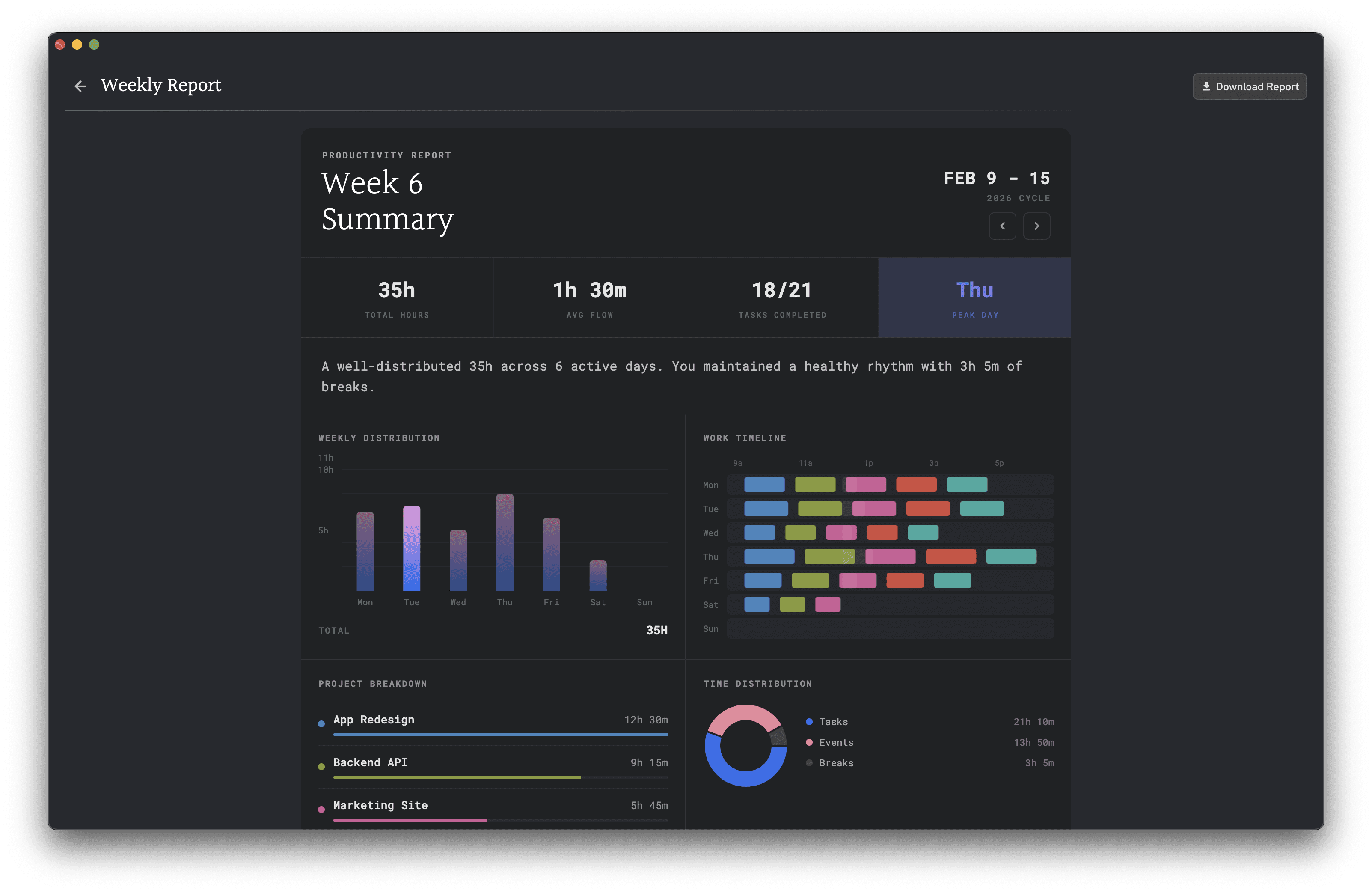
How To Start Tomorrow
For the next two weeks, end every work day with one deliberate action: write down one thing you completed or moved forward today, however small. Do this before closing your laptop. At the end of two weeks, compare how those days feel in memory against days you ended abruptly without this ritual. The peak-end rule predicts a clear difference in retrospective evaluation even when the days themselves were similar in quality.
Related Principles
Shutdown Ritual — the shutdown ritual is the practical implementation of peak-end design at the day level
Weekly Reviews — the weekly review gives the week a designed ending that the peak-end rule predicts will shape how the week is remembered
Progress Principle — small completions at the end of a day or week serve both the progress principle and the peak-end rule simultaneously
Self-Monitoring — tracking completions makes peak moments visible and ensures they are available to memory when evaluating the period
Related Reading
Best Weekly Review Apps — Weekly review apps that frame the week's ending well — the peak-end rule applied to reflection.
Best Productivity Systems for High Performers — Systems that design for how the week feels, not just how much it produces.
Best AI Time Audit Tools — Tools that surface the high points of your week, not just where time went.
Frequently Asked Questions
What is the peak-end rule?
The peak-end rule is Kahneman's finding that people evaluate past experiences primarily by two moments: the most intense point (the peak) and the final moment (the end). The total duration of the experience and its average quality have surprisingly little influence on retrospective evaluation. A longer experience with a mild ending is remembered as better than a shorter experience that ended at its worst point, even if the longer one contained more total discomfort.
What does the peak-end rule mean for how you end your workday?
It means the last few minutes of your day have disproportionate influence on how the entire day is remembered and evaluated. A day that ends with a frustrating task unfinished, an abrupt stop, or a difficult interaction will be remembered more negatively than its actual quality warrants. A day that ends with a small completion, a clear shutdown, and a forward-facing note will be remembered more positively — regardless of how much of the middle was difficult.
How does the peak-end rule apply to weekly reviews?
The weekly review gives the week a designed ending. When the review surfaces completions, names what was accomplished, and sets clear priorities for next week, it creates a positive end experience that the peak-end rule predicts will shape how the entire week is remembered. A week that simply stops on Friday afternoon without closure is evaluated by whatever happened to be the final moment — usually something reactive — rather than by a designed reflection.
Does duration neglect mean you should always make experiences shorter?
Not necessarily — duration neglect is a descriptive finding about how memory works, not a prescription. It means that adding more time to an experience does not proportionally improve how it is remembered if the peak and end are unchanged. For designing work sessions and reviews, it suggests focusing on the quality of endings rather than simply extending duration. A 30-minute session with a strong end may be remembered better than a 90-minute session that trails off.
Further Reading
Kahneman, D., et al. (1993). When more pain is preferred to less: Adding a better end. Psychological Science, 4(6), 401-405. DOI: 10.1111/j.1467-9280.1993.tb00589.x
Redelmeier, D. A., & Kahneman, D. (1996). Patients' memories of painful medical treatments. Pain, 66(1), 3-8. DOI: 10.1016/0304-3959(96)02994-6