The Principle
You spend fifteen minutes in the morning deciding what to work on first. Then you get interrupted and spend ten minutes deciding whether to respond now or later. Then a meeting request arrives and you spend five minutes deliberating. By mid-morning you have made dozens of small decisions and haven't done the work those decisions were supposed to precede. Each individual decision seemed trivial. Their cumulative cost was not.
Decision batching is the practice of grouping decisions into a single dedicated session rather than making them one at a time as they arise. The principle draws on decision fatigue research — the finding that decision-making quality degrades as the number of decisions made increases throughout the day — and applies it practically: if you must make many decisions, making them together at a chosen time costs less total cognitive capacity than making them individually as they surface. Weekly planning is the most common form; it consolidates a week's worth of task prioritisation, scheduling, and commitment decisions into one session rather than distributing them across hundreds of in-the-moment choices.

Definition
Decision batching is the deliberate practice of consolidating multiple decisions into a single scheduled session rather than making them individually as they arise throughout the day or week. It reduces the cumulative cognitive cost of decision-making by concentrating the load into a bounded period, preserving mental capacity for execution.
What The Research Shows
Danziger, Levav & Avnaim-Pesso (2011) analysed 1,112 parole board rulings and found that favourable decisions dropped from ~65% to nearly 0% as the session progressed, rebounding after breaks — a direct demonstration of decision fatigue accumulating and resetting. Baumeister et al. (1998) established the ego depletion framework showing that self-regulatory resources are consumed by decisions and choices. While the ego depletion model has faced replication challenges (Hagger et al., 2016), the practical effect of decision accumulation on choice quality has been replicated in applied settings. Decision batching as a specific intervention is less experimentally tested than the fatigue it addresses. Limitations: the ego depletion model is contested; the parole study has methodological critics; individual differences in decision capacity are substantial.

What This Means
Making decisions about your work throughout the day costs cognitive resources that could go to the work itself. Consolidating those decisions — what to work on, when to do it, which requests to accept — into a single weekly or daily planning session means the rest of your day can be spent executing rather than deliberating. The planning session absorbs the decision cost so that execution hours are as clear as possible.
What Most People Get Wrong
Most people make planning decisions reactively, as tasks and requests arrive.
Each email that arrives prompts a decision about whether and when to respond. Each task that surfaces prompts a decision about priority. Each meeting request triggers a deliberation about whether to accept. These decisions are individually small but collectively substantial — and they are made at the cost of the cognitive capacity needed for deeper work. Batching them into a planning session does not eliminate the decisions, but it changes when and how they are made: in a fresh state, with full context, before the day's other demands have eroded decision quality.
When it Fails…
Genuinely urgent decisions cannot wait. Decision batching works for decisions that can be deferred to a planning window — most scheduling, prioritisation, and commitment decisions. Decisions that are genuinely time-sensitive cannot be batched without cost.
Rigid batching can create its own anxiety. For people with high uncertainty tolerance needs, knowing that decisions are deferred to a specific window requires trust in the system. Some find the backlog of unprocessed decisions more stressful than the decisions themselves.
Highly autonomous roles may have fewer batchable decisions. People whose work is largely predetermined by external factors have less to batch, reducing the benefit.
What This Means For You…
If you find yourself making decisions about your work throughout the day — what to do next, whether to accept a request, how to prioritise competing demands — you are spending execution time on planning decisions. Consolidate them. Do one planning session at the start of each day that answers: what am I working on today, in what order, and what am I not doing? Do one weekly session that answers those questions at the week level. Batch your email responses into two windows rather than deciding continuously. Each of these is decision batching in practice — not a productivity hack, but a direct application of what the fatigue research predicts about how decision quality changes through the day.
How Aftertone Implements It.
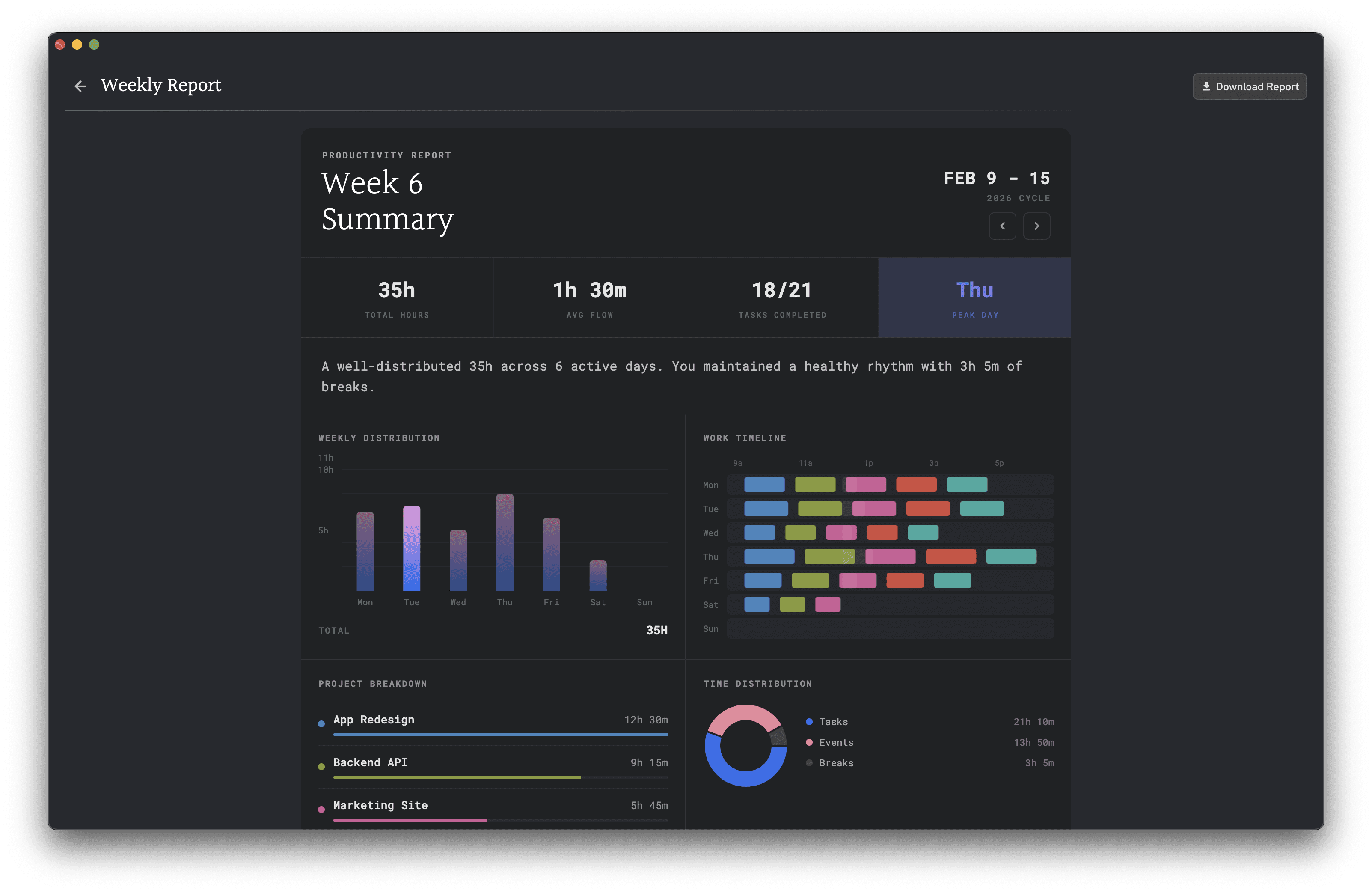
The weekly planning session in Aftertone is the primary decision-batching mechanism in the system. Processing your inbox with Shift+P — assigning dates to every task, setting your top priorities, blocking time — consolidates a week's worth of scheduling and prioritisation decisions into a single bounded session. The daily focus screen then presents the output of those decisions without requiring further deliberation: the work for the day is already decided, and execution can begin immediately without a fresh round of prioritisation choices.
How To Start Tomorrow
Try a simple experiment tomorrow: before you start work, spend ten minutes writing down exactly what you will work on and in what order. Make every scheduling and priority decision you can for the day in that window. Then close the list and execute. Track how much time you spend on in-the-moment decision-making on days you do this versus days you don't. The difference is decision batching at its simplest.
Related Principles
Decision Fatigue — decision batching is the primary practical intervention for managing decision fatigue
Weekly Reviews — the weekly review is the highest-leverage decision-batching session available
Cognitive Load Theory — batching reduces the extraneous cognitive load of distributed decision-making
Related Reading
Best Time Blocking Apps — Weekly planning is decision batching applied to your calendar — these tools make it efficient.
Best AI Daily Planning Tools — AI planners that handle the daily scheduling decision in one session, not throughout the day.
Best Productivity Apps for Founders — Founders face high decision volume daily — these apps help contain it to defined windows.
Frequently Asked Questions
What is decision batching?
Decision batching is the deliberate practice of consolidating multiple decisions into a single scheduled session rather than making them individually throughout the day as they arise. The rationale is that decision-making quality degrades with cumulative load — making many decisions sequentially consumes cognitive resources that could go to the decisions themselves and to the work that follows them.
How does decision batching reduce fatigue?
By concentrating the decision load into one bounded session, decision batching ensures that the fresh cognitive resources available at the start of that session are available for all the decisions in the batch. Distributed decision-making means each decision competes for whatever capacity remains after prior decisions, which degrades progressively. A planning session at the start of the day resolves priorities, scheduling, and commitments once — leaving execution time free of repeated deliberation.
What types of decisions are best batched?
Scheduling decisions (what to work on and when), prioritisation decisions (what matters most this week), commitment decisions (what to accept or decline), and processing decisions (how to handle incoming tasks and messages) are all well-suited to batching. Genuinely urgent decisions that are time-sensitive cannot wait for a batch window. Creative and strategic decisions benefit from the fresh cognitive state that a dedicated session provides more than from being made reactively throughout the day.
Is a weekly planning session a form of decision batching?
Yes — the weekly review and planning session is the highest-leverage decision-batching practice most knowledge workers can adopt. It consolidates a week's worth of scheduling, prioritisation, and commitment decisions into one session at a chosen time, rather than distributing them across hundreds of reactive moments throughout the week. The daily planning ritual is a smaller-scale version of the same principle applied each morning.
Further Reading
Danziger, S., Levav, J., & Avnaim-Pesso, L. (2011). Extraneous factors in judicial decisions. Proceedings of the National Academy of Sciences, 108(17), 6889-6892. DOI: 10.1073/pnas.1018033108
Baumeister, R. F., et al. (1998). Ego depletion: Is the active self a limited resource? Journal of Personality and Social Psychology, 74(5), 1252-1265. DOI: 10.1037/0022-3514.74.5.1252