The Principle
You built a productivity system. It has categories, tags, priority levels, a weekly review checklist, a daily shutdown ritual, and a capture inbox. You spent a weekend setting it up. By Wednesday you had abandoned it — not because you lacked discipline, but because operating the system consumed more cognitive resources than the work it was supposed to organise.
Cognitive load theory, developed by John Sweller in the 1980s, describes the limits of working memory and the cost of demanding too much from it at once. Working memory — the mental workspace where active thinking happens — holds roughly four chunks of information at a time. Every additional decision, every unfamiliar system interaction, every choice about how to categorise something draws from that limited pool. When the system itself generates cognitive load, it undermines the very capacity it was meant to protect.

Definition
Cognitive load is the total amount of mental effort your working memory is handling at any moment. Sweller identified three types: intrinsic (complexity of the task itself), extraneous (complexity created by how the task is presented or structured), and germane (effort spent building useful mental models). Productivity systems that are hard to use generate extraneous load — overhead that competes with the work they are meant to support.
What The Research Shows
Sweller (1988, 1994) developed cognitive load theory from educational psychology, demonstrating that working memory holds approximately 4 ± 1 chunks simultaneously and degrades significantly under high load. Cowan (2001) refined the estimate to approximately four meaningful chunks. Applied to knowledge work: Mark et al. (2014) found that email interruptions and task-switching each generate measurable spikes in stress (measured by heart rate variability), directly consistent with extraneous load predictions. Limitations: most foundational CLT research is in educational settings; direct application to productivity systems is inferred rather than experimentally tested.

What This Means
If your planning system requires you to make decisions about the system while you are trying to use it, it is consuming cognitive resources that should be going to your actual work. A simple system you use every day beats a comprehensive system you avoid because operating it is itself effortful.
What Most People Get Wrong
The assumption is that more powerful systems produce better results.
In practice, system complexity has a direct cognitive cost. Every additional category you have to choose between, every tag you have to decide to apply, every nested hierarchy you have to navigate is extraneous load — not load from the work, but load from the tool. The people who get the most from productivity systems are often those who have the simplest ones: a short list, a few time blocks, a weekly check-in. Simplicity is not laziness. It is cognitive load management.
When it Fails…
Highly routine work reduces the problem. If someone does the same type of tasks every day, the system becomes automatic and its load drops significantly. The overhead matters most for knowledge workers with highly variable work.
Power users can absorb complexity. People who have internalised a system so thoroughly that its operations are automatic do not pay the same cognitive cost. The problem is in the early and mid stages of adoption.
What This Means For You…
Every decision your planning system forces you to make is a withdrawal from the same mental budget you need for your actual work. The question to ask of any productivity tool or system is not "does it have all the features I might need?" but "how much does it cost me to operate?" A tool that requires fifteen seconds and zero decisions to capture a task is worth more than one that takes two minutes and three choices — even if the second has better features. The goal is not to have the most sophisticated system. It is to have the least burdensome one that still works.
How Aftertone Implements It.
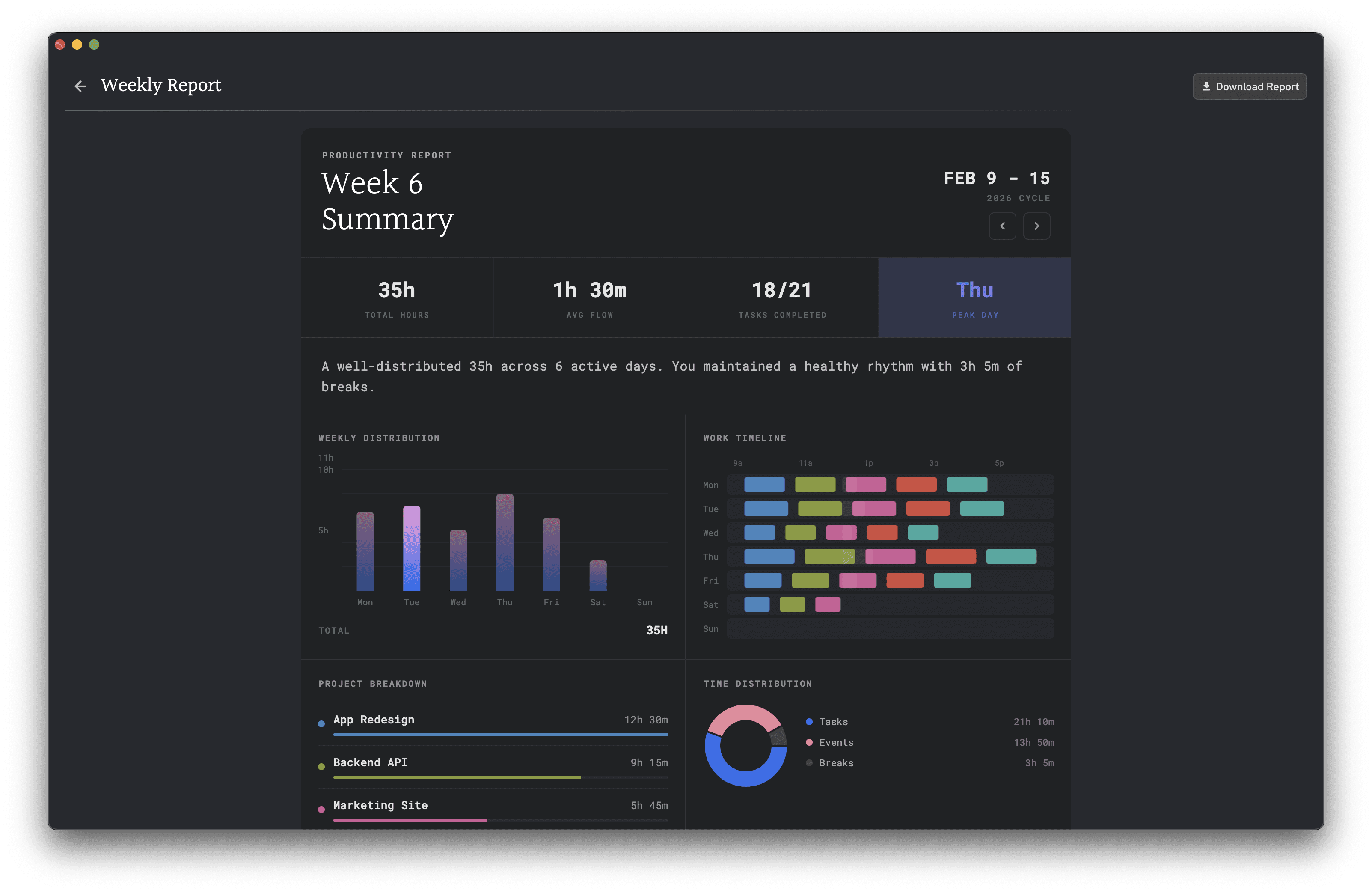
Aftertone is deliberately minimal in its interaction design. Quick Capture (Option+Space) requires zero categorisation decisions — the task goes to inbox, full stop. Time blocking is drag-and-drop. The daily focus screen eliminates the decision of what to work on. Each of these choices reduces extraneous cognitive load during the moments when you need your full mental capacity for the work itself, not the system managing it.
How To Start Tomorrow
Look at your current planning system and count the decisions it asks you to make per task: priority level, category, tag, project, due date, context. Each one is cognitive overhead. Try eliminating all but two: what is it, and when will you do it. Run that for one week and notice whether you actually use the system more consistently.
Related Principles
Decision Fatigue — each system decision contributes to cumulative decision fatigue throughout the day
Attention Residue — high-load system interactions generate their own residue
Overplanning — elaborate planning systems are a primary source of extraneous cognitive load
Related Reading
Best AI Task Managers for Mac — Task managers that reduce cognitive load by handling capture, sorting, and surfacing for you.
Best AI Daily Planning Tools — AI planners that make decisions before the day starts — reducing in-day cognitive overhead.
Best Deep Work Apps — Focus apps that remove decisions and options from your screen, protecting working memory for the work.
Frequently Asked Questions
What is cognitive load theory?
Cognitive load theory, developed by John Sweller, describes the limits of working memory and the consequences of exceeding them. Working memory — the mental workspace where active thinking happens — holds roughly four chunks of information at a time. When the demands on working memory exceed this capacity, performance degrades. Sweller distinguished intrinsic load (from task complexity), extraneous load (from how the task is presented), and germane load (from useful schema building).
How does cognitive load affect productivity systems?
A productivity system that is complicated to use generates extraneous cognitive load — overhead from the tool itself that competes with the cognitive resources needed for actual work. Every decision the system requires (which category, which priority level, which tag) is a small withdrawal from the same mental budget. Simple systems used consistently outperform sophisticated systems that are partially avoided because operating them is effortful.
What is the practical working memory capacity?
Cowan's influential 2001 review revised Miller's famous 'magical number seven' downward, concluding that working memory holds approximately four meaningful chunks simultaneously. This figure applies to novel, complex information — familiar patterns and automated skills place lower demand on working memory because they are processed as single chunks rather than multiple independent elements. Expertise effectively increases functional capacity by chunking.
How do you design a productivity system that minimises cognitive load?
The principle is to eliminate decisions at the point of use. Capture should require zero categorisation — tasks go into a single inbox without choices. Daily focus should present the work without requiring the person to decide what to work on. Defaults should be set thoughtfully at setup rather than requiring repeated decisions in use. Each decision eliminated at the moment of doing is a small cognitive resource preserved for the work itself.
Further Reading
Sweller, J. (1988). Cognitive load during problem solving: Effects on learning. Cognitive Science, 12(2), 257-285. DOI: 10.1207/s15516709cog1202_4
Cowan, N. (2001). The magical number 4 in short-term memory. Behavioral and Brain Sciences, 24(1), 87-114. DOI: 10.1017/S0140525X01003922