The Principle
You are not actually short of time. But you feel like you are, constantly — like there is never enough of it, like the day ends before the work does, like relaxing is something you will do later when you've earned it. That feeling is not an accurate read on your calendar. It is a psychological state, and it has consequences independent of how many hours you actually have.
Ashley Whillans and colleagues at Harvard have documented what they call "time affluence" — the felt sense of having enough time — as a predictor of wellbeing, prosocial behaviour, and decision quality. Time poverty, its opposite, predicts worse health, lower happiness, and reduced capacity for the kind of deliberate, high-quality thinking that knowledge work demands. Critically, the research shows that the subjective experience of time scarcity is damaging even when objective time is available. The feeling itself is the problem.

Definition
Time affluence is the subjective sense of having sufficient time for what matters. It is distinct from having actual free time — people can be objectively time-rich and feel time-poor, or vice versa. The research shows that felt time scarcity impairs decision quality, reduces prosocial behaviour, and independently predicts lower life satisfaction, separate from income or actual busyness.
What The Research Shows
Whillans et al. (2016) surveyed over 2.5 million Americans and found that 80% reported feeling they never had enough time, and this subjective time poverty independently predicted lower wellbeing controlling for income, employment, and objective hours. Whillans, Dunn et al. (2017) found that spending money to buy back time increased happiness, but only when it reduced felt time pressure — not simply when it created objective free time. Mogilner & Aaker (2009) showed that priming people to think about time (vs money) increased happiness and prosocial behaviour. Limitations: largely correlational; direction of causality between time poverty and wellbeing is not always clear.

What This Means
How busy your calendar looks matters less than how rushed you feel. A packed schedule that you feel in control of produces less damage than a moderate schedule that feels overwhelming. The target is not fewer commitments — it is a felt sense of sufficiency and control over your time.
What Most People Get Wrong
The assumption is that feeling rushed is a signal to do more, faster.
The research suggests the opposite: felt time scarcity produces cognitive tunnel vision that narrows attention, reduces decision quality, and impairs the kind of reflective thinking that might actually solve the underlying problem. Trying to fix time poverty by working harder through it is like trying to fix dehydration by running faster. The state itself needs to be addressed, not outrun. Small deliberate interventions — protecting unscheduled time, finishing earlier, refusing low-priority commitments — reduce felt scarcity disproportionately relative to their actual time savings.
When it Fails…
Chronic overcommitment is structural, not perceptual. When someone is genuinely working 70-hour weeks with no discretion over their schedule, interventions targeting perceived scarcity alone are insufficient — the objective conditions need to change too.
High achievers sometimes wear busyness as identity. For people whose sense of worth is tied to being busy, reducing felt time pressure requires addressing the underlying identity as well as the schedule.
What This Means For You…
Protecting slack time in your calendar is not laziness — it is a direct intervention on a measurable psychological state that affects your decision quality, wellbeing, and the kind of thinking your work actually requires. The goal is not to have more hours. It is to feel like the hours you have are sufficient. This is partly about what you commit to, but it is equally about how you plan: a calendar that has buffer, that ends at a reasonable time, that is not perpetually over-full, produces a different felt experience than an identical number of hours crammed without margin. Plan for sufficiency, not efficiency.
How Aftertone Implements It.
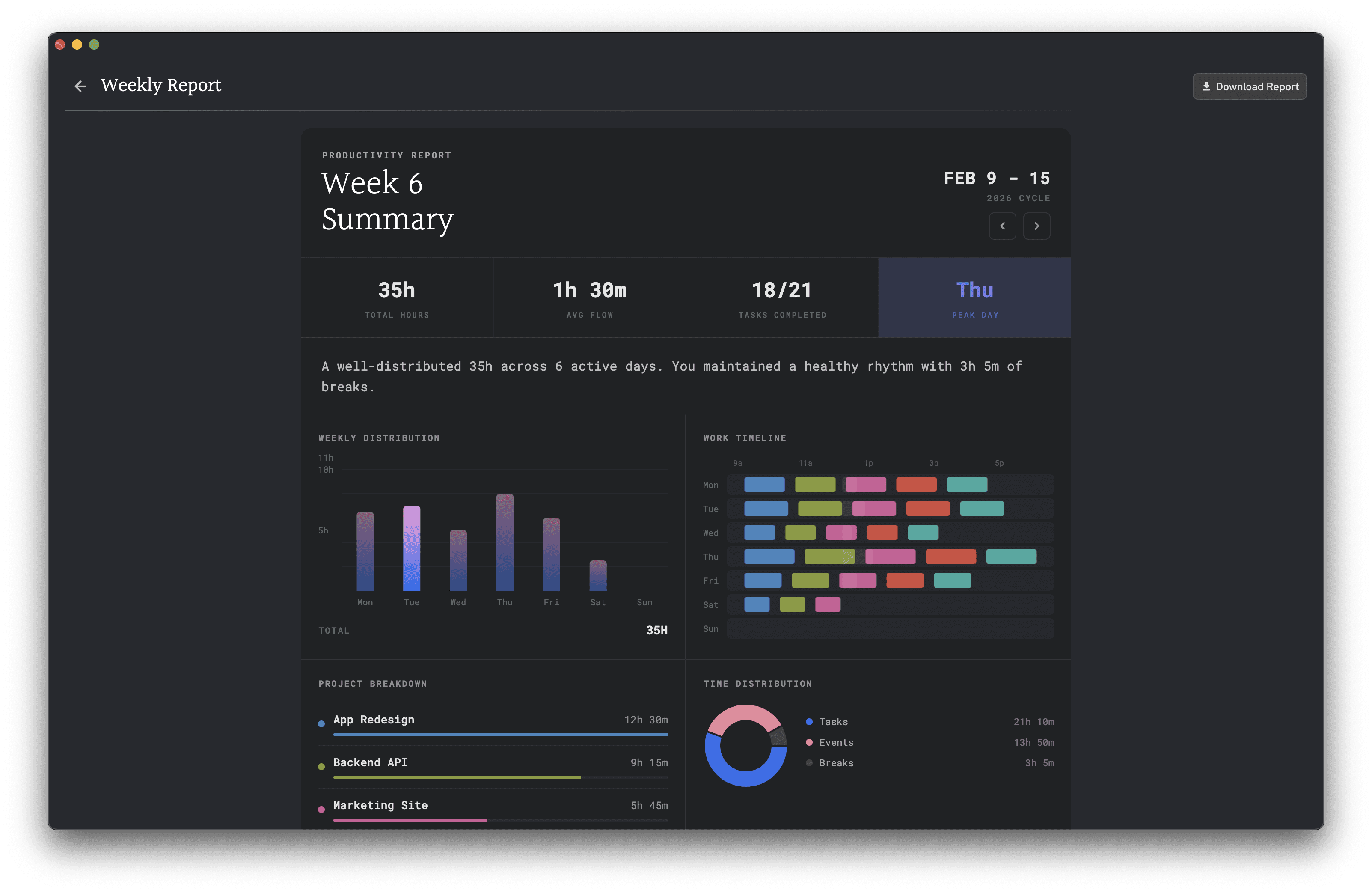
Aftertone's weekly pattern analysis shows you whether your scheduled time matches your available capacity — making over-commitment visible before it becomes a felt experience. The AI report surfaces patterns like consistently scheduling more than you complete, or blocking evenings that should be recovery time. The goal is not to fill your calendar but to build a schedule that feels like it has room — because that feeling is itself a performance input.
How To Start Tomorrow
Look at tomorrow's calendar. Does it have any unscheduled time — not "free time" to fill, but deliberate white space? If not, remove one commitment or shrink one block. Notice whether the feeling of your day changes, even if the actual time available barely does. That change in felt scarcity is the variable the research says matters.
Related Principles
Recovery and Detachment — time affluence requires actual psychological detachment, not just empty calendar slots
Buffer Time — buffer creates the felt margin that reduces time poverty
Overplanning — overplanned calendars are a direct source of felt time scarcity
Related Reading
Best AI Time Audit Tools — Time audit tools that show where the time actually went — often more than expected.
Best Productivity Apps for Solopreneurs — Solopreneurs feel time pressure acutely — these apps help manage the perception alongside the reality.
Best Productivity Systems for High Performers — Systems that build in slack deliberately, because the research shows it pays back.
Frequently Asked Questions
What is time affluence?
Time affluence is the subjective sense of having sufficient time — feeling that you have enough time for what matters, even if your calendar is reasonably full. It is distinct from having objectively free time. Research by Ashley Whillans at Harvard found that time affluence is a stronger predictor of life satisfaction and wellbeing than income above a basic threshold, and that 80% of Americans report feeling time-poor regardless of their actual available hours.
Can you feel time-poor even when you have enough time?
Yes — and this is the central finding. Felt time scarcity is partially independent of actual time available. People with identical schedules can feel drastically different levels of time pressure based on how they perceive, value, and relate to their time. The research shows that the subjective experience of time scarcity carries its own costs — impaired decision quality, reduced prosocial behaviour, and lower wellbeing — even when objective time is sufficient.
What makes people feel time-poor?
Several factors independently contribute: overcommitment relative to capacity, lack of control over how time is spent, absence of unscheduled white space, and the cultural association of busyness with status. The last factor is particularly insidious — in professional cultures where being busy signals importance, people may unconsciously perpetuate or even perform time poverty as a form of social signalling even when their actual schedule could accommodate more slack.
How do you increase felt time affluence without working less?
Research suggests several interventions: spending money to outsource disliked tasks (which reduces felt time pressure more than it increases actual free time), giving time to others through volunteering (which paradoxically increases felt time abundance), protecting small amounts of unscheduled white space in the calendar, and reframing time choices as active decisions rather than imposed obligations. The felt sense of control over time is itself a component of time affluence, separate from the actual quantity of free hours.
Further Reading
Whillans, A. V., Weidman, A. C., & Dunn, E. W. (2016). Valuing time over money is associated with greater happiness. Social Psychological and Personality Science, 7(3), 213-222. DOI: 10.1177/1948550615623842
Whillans, A. V., Dunn, E. W., et al. (2017). Buying time promotes happiness. Proceedings of the National Academy of Sciences, 114(32), 8523-8527. DOI: 10.1073/pnas.1706541114
