Aftertone vs Reclaim AI (2026): Behavioral AI vs Calendar Automation
Written By The Aftertone Team
Aftertone vs Reclaim AI (2026)
TL;DR
Aftertone: $30/month. macOS productivity system — tasks, time blocking, Focus Screen, behavioural AI, weekly reports.
Reclaim.ai: Free (Lite), $8/mo (Starter), $12/mo (Business), $18/mo (Enterprise). AI scheduling layer on top of Google Calendar and Outlook. Auto-schedules tasks, habits, and focus blocks. No native mobile app. Acquired by Dropbox, August 2024.
Key difference: Reclaim defends time on your calendar. Aftertone is the app you actually work inside.
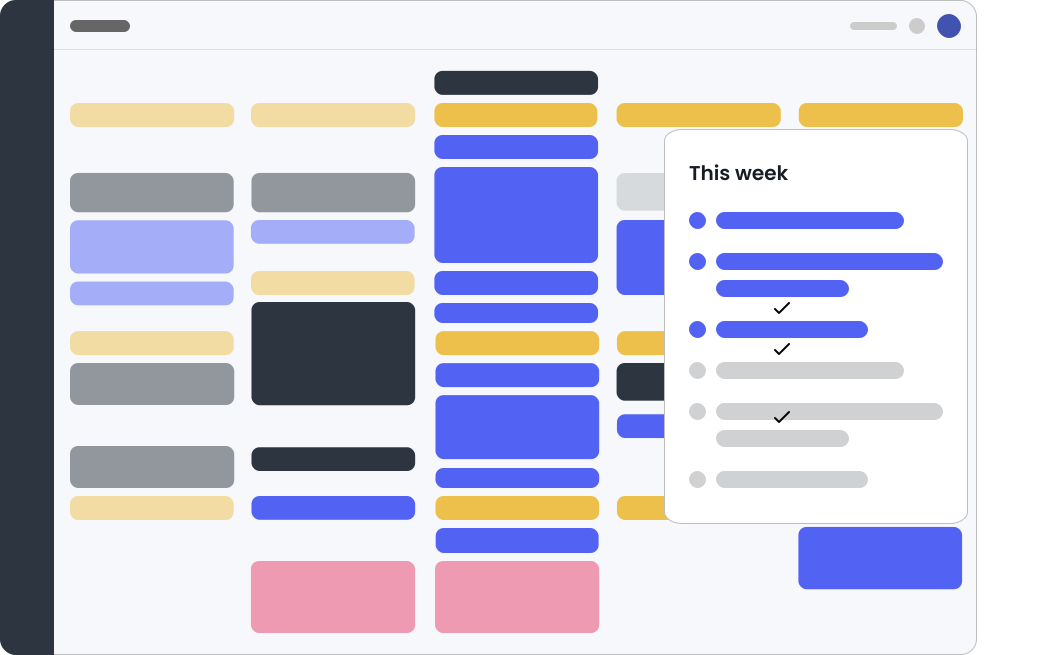
Reclaim.ai is a scheduling layer that sits on top of Google Calendar. It auto-blocks focus time, schedules habits, and finds meeting slots. It's a clever idea — though you're adding a layer on top of your calendar rather than working inside a purpose-built system.
But you still use Google Calendar as your main interface. Reclaim's task management is minimal — most users run Todoist or Asana alongside it. Its analytics are surface-level. And since Dropbox acquired it in August 2024, there are open questions about where the product goes next.
Aftertone is a standalone macOS app. Tasks, time blocks, Focus Screen, AI behavioral insights, weekly reports — all in one place. No dependency on Google Calendar's interface. No need for a second task manager. One payment. Yours forever.
Side-by-Side
Feature | Aftertone | Reclaim.ai |
|---|---|---|
Pricing | $30/month | Free tier, Starter $8/mo, Business $12/mo, Enterprise $18/mo |
Free trial | 7 days, no card required | 14-day free trial + free Lite plan forever |
What it is | Standalone macOS productivity app | Scheduling layer on top of Google/Outlook Calendar |
Task management | Native — keyboard capture, project tags, filtering | Barebones — most users pair with Todoist or Asana |
AI approach | Behavioral — tracks patterns, stalled tasks, time drift, energy. Weekly insight reports. | Scheduling — auto-places meetings, defends focus time, habit slots |
Focus Screen | Context-aware — current task, overdue flags, 1-2-3 shortcuts, auto calendar updates | Auto-blocks focus time on your Google Calendar |
Weekly reports | Automated, AI-generated, personalised | Surface-level time analytics |
Calendar sync | Google Calendar, two-way | Google Calendar + Outlook (Outlook launched August 2025; some limitations vs Google depth) |
Habit scheduling | Built into Plan → Execute → Evaluate → Optimize cycle | Dedicated feature — auto-protects recurring habits |
Team features | Individual productivity | Team analytics, capacity planning, Smart Meetings |
Mobile | iOS/Android coming | No dedicated app |
Mobile app | iOS + Android in development | No native app — web-only (PWA workaround on mobile) |
Independently owned | Yes | No — acquired by Dropbox, August 2024 |
Where Aftertone pulls ahead
It's the whole app, not a plugin
Reclaim makes Google Calendar smarter. Aftertone replaces the need to live in Google Calendar. You get a purpose-built interface with time blocks, tasks, focus mode, and AI — without switching between Reclaim's settings, Google Calendar's UI, and whatever task manager you've bolted on.
Task management without duct tape
Reclaim's task management is consistently called "barebones" in reviews. No project organisation, no quick capture, no filtering. Most users bolt on Todoist or Asana, which means managing three tools instead of one. Aftertone has native task capture — keyboard shortcut from anywhere on your Mac, tag it, move on.
Different kind of AI
Reclaim's AI is about time placement — it moves meetings, defends focus blocks, auto-schedules habits. Useful, but it doesn't help you understand your own patterns. Aftertone's AI watches how you actually work across your week and produces a report: which tasks keep stalling, where planned time drifts from actual time, when your energy peaks and dips. Reclaim organises your calendar. Aftertone helps you understand yourself.
The Focus Screen is for working, not blocking
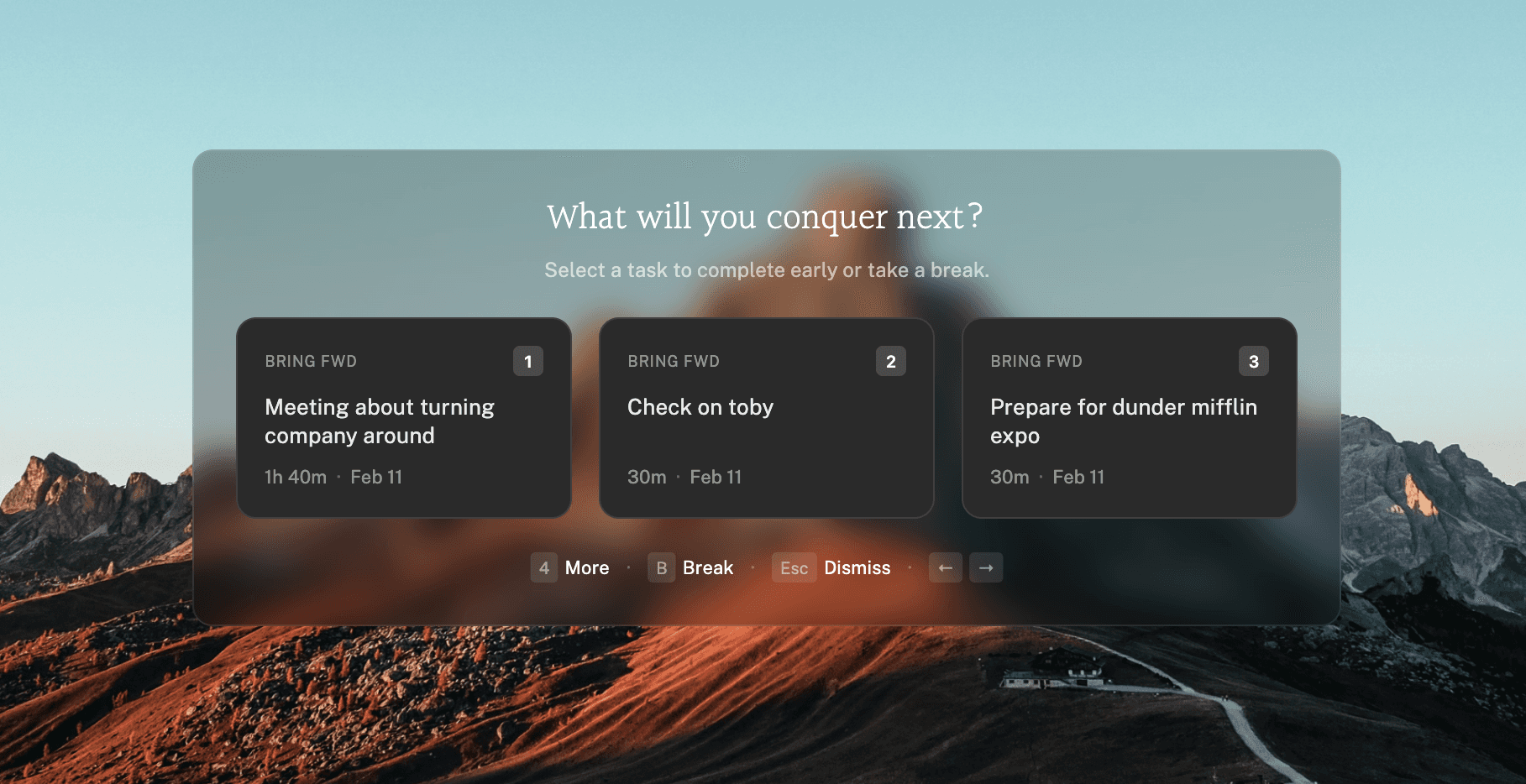
Reclaim "defends" focus time by putting coloured blocks on your Google Calendar. When you're in that block, you're still staring at Google Calendar. Aftertone's Focus Screen strips everything away and shows your current task. If something's overdue, it flags it. Finish early? Pick from your next tasks with a simple 1-2-3 selection and your calendar updates in the background. One protects time on a calendar. The other protects your attention while you work.
No corporate parent
Reclaim is now owned by Dropbox. That might mean more resources. It might also mean pricing changes, feature reprioritisation, or integration into Dropbox's broader product suite. Aftertone is independently owned. The roadmap is driven by the people who use it.
Where Reclaim is the better fit
Reclaim has a free tier. Aftertone has a free trial but no permanent free plan.
Smart Meetings is genuinely valuable — it finds optimal meeting times across team calendars automatically. Aftertone doesn't do meeting scheduling.
Reclaim works with both Google Calendar and Outlook. Aftertone syncs with Google Calendar only.
Reclaim's integration ecosystem is large: Slack, Asana, ClickUp, Jira, Todoist, Linear, Zoom.
Habit scheduling — automatically protecting time for lunch, exercise, breaks — is a well-loved feature that Reclaim does natively.
Honest limitation to know: Reclaim has no native iOS or Android app. It works as a PWA in mobile browsers, and events it creates appear in your regular calendar app. But there are no push notifications and no dedicated mobile experience. If you manage your day primarily from your phone, this is a real gap that Reclaim itself acknowledges is its most-requested missing feature.
Who should choose Reclaim.ai
If you need cross-platform support beyond macOS, Reclaim.ai may be the better fit today. If you rely heavily on integrations with other tools in your stack, check whether Reclaim.ai connects to what you use daily. And if Reclaim.ai's specific approach — its unique features and design philosophy — matches how you prefer to work, it's worth trying.
But if you want a productivity system that goes beyond planning into execution, evaluation, and optimisation — with behavioral AI that learns your patterns and a Focus Screen that protects your attention — Aftertone goes deeper.
Frequently asked questions
Is Reclaim.ai better than Aftertone?
It depends on what you need. Reclaim.ai has its own strengths — particularly if you need broader platform support or specific integrations. Aftertone is stronger on execution: its Focus Screen, behavioral AI, and weekly reports create a four-phase productivity system (plan, execute, evaluate, optimise) that most competitors don't attempt.
Does Aftertone work on Windows or Linux?
Not yet. Aftertone is currently macOS-only, built as a native Mac app for performance and deep OS integration. iOS and Android apps are in development. If you need Windows or Linux support today, Reclaim.ai may be a better short-term choice.
Can I use Aftertone with Google Calendar?
Yes. Aftertone syncs with Google Calendar via two-way sync. Your time blocks, events, and schedule changes appear in both apps. Aftertone adds the productivity layer — tasks, Focus Screen, AI insights — on top of your existing calendar.
How much does Aftertone cost?
Aftertone is $30/month with a 7-day free trial — no card required to start. Every feature is included: Focus Screen, Smart Capture, Smart Zoning, behavioural AI, weekly and daily reports, and unlimited projects.
What if I'm switching from Reclaim.ai to Aftertone?
Aftertone syncs with Google Calendar, so any events you have there will appear automatically. For tasks, you'll need to recreate them in Aftertone — but the keyboard shortcut capture makes this fast. Most users are fully set up within a day.
What are Reclaim AI’s pricing tiers?
Reclaim has four tiers: Lite (free forever, limited to 1 habit, 1 scheduling link, 1-week scheduling range), Starter ($8/month), Business ($12/month), and Enterprise ($18/month). The free Lite plan is genuinely functional for basic focus time protection — not just a trial. Starter adds longer scheduling range and more task integrations. Business adds team analytics. Aftertone is $30/month all-in, 7-day free trial, no feature gating.
Related reading
For more context on how Aftertone compares in the broader productivity landscape, see Best Reclaim AI Alternatives (2026), Best Mac Calendar Apps for Time Blocking (2026) and Productivity Methods Compared.
Bottom line
Reclaim is a smart upgrade to your Google Calendar. Aftertone is a standalone system for people who want more than a smarter calendar. If you want native task management, a Focus Screen that adapts while you work, AI that helps you understand your own patterns, weekly reports that compound your improvement, and the simplicity of owning one app outright — Aftertone is built for that. Try Aftertone free at aftertone.io.