The Principle
Two people have the same job title, the same manager, and roughly the same task list. One finds the work engaging, meaningful, and energising. The other finds it draining, disconnected, and hard to motivate. The difference is not always in the job — sometimes it is in how each person has shaped it. One has, perhaps without realising it, gradually expanded the parts that play to their strengths, built relationships that make the work feel connected to something larger, and reframed tasks in terms of their purpose rather than their mechanics. The other has not.
Job crafting, introduced by Amy Wrzesniewski and Jane Dutton in 2001, describes the proactive, self-initiated changes people make to the task, relational, and cognitive boundaries of their work. Unlike top-down job design — where an organisation shapes roles — job crafting is what happens from the inside: the person adjusts what they do, who they interact with, and how they think about their work, within whatever formal constraints exist. Research consistently finds that job crafters show higher engagement, better performance, and greater wellbeing than those who receive their work passively.

Definition
Job crafting is the proactive, self-initiated process of changing the task, relational, or cognitive boundaries of one's own work role. Task crafting involves changing what you do and how much. Relational crafting involves changing who you interact with at work. Cognitive crafting involves changing how you think about your work — reframing its purpose or meaning. All three forms are associated with increased engagement and wellbeing independent of formal job changes.
What The Research Shows
Wrzesniewski & Dutton (2001) introduced job crafting through qualitative studies of hospital cleaners who expanded their role to include emotional support for patients — transforming the same formal job through relational and cognitive crafting. Tims, Bakker & Derks (2012) developed the Job Crafting Scale and found through longitudinal studies that job crafting predicted increases in work engagement over time. Rudolph et al. (2017) conducted a meta-analysis of 122 studies (N = 35,670) and found that job crafting significantly predicted task performance (r = 0.26), organisational citizenship behaviour (r = 0.30), and job satisfaction (r = 0.53). Limitations: most research is correlational and cross-sectional; causal direction is not always clear from the literature.

What This Means
Engagement and meaning at work are partly outcomes of what you do with the job you have — not only the job itself. Within almost any role, there are degrees of freedom in what you emphasise, which relationships you invest in, and how you frame the purpose of the work. Job crafting is the deliberate use of those degrees of freedom to move the work toward greater personal meaning, stronger energy, and better fit with your strengths.
What Most People Get Wrong
The most common mistake is treating engagement as something that happens to you — produced by the job or the organisation — rather than something partly constructed by how you engage with the work.
Waiting for the perfect role, the ideal manager, or the right assignment before investing in engagement is a passive strategy that consistently underperforms active crafting. Within the constraints of most roles, the scope for crafting is almost always non-zero, and the returns on using it are well-documented. The person who uses existing degrees of freedom tends to create more of them over time.
When it Fails…
Highly constrained roles leave little room for crafting. Assembly-line work, heavily scripted customer service, and roles with rigid compliance requirements offer fewer degrees of freedom. The effect size is smaller in these contexts, though research finds some benefits even there through cognitive crafting.
Crafting can conflict with role expectations. Expanding task boundaries beyond what a manager expects, or changing relational patterns in ways that affect team dynamics, can create friction. Crafting works best when aligned with organisational and team needs rather than purely individual preference.
Cognitive crafting alone is insufficient for genuinely poor role fit. Reframing the meaning of deeply misaligned work has limits. The research supports crafting as an enhancement to reasonable fit, not as a replacement for structural changes that severe misalignment requires.
What This Means For You…
Audit your current work with three questions: Which tasks play to your strengths and which drain you? Which relationships energise you and which deplete you? Which aspects of your work connect to a purpose that feels meaningful? This reveals the raw material for crafting. Then ask: what is one thing you could shift — more time on the energising tasks, less on the draining ones; more contact with the energising relationships; a reframe of the depleting tasks in terms of their downstream purpose? Job crafting is iterative and incremental. A single small shift in any of the three dimensions has measurable effects on engagement over time.
How Aftertone Implements It.
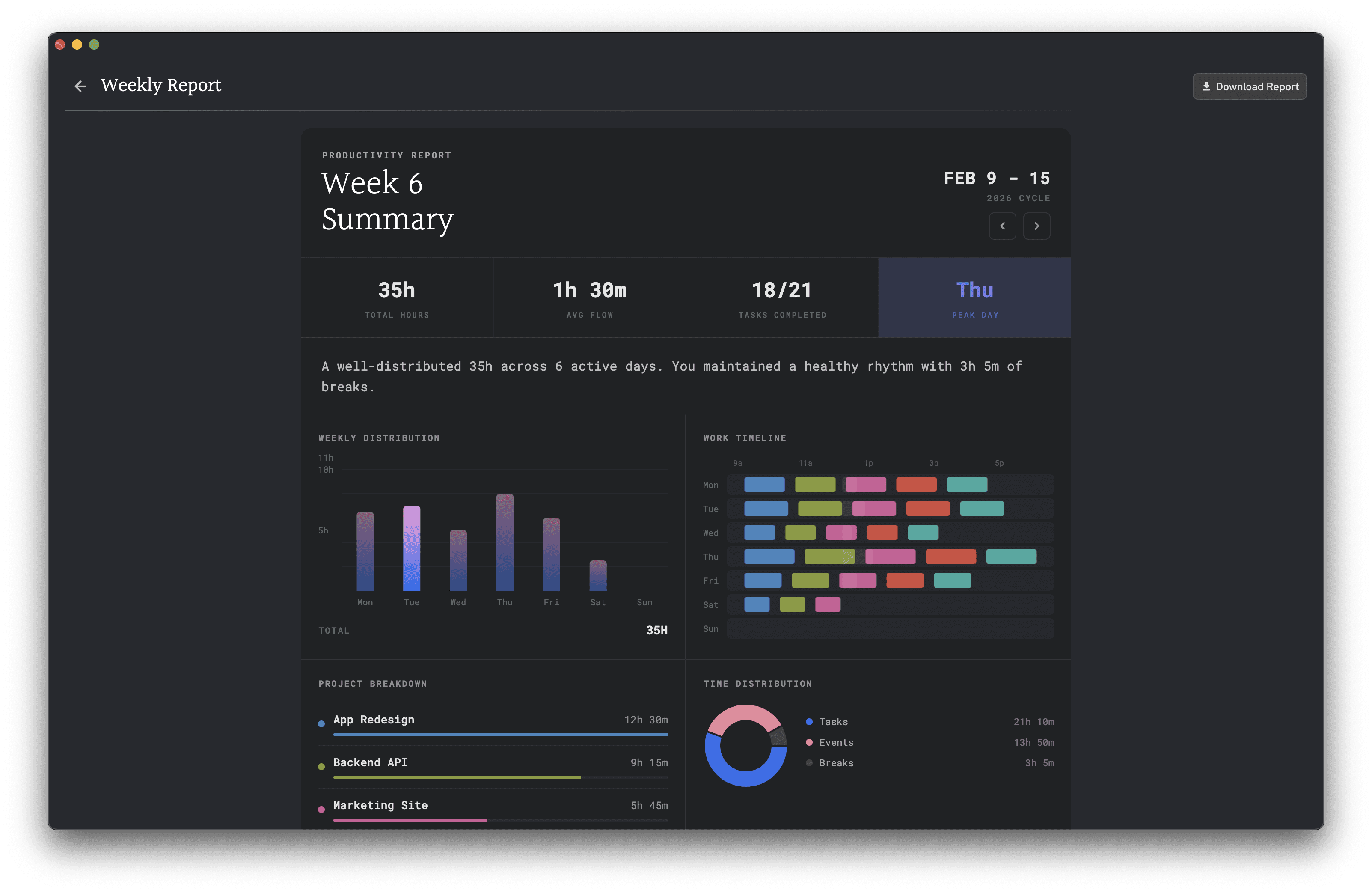
Aftertone's weekly pattern analysis provides the data that makes job crafting visible. When the AI report shows that certain task types consistently produce completed focus blocks and others consistently get deferred or shortened, that data is a map of your current task-fit landscape. Deliberately scheduling more time for high-completion-rate work and less for chronic deferral is the simplest form of task crafting available within a calendar tool — and it is made possible by seeing the pattern rather than guessing at it.
How To Start Tomorrow
At the end of this week, write down the three tasks that gave you the most energy and the three that cost you the most. Look at the ratio: how much of your scheduled time went to each category? Now identify one concrete change you could make next week — one way to shift the balance slightly toward the energising work, or one way to reframe a draining task in terms of why it serves something that matters to you. That is job crafting at its simplest. Do it weekly and it compounds.
Related Principles
Autonomy and Intrinsic Motivation — job crafting is the active exercise of autonomy; SDT explains why that autonomy is psychologically necessary
Energy Management — task crafting toward energising work is a direct application of energy management principles to role design
Progress Principle — crafting toward more meaningful work amplifies the motivational effect of progress, because progress in work that matters produces stronger positive affect
Planned vs Actual — tracking planned versus actual time by task type reveals the data needed to identify crafting opportunities
Related Reading
Best Productivity Apps for Founders — Founders have the most latitude to craft their role — these apps help make that deliberate.
Best Productivity Systems for High Performers — Systems that track what work energises versus drains, giving you the data to craft around.
Best AI Time Audit Tools — Time audit tools that surface which task types produce your best output — the raw material for crafting.
Frequently Asked Questions
What is job crafting?
Job crafting is the proactive, self-initiated process of changing your own work role — what you do, who you interact with, and how you think about your work — within whatever formal constraints exist. Introduced by Wrzesniewski and Dutton in 2001, research consistently finds that job crafting predicts higher engagement, performance, and wellbeing.
What are the three types of job crafting?
Task crafting involves changing what you do and how much — spending more time on energising work, less on draining work. Relational crafting involves changing who you interact with. Cognitive crafting involves changing how you think about your work — reframing its purpose. All three independently predict engagement.
Can you job craft in a highly constrained role?
Yes, though the scope is smaller. Research finds benefits even in heavily constrained roles, primarily through cognitive crafting — reframing the meaning of the work. The hospital cleaners in Wrzesniewski and Dutton's original study crafted a low-autonomy role into meaningful work through relational and cognitive crafting within their formal task boundaries.
Is job crafting the same as autonomy?
Related but distinct. Autonomy is the psychological need to feel genuine choice over your work. Job crafting is the active behaviour of exercising whatever choice is available. High autonomy makes crafting easier, but crafting can happen in lower-autonomy settings. Increasing autonomy is something the organisation does; job crafting is something the individual does with whatever autonomy they have.
Further Reading
Wrzesniewski, A., & Dutton, J. E. (2001). Crafting a job: Revisioning employees as active crafters of their work. Academy of Management Review, 26(2), 179-201. DOI: 10.2307/259118
Rudolph, C. W., et al. (2017). Job crafting: A meta-analysis of relationships with individual differences, job characteristics, and work outcomes. Journal of Vocational Behavior, 102, 112-138. DOI: 10.1016/j.jvb.2017.05.008