The Principle
The weekly check-in goes like this: everyone says what they completed, what they are working on, and what is next. Almost everyone reports roughly on track. The plans look clean. The system looks functional. And yet the project is late, deliverables keep slipping, and nobody seems to see it coming until it is very close. The system did not fail. The data did. And the data failed because people felt unsafe providing it honestly.
Amy Edmondson's concept of psychological safety — introduced in her 1999 Administrative Science Quarterly paper and one of the most cited constructs in organisational psychology — describes the shared belief that it is safe to take interpersonal risks: to speak up, ask for help, admit mistakes, and share concerns without fear of punishment, embarrassment, or rejection. The absence of psychological safety does not produce silence. It produces a particular kind of noise: confident-sounding reports that are systematically optimistic, plans that look complete but are quietly abandoned, and data that describes how things should be rather than how they are.

Definition
Psychological safety is a shared belief held by members of a group that the team is safe for interpersonal risk-taking — including admitting mistakes, reporting problems, asking for help, and sharing bad news. Edmondson distinguishes it from trust (which is interpersonal) and from confidence (which is individual): it is a property of the shared social environment that determines whether accurate information flows freely or gets filtered for self-protection.
What The Research Shows
Edmondson (1999) introduced psychological safety in a study of hospital nursing teams, finding that higher psychological safety predicted better learning behaviour and error reporting. Counterintuitively, teams with higher psychological safety reported more errors — not because they made more, but because they were willing to surface them. Google's Project Aristotle (2016), a two-year study of 180 teams, found psychological safety to be the most consistent differentiator of high-performing teams above skill mix, seniority, and co-location. Frazier et al. (2017) conducted a meta-analysis of 136 studies (N > 21,000) finding that psychological safety significantly predicted creativity, information sharing, learning behaviour, and performance. Limitations: most research is at team rather than individual level; creating psychological safety is an organisational and leadership challenge that individual techniques cannot fully address.

What This Means
A planning system is only as good as the accuracy of the information it contains. When people feel unsafe admitting they are behind, the system fills with inaccurate data: tasks marked complete that are not, estimates that remain optimistic despite evidence, problems that surface only when they become crises. The system continues to function but it is operating on false inputs. The output of a planning system fed false data is confident misdirection.
What Most People Get Wrong
The assumption is that planning system failures are caused by poor planning practices — the wrong framework, the wrong tool, the wrong cadence.
Psychological safety research suggests many planning failures are data failures. People know the plan is not going as described. They do not say so because saying so carries social risk. The fix, then, is not a better planning template — it is a social environment in which updating the plan with accurate information feels safer than maintaining a fiction of smooth progress. This insight applies individually too: honest self-review requires psychological conditions as much as structural ones.
When it Fails…
Psychological safety cannot be created by individuals alone in unsafe organisations. If the cultural or managerial environment punishes honest reporting of problems, individual willingness to be transparent will erode regardless of personal values or intentions.
Psychological safety does not eliminate the need for accountability. Edmondson explicitly distinguishes it from permissiveness: it is not an environment where anything goes, but one where honest information about problems can be shared without fear. High standards and psychological safety can and should coexist.
Solo workers face a distinct version of the problem. Individual psychological safety — the willingness to review one's own performance honestly without defensive distortion — is harder to measure but likely follows similar principles. Self-compassion research is the closest individual-level analogue.
What This Means For You…
If your planning system consistently shows plans being met when you have a sense that they are not, the problem is likely not the system — it is the data going into it. Ask whether the environment makes it safe to report problems early. Ask whether you, individually, feel able to update your own plans with honest information without the update feeling like an indictment. The most valuable thing a planning system can do is surface reality accurately. That requires psychological conditions as much as structural ones.
How Aftertone Implements It.
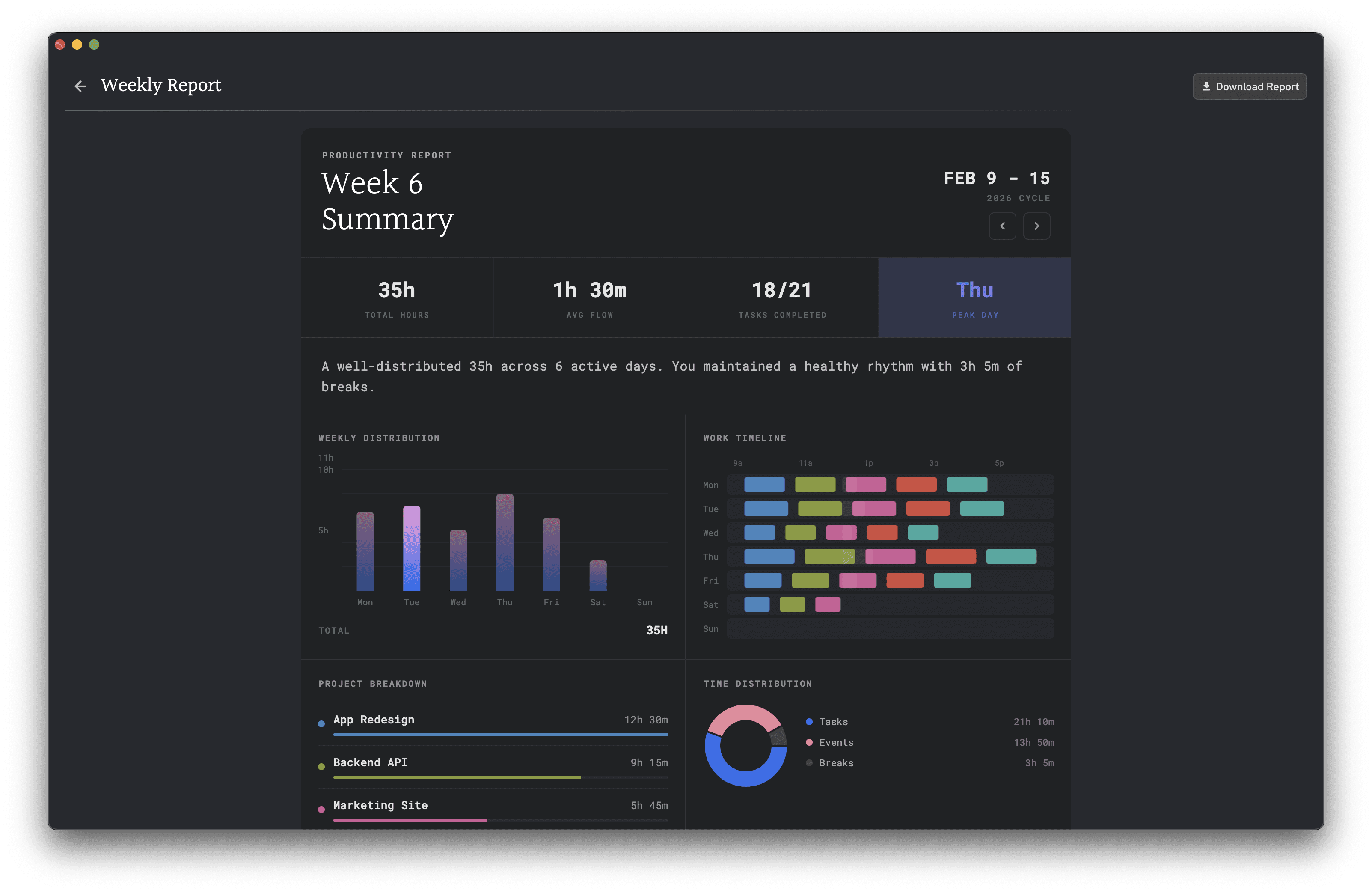
Aftertone's planned vs actual review is designed to make honest data visible as information rather than as failure. When the AI report shows that focus blocks were consistently scheduled but not completed, or that certain task types systematically slip, the frame is pattern analysis — not performance judgement. The goal is to create the individual-level equivalent of psychological safety: a review process where accurate information is more useful than a clean-looking plan, and where updating is easy rather than expensive to admit.
How To Start Tomorrow
At the end of this week, look at your original plan and write down — honestly, without softening — what was completed, what was partially done, and what did not happen at all. Do not reframe incomplete tasks as "in progress." Then ask: what would have needed to be true for me to update this plan earlier, when I first knew it was slipping? That question identifies the psychological safety gap — the point at which honesty about the plan became too costly. Closing that gap is more valuable than improving the plan itself.
Related Principles
Self-Compassion — self-compassion is the individual-level mechanism that enables honest self-review; psychological safety is the social-level equivalent
Planned vs Actual — the planned vs actual review only works when the data is honest; psychological safety determines whether it will be
After-Action Reviews — AARs require psychological safety to produce genuine learning rather than defensive rationalisation of outcomes
Social Loafing — the same group dynamics that produce social loafing also reduce psychological safety; both are structural features of collective settings
Related Reading
Best AI Weekly Planning Tools — Weekly planning tools that make honest forecasting easy rather than requiring bravado.
Best Productivity Systems for High Performers — Systems that treat missed plans as data rather than failure.
Best Apps to Reduce Meeting Overload — Fewer, better-structured meetings reduce the performance context that makes honest planning feel risky.
Frequently Asked Questions
What is psychological safety?
Psychological safety is Amy Edmondson's term for the shared belief that it is safe to take interpersonal risks in a group — including admitting mistakes, surfacing problems, asking for help, and sharing bad news. Google's Project Aristotle identified it as the strongest predictor of team performance across 180 teams studied over two years.
How does lack of psychological safety affect planning systems?
It fills them with inaccurate data. When people feel unsafe admitting they are behind, plans continue to look clean while reality diverges. Tasks get marked complete prematurely, problems surface only when they become crises, and estimates remain optimistic despite contrary evidence. A planning system fed inaccurate data produces confident misdirection.
Can psychological safety be created by one person in a team?
Partially. Edmondson's research identifies leadership behaviour as the primary driver — leaders who model openness and respond non-punitively to bad news create the conditions for safety. Individual team members can contribute by being transparent themselves, but they cannot fully override an environment that punishes honest reporting.
Is there an individual equivalent of psychological safety?
Yes — the willingness to review your own performance honestly without defensive distortion. Self-compassion research provides the closest individual-level analogue: people who treat themselves kindly after failure are more willing to look at accurate data about what happened, because the review does not feel threatening.
Further Reading
Edmondson, A. C. (1999). Psychological safety and learning behavior in work teams. Administrative Science Quarterly, 44(2), 350-383. DOI: 10.2307/2666999
Frazier, M. L., et al. (2017). Psychological safety: A meta-analytic review and extension. Personnel Psychology, 70(1), 113-165. DOI: 10.1111/peps.12183