The Principle
You were automatically enrolled in the pension plan. The settings on your phone came pre-configured. The calendar template someone shared with you became your permanent system. You didn't choose any of these things deliberately — they were the default, and you left them as they were. Most people do. This is not laziness or indifference. It is one of the most robust patterns in behavioural science.
Default effects describe the powerful tendency for people to accept whatever option is presented as standard, regardless of whether it serves them well. The mechanism has several causes: inertia (changing requires effort), implied endorsement (the default feels like a recommendation), and loss aversion (deviating feels like losing the default). Together these forces make the default option enormously influential — more influential, in many documented cases, than the actual preferences of the people choosing. For productivity systems and calendar design, this has direct implications: whatever structure is presented first will tend to persist.

Definition
A default effect occurs when people disproportionately select the pre-set option in any choice environment, even when alternatives are equally available and switching costs are low. The default becomes the de facto choice for the majority not through deliberate selection but through inertia, implied endorsement, and the effort required to deviate.
What The Research Shows
Johnson & Goldstein (2003) demonstrated that opt-in versus opt-out organ donation defaults produced dramatic differences in consent rates across European countries — in some cases shifting rates from below 20% to above 95% with no change to the underlying policy. Madrian & Shea (2001) found that automatic enrollment in 401(k) plans dramatically increased participation rates among new employees, with most retaining the default contribution rate and fund allocation years later. Thaler & Sunstein (2008) systematised these findings into nudge theory. Limitations: the strength of default effects varies considerably by context, stakes, and domain — high-stakes decisions with time for deliberation show smaller effects.

What This Means
Whatever you set as your default — your default work hours, your default task duration, your default week structure — will tend to persist with far more staying power than you expect. This is useful if the default is good, and costly if it is not. The practical implication is that setting up the right defaults at the start of a system or week matters more than most ongoing willpower-based interventions.
What Most People Get Wrong
The common assumption is that people will change settings, templates, and structures when they stop working.
They mostly don't. Whatever arrives first tends to stay. This means poorly designed defaults — an overloaded weekly template, a default task duration that is too short, a meeting-heavy calendar structure — are not just suboptimal in the short term. They persist because the default effect makes them sticky. The moment of setup is far more important than it feels. Getting the initial structure right matters disproportionately to any subsequent adjustment.
When it Fails…
High-stakes decisions with time for reflection show smaller effects. When someone is motivated to think carefully and the decision matters greatly, deliberation overrides inertia more reliably.
Experienced users adapt more readily. People who have strong existing preferences and habits in a domain are less susceptible to defaults than novices encountering the domain for the first time.
Transparent manipulation backfires. When defaults feel like manipulation — obviously designed to serve the designer rather than the user — they generate reactance and the user deliberately opts out.
What This Means For You…
The most powerful productivity intervention is often not a habit or a technique — it is setting the right defaults at the moment you set up your system. Design your default week template as though it will be your week forever, because it largely will be. Set default task durations that match reality rather than aspiration. Build buffer into your default meeting lengths. Leave visible white space in your default day structure. These decisions feel small at setup time but compound enormously over months of use because the default effect makes them sticky — changing them requires deliberate effort you are unlikely to make repeatedly.
How Aftertone Implements It.
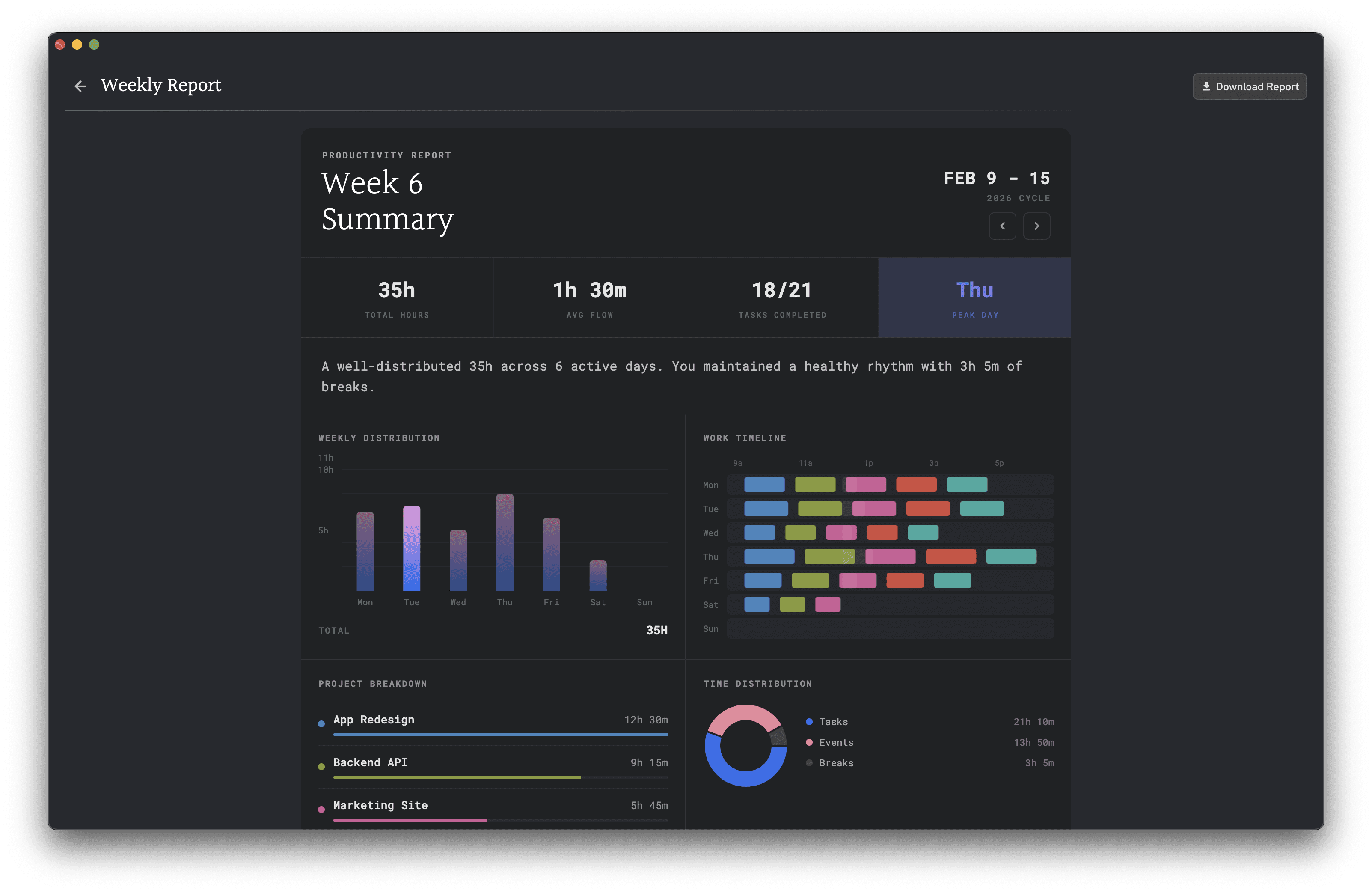
Aftertone's default calendar structure, default task durations, and default focus block lengths are all designed with the default effect in mind — because we know most users will keep whatever they start with. The onboarding sequence prompts deliberate setup of these defaults rather than leaving them as arbitrary system choices, because a thoughtfully set default is worth more than any feature the user consciously activates later. The goal is to make the starting state the right state.
How To Start Tomorrow
Look at your current calendar and task system and identify every default you have never deliberately changed. Your typical meeting length. Your default work block size. Your standard week structure. For each one, ask: did I choose this, or did I just leave it? If you didn't choose it, decide now whether it serves you. The effort of changing it once is less than the cost of keeping a bad default for years.
Related Principles
Cognitive Load Theory — defaults reduce cognitive load by eliminating decisions; the question is whether the default decision is good
Environment Design — defaults are the most powerful form of environment design because they are the starting state
Buffer Time — building buffer into default meeting and task durations is one of the highest-leverage default changes available
Related Reading
Best Time Blocking Apps — The best time blockers make structured focus the default — so inaction becomes protected time.
Best AI Daily Planning Tools — AI planners that generate a schedule automatically, so the default is a good plan rather than no plan.
Best Productivity Systems for High Performers — Systems that hardwire good defaults in advance so the path of least resistance leads somewhere useful.
Frequently Asked Questions
What is a default effect?
A default effect occurs when people disproportionately stick with the pre-set option in any choice environment, even when alternatives are equally accessible and the cost of switching is low. The default becomes the de facto choice for most people through inertia, implied endorsement (the default feels like a recommendation), and loss aversion. Johnson and Goldstein's organ donation research is the most cited demonstration: switching from opt-in to opt-out consent raised donation rates from below 20% to above 95% with no other policy change.
Why do people stick with defaults even when they would prefer something different?
Three mechanisms combine. Inertia: changing requires effort that not acting does not. Implied endorsement: defaults feel like the recommended choice, suggesting someone competent has already made the decision. Loss aversion: deviating from a default feels like giving something up, which triggers loss aversion even when the alternative is objectively better. Together these forces make defaults far stickier than rational choice models would predict.
How does the default effect apply to productivity systems?
Whatever structure you start with in a planning system tends to persist. Default task durations, default meeting lengths, default week templates, and default calendar views are rarely changed after setup — even when they are poorly suited to actual work patterns. This means the moment of setup is disproportionately important: a well-designed default at the start is worth more than any feature activated later, because most users will keep whatever they start with.
Can you use default effects deliberately to improve your own behaviour?
Yes — this is the core application of nudge theory. Setting better defaults for yourself before willpower is required removes the decision from the moment of temptation. Blocking focus time as a recurring calendar default means protecting it requires active cancellation rather than active creation. Defaulting your phone to Do Not Disturb means enabling notifications requires effort rather than disabling them. Design your defaults for your best self, not your average self.
Further Reading
Johnson, E. J., & Goldstein, D. (2003). Do defaults save lives? Science, 302(5649), 1338-1339. DOI: 10.1126/science.1091721
Madrian, B. C., & Shea, D. F. (2001). The power of suggestion: Inertia in 401(k) participation and savings behavior. Quarterly Journal of Economics, 116(4), 1149-1187. DOI: 10.1162/003355301753265543