The Principle
You've met this person. They mention how little sleep they got, how many meetings they have, how they haven't had a proper lunch break in weeks. They are not complaining — they are, subtly, signalling. In certain professional cultures, busyness has become a form of social currency. Being busy means being important. Having a packed calendar means being in demand. Having no time means your time is valuable.
Silvia Bellezza and colleagues at Columbia documented this precisely. In the United States, they found that people who described themselves as busy and overworked were judged as higher status — a reversal from earlier eras when leisure was the mark of social standing. The research matters for productivity because it explains a behavioural pattern that no time management technique can address: some people are over-scheduled not because they have failed to manage their time, but because over-scheduling serves a social function they may not consciously acknowledge.

Definition
Busyness as status is the phenomenon where appearing busy, overworked, and in high demand signals social status in certain professional cultures. This drives deliberate or unconscious over-commitment not from poor time management but from the social rewards — perceived importance, high value, desirability — that accompany being visibly occupied.
What The Research Shows
Bellezza, Paharia & Keinan (2017) ran five studies showing that in the United States, people who described themselves as busy and having no leisure time were rated as higher status than those with abundant free time. This effect was specific to cultures that valorise hard work (US), and did not replicate in Italy, where leisure signals status. Gershuny (2005) documented the "busy ethic" in longitudinal time-use data, showing that high-income professionals report working longer hours and having less leisure than lower-income groups — a reversal from historical patterns. Limitations: effects are culturally specific and likely vary substantially by industry and national context.

What This Means
For knowledge workers in high-status professional environments, being seen to be busy may be providing social and career rewards that compete directly with the benefits of better time management. If a less packed calendar signals lower status or reduced importance, the rational response — from a social signalling perspective — is to stay over-scheduled even when it costs performance. This is not irrational. It is optimising for a different outcome.
What Most People Get Wrong
Productivity advice assumes that everyone wants to be less busy.
The busyness-as-status research suggests this assumption fails for a meaningful portion of knowledge workers. The correct diagnosis when someone remains perpetually over-scheduled despite knowing better is not always "they need better systems." Sometimes it is "they are getting something from the busyness that the system cannot provide." The solution in those cases is addressing the underlying status motivation — either by finding alternative signals, changing the cultural environment, or making the cost of over-scheduling visible in terms the person actually cares about (health, output quality, relationships) rather than just efficiency.
When it Fails…
Culturally variable. The busyness-status link is strong in the US but weaker in European and Asian professional cultures, where different signals carry status. Context matters enormously.
Not universal within cultures. Many knowledge workers genuinely want less busyness and respond to time management interventions without the status complication. The effect is real but not universal.
What This Means For You…
If you notice that you fill available time, resist protected blocks, or feel uncomfortable with a lighter calendar — it is worth asking honestly whether some of that discomfort is social. Does an open afternoon feel like freedom or like a signal that you are not in demand? Does refusing a meeting feel like good time management or like admitting you are less busy than you want to appear? These are not productivity questions. They are identity questions, and they require honest answers before any calendar intervention will stick. The research is not an accusation — it is a frame. Busyness is not evidence of value. Output is.
How Aftertone Implements It.
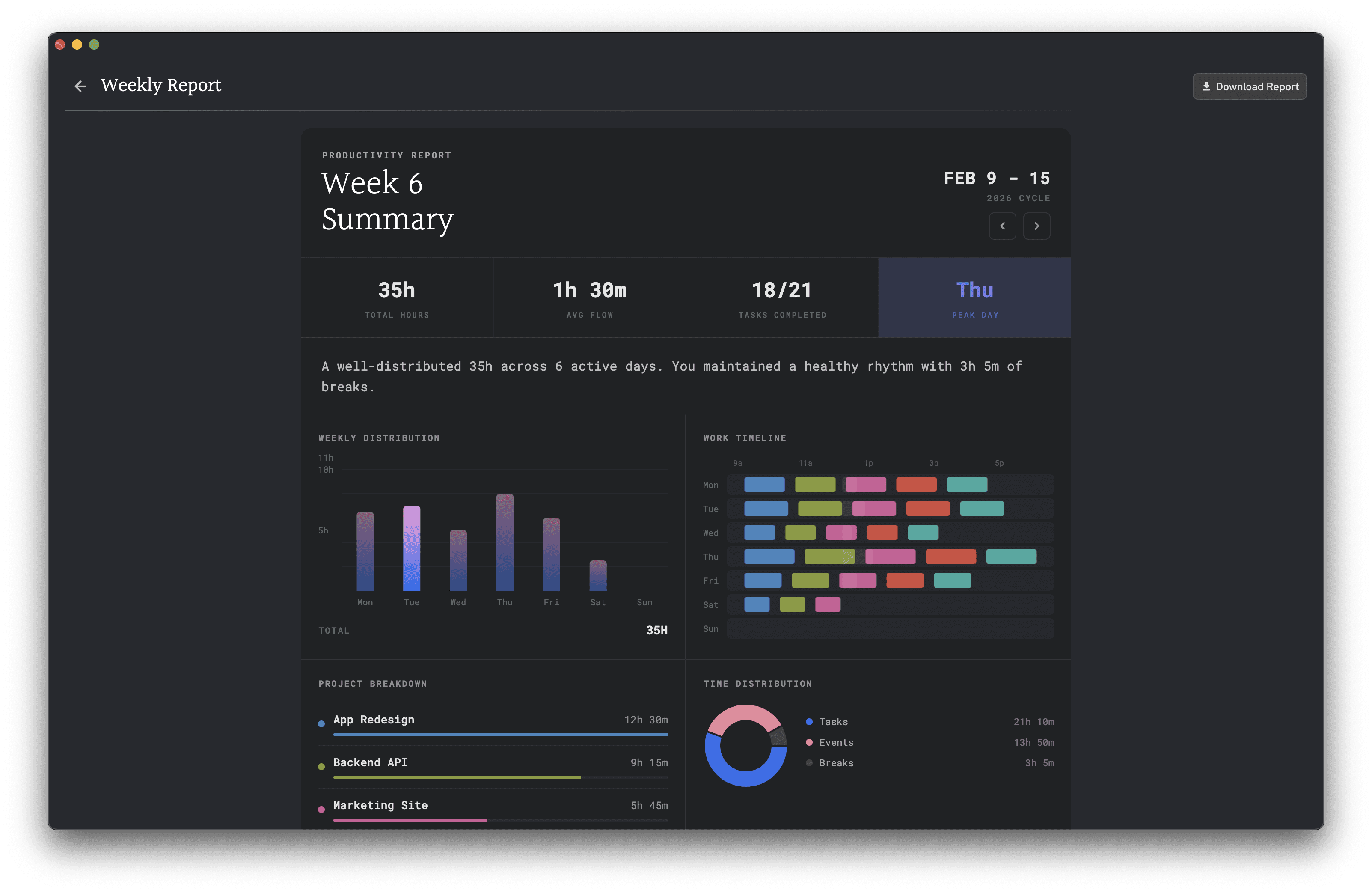
Aftertone's weekly pattern analysis makes the relationship between busyness and output explicit. When the data shows that high-meeting weeks consistently produce less completed deep work, the status case for being busy weakens — because the cost becomes visible in terms of the things the user actually cares about. Making planned versus actual work visible is a direct counter to the busyness-as-productivity conflation that drives over-scheduling.
How To Start Tomorrow
Track your two most productive weeks and two least productive weeks over the next month. At the end, compare your calendar density in each. If your busiest weeks were not your most productive, you have evidence against the intuition that more scheduled equals more accomplished. The data is a more effective counter to busyness culture than any argument.
Related Principles
Time Affluence — busyness as status actively works against time affluence by making slack feel like failure
Planned vs Actual — tracking actual output relative to planned busyness makes the cost of over-scheduling concrete
Deep Work — deep work requires unscheduled time, which busyness culture makes psychologically costly to protect
Related Reading
Best AI Time Audit Tools — Time audit tools that distinguish genuine output from performed activity.
Best Productivity Systems for High Performers — Systems that measure what matters, not what looks busy.
Best Productivity Apps for Founders — Founders who conflate busyness with progress burn out — these apps help separate the two.
Frequently Asked Questions
Why has busyness become a status symbol?
Bellezza, Paharia and Keinan's research found that in cultures that valorise hard work and productivity — particularly the United States — being visibly busy and time-poor signals that your time is in high demand, which confers status. This is a reversal from earlier eras when leisure signalled wealth and importance. The shift reflects a cultural association between constant work and desirability in professional labour markets.
Does everyone experience busyness as a status signal?
No — the effect is culturally specific. Bellezza's studies found it was strong in the US but did not replicate in Italy, where leisure and dolce far niente still carry positive status connotations. Within any culture, the effect varies by industry, seniority, and individual values. Awareness of the phenomenon does not make someone immune to it — the social reward for appearing busy operates partly below conscious recognition.
How does busyness culture make it harder to protect focus time?
When a light calendar signals low status or low demand, protecting unscheduled time creates a social cost that competes with the productivity benefit. Declining meetings, leaving gaps in the day, or finishing work at a reasonable hour can feel like admitting you are less important than those with packed schedules. This means time management interventions alone are insufficient for people whose busyness is serving a status function — the underlying social dynamic needs to be addressed.
What is the actual relationship between busyness and output?
Consistently weak once past a threshold. Research on working hours finds diminishing returns above 50 hours per week, with cognitive performance declining as hours increase. Calendar density — the proportion of time in meetings and reactive work — is negatively associated with deep work output in most knowledge roles. The correlation people assume between busyness and productivity is real in some contexts but breaks down precisely where knowledge work requires sustained, uninterrupted focus.
Further Reading
Bellezza, S., Paharia, N., & Keinan, A. (2017). Conspicuous consumption of time: When busyness and lack of leisure time become a status symbol. Journal of Consumer Research, 44(1), 118-138. DOI: 10.1093/jcr/ucw076