The Principle
The idea arrives in the shower. Or on the walk to get coffee. Or in the ten minutes between meetings when you weren't doing anything in particular. It does not arrive during a scheduled brainstorming session, or when you have blocked time for "creative thinking." The conditions that produce insight are not the conditions that look productive on a calendar.
Leslie Perlow at Harvard Business School studied engineers at a software firm and found that the perpetual time pressure of fully packed schedules — interruption, crisis response, immediate problem-solving — left no time for the kind of reflective, non-directed thinking that produces genuine innovation. The engineers were busy continuously but making limited progress on the harder problems that required time to think. Deliberately protecting unstructured time — time with no task, no meeting, no immediate deliverable — produced measurably better outcomes than filling the same hours with more scheduled work.

Definition
Slack time is deliberate unstructured time in the schedule — not free time to fill with lower-priority tasks, but time specifically protected from scheduled demands. The research shows that this unstructured time is not wasted but is functionally necessary for insight, creative problem-solving, and the kind of integrative thinking that is hardest to schedule explicitly.
What The Research Shows
Perlow (1999) ran an intervention at a software engineering firm where engineers were given protected quiet time (mornings with no interruptions). Engineers reported higher productivity and better problem-solving during those periods, and the firm saw measurable improvements in project outcomes. Baird et al. (2012) demonstrated that mind-wandering during undemanding tasks significantly improved performance on creative insight problems (Unusual Uses Task), supporting the idea that unfocused cognition serves a distinct function. Immordino-Yang et al. (2012) linked default mode network activity (activated during rest and mind-wandering) to self-reflection, moral reasoning, and creative association. Limitations: Perlow's study was a single firm; lab measures of creativity do not fully capture real-world creative output.

What This Means
The thinking that produces your best work often happens outside your scheduled work time. A calendar without slack does not just cause stress — it actively removes the cognitive conditions under which insight and complex problem-solving emerge. Scheduling every hour is not a sign of high productivity. It is a structural impediment to a specific category of high-value thinking.
What Most People Get Wrong
Unscheduled time feels like wasted time.
In environments that reward visible busyness, leaving open space on the calendar creates discomfort — it looks like availability, like low demand, like not being fully committed. The result is that slack time gets filled as soon as it appears: with meetings, with reactive work, with tasks that could wait. The research suggests this is precisely backwards. Slack is not the residue of poor scheduling. It is a productive input that needs to be protected with the same deliberateness as a focus block, because the cognitive processes it enables cannot be scheduled directly.
When it Fails…
Highly routine, execution-focused work benefits less. For roles where the work is well-defined and doesn't require creative insight or novel problem-solving, slack time has smaller measurable benefits.
Unstructured time is not the same as rest. Slack that is filled with passive media consumption does not produce the same mind-wandering benefits as genuinely unstructured, low-demand activity. The type of slack matters.
Cultural resistance is real. In organisations where unscheduled time is read as lack of commitment, protecting slack requires deliberate management of perception as well as schedule.
What This Means For You…
If your calendar has no unscheduled time, you are not just at risk of burnout — you are actively preventing a category of cognitive processing that produces your best ideas. Protecting slack is not about doing less. It is about preserving the conditions for the thinking that cannot be assigned to a time block. Concretely: leave at least one open hour each day with no task attached. Protect it the same way you protect a focus block. Do not fill it. Notice what emerges in those hours over two weeks. The research predicts it will not be nothing.
How Aftertone Implements It.
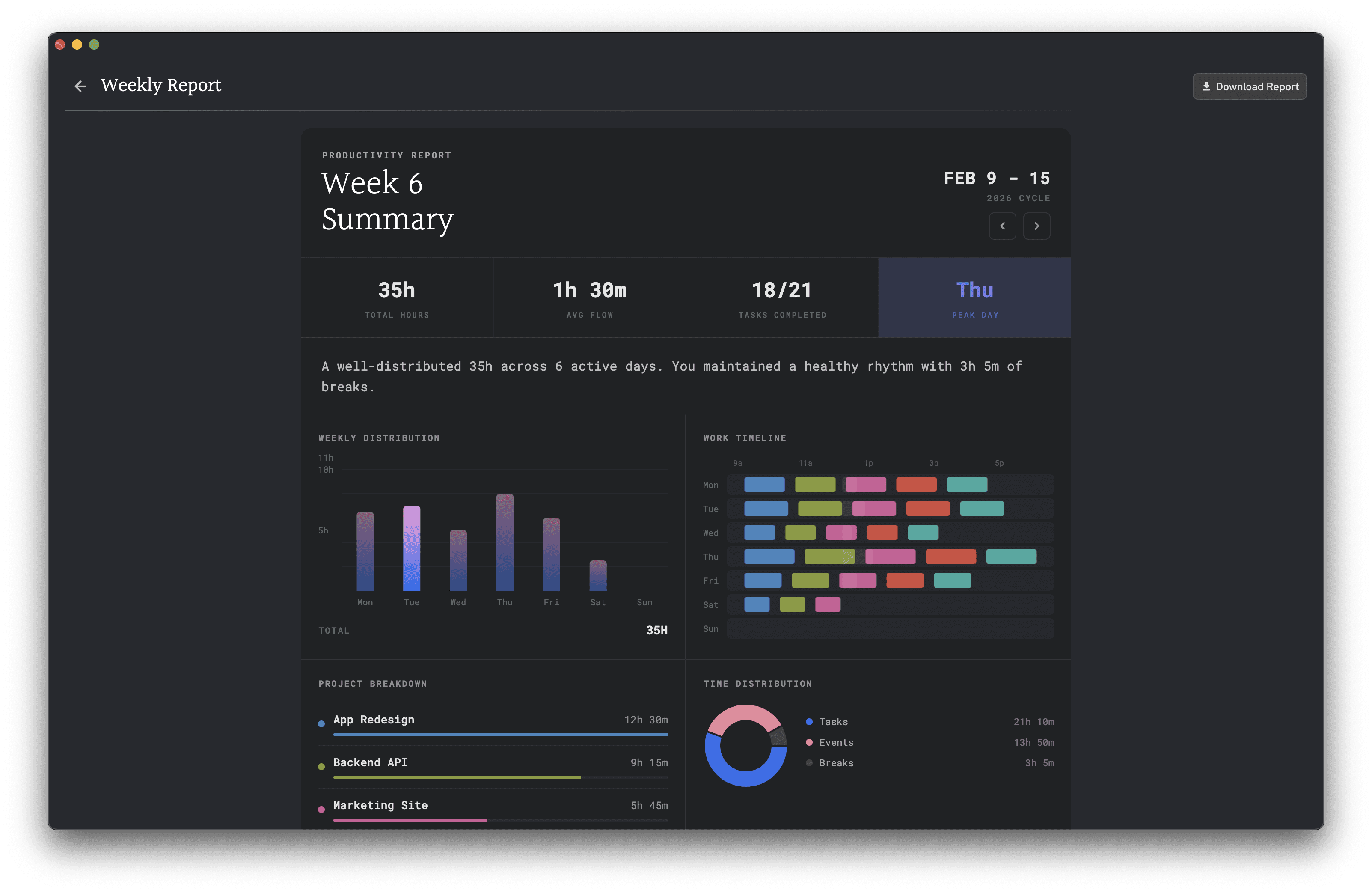
Aftertone's weekly pattern analysis flags over-scheduled weeks — weeks where the ratio of blocked time to total available time leaves no meaningful slack. The AI report surfaces this as a pattern risk, not just a capacity issue, because the research makes clear that the cost of zero slack is not only stress but reduced quality of the work that does get done. The goal is a schedule that is full enough to be focused but not so full that reflection becomes impossible.
How To Start Tomorrow
Look at tomorrow. Find thirty minutes with nothing scheduled. Do not fill it with a task. Go for a walk, make coffee, sit without a screen. If something important occurs to you, note it. Do this every day for one week and observe what happens to the quality of your thinking on the hard problems you're working on. That is the slack effect — not productivity theatre, but a genuine cognitive input.
Related Principles
Time Affluence — slack time is the structural source of felt time sufficiency
Recovery and Detachment — slack enables the psychological detachment that makes recovery possible
Busyness as Status — the status rewards of busyness are the primary cultural force that eliminates slack
Related Reading
Best Deep Work Apps — Focus apps that protect unstructured time with the same logic they use for structured sessions.
Best AI Tools to Protect Deep Work Time — AI tools that block off recovery time before the calendar fills itself.
Best Time Blocking Apps — The best time blockers make white space intentional — not a scheduling failure.
Frequently Asked Questions
What is slack time and why does it matter for creative work?
Slack time is deliberately unscheduled time — not free time to fill with lower-priority tasks, but time specifically protected from task demands. It matters for creative and complex knowledge work because the cognitive processes that produce insight, creative connection, and novel problem-solving are not the same processes used for focused execution. They are associated with the default mode network, which activates during rest and mind-wandering rather than during directed attention.
What does the research say about mind-wandering and creativity?
Baird et al. (2012) found that performing an undemanding task — one that allows mind-wandering — significantly improved performance on creative insight problems compared to focused rest or no break at all. The default mode network, active during mind-wandering, appears to facilitate the kind of associative, non-linear thinking that produces creative connections. A fully scheduled brain has no time for this process.
How much slack time is enough?
The research does not specify a universal figure. Perlow's engineering firm study found that protecting mornings from interruption — roughly two to three hours of unstructured time — produced measurable improvements in problem-solving quality. A practical minimum is one unscheduled hour per day without a specific task attached. This is distinct from breaks between tasks — the slack needs to be genuinely open, not pre-filled with lower-priority work.
Is slack time the same as procrastination or laziness?
No — the distinction is intentionality and context. Procrastination is avoidance of specific work that should be happening. Laziness is a general disinclination to effort. Slack time is a deliberately designed input to cognitive performance — protected time for the default mode network to operate, just as sleep is protected time for memory consolidation. Treating slack as waste, and filling it with reactive work, removes a legitimate cognitive input without realising it.
Further Reading
Perlow, L. A. (1999). The time famine: Toward a sociology of work time. Administrative Science Quarterly, 44(1), 57-81. DOI: 10.2307/2667031
Baird, B., et al. (2012). Inspired by distraction: Mind wandering facilitates creative incubation. Psychological Science, 23(10), 1117-1122. DOI: 10.1177/0956797612446024